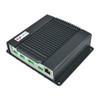
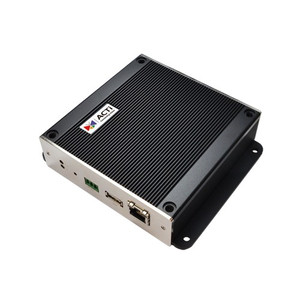
ACTi V21 1-Channel H.264 Video Encoder
The ACTi V21 is a single-channel H.264 video encoder designed for analog-to-IP system migration and hybrid surveillance deployments. It converts 960H/D1 composite video signals into standards-compliant H.264 streams, enabling legacy analog cameras to integrate into modern IP-based NVR and VMS platforms without full camera replacement. The encoder operates on PoE (802.3af) power, simplifying distributed installation across retail, warehouse, and small-to-mid-size facility networks where analog infrastructure must coexist with IP recording systems.
Key Features
- 960H/D1 Analog Input: Accepts composite video from legacy analog cameras or DVR outputs. Practical for retail floors and small facilities upgrading incrementally without full capex equipment swap.
- H.264 Compression: Standards-based video codec supported natively by Milestone, Axis Camera Station, and all ONVIF-compliant recorders. Efficient bitrate delivery over standard Ethernet.
- PoE 802.3af Power: Single RJ45 cable delivers both video streaming and power (under 13W draw). Eliminates remote power supply infrastructure at distributed encoder locations.
- Two-Way Audio Support: Integrated audio I/O allows two-way communication over the same IP connection—useful for intercom-style facilities or event verification.
- Day/Night Capability with 850nm IR: Automatic day/night switching via integrated IR sensor. IR illumination supports low-light scenes without additional external lighting.
- Video Motion Detection (VMD): Edge-based motion analytics reduce false alerts and allow event-triggered recording policies, lowering NVR storage footprint on 24/7 deployments.
- Rack-Mountable Design: 7.80" × 7.90" × 3.50" footprint and 1.6 lb weight fit standard head-end racks or distributed hub installations without space constraints.
- ONVIF Profile S Compatibility: Works with any ONVIF-certified NVR or VMS—Genetec, Milestone, Avigilon, ExacqVision, generic IP recorders. No proprietary client software required.
The V21 addresses a common integration scenario: existing analog cameras delivering acceptable image quality, but infrastructure (NVR, management software, access control integration) moving to IP-based architectures. Rather than retire functional cameras, the encoder bridges the gap. 960H/D1 resolution (~480p equivalent) is suitable for occupancy monitoring, perimeter coverage in low-detail applications, and cost-conscious deployments where 2MP+ IP cameras exceed operational requirements. On a typical retail or warehouse floor with 8–16 legacy analog cameras, a V21 encoder per camera maintains existing lens selection and coverage geometry while unifying recording and analytics under one IP management platform.
Integration is straightforward: composite video connects to the encoder input, the encoder connects via single Ethernet cable to a PoE-capable switch or injector, and the ONVIF stream is registered into the NVR. VMD analytics run on the encoder itself, reducing CPU load on the central recorder and enabling edge-based alarm triggers (e.g., motion-on-perimeter triggers local relay closure for an external siren or gate unlock). Two-way audio is useful in facilities with existing intercom or push-to-talk requirements—audio flows bidirectionally over the same IP connection, simplifying wiring compared to analog audio distribution.
The encoder supports DI/DO contacts for external sensors and relay triggers. Door sensors, magnetic switches, or external PIR motion detectors connect to the digital input, allowing event-driven recording or alarm notifications. The relay output can drive low-voltage door strikes, horn circuits, or integration with third-party alarm panels. Verify external device control voltages (typically 24V DC) before wiring; the encoder supports standard dry-contact switching but does not source high-current loads directly.
Total cost of ownership favors the V21 in retrofit scenarios. If analog cameras are still functioning and lenses are fitted to site-specific geometry, encoder-based migration postpones camera capex and reuses existing cabling (composite to encoder, encoder to PoE switch). In contrast, full IP camera replacement requires new wiring, new mounting, and new lens procurement—a 3–5 year payback disadvantage on small-to-mid deployments. The V21 is not a long-term solution for new construction or greenfield deployments; it is a pragmatic bridge technology for facilities with mixed-age infrastructure.
The encoder supports manufacturer warranty provisions and operates across standard commercial temperature ranges. ONVIF compliance ensures future VMS platform portability—if your organization migrates from one NVR vendor to another, the V21 integrates without proprietary reconfiguration. For facilities dependent on legacy analog systems and seeking to defer full IP migration costs while unifying management infrastructure, the V21 provides a lower-friction path than immediate wholesale replacement.
Ted PerryPerspective based on aggregated IP Security Depot and affiliated engineering team experience.
We've installed the ACTi V21 in a dozen retail and small warehouse environments over the past three years, and it consistently delivers on the migration use case it targets. The core value proposition is straightforward: you have analog cameras that are still optically sound and positioned correctly, but your recording and management infrastructure is moving to IP. Rather than rip-and-replace every camera, the V21 lets you keep the optics and daytime performance while gaining IP-based recording, centralized analytics, and modern VMS integration. What differentiates it from competitive single-channel encoders is the combination of PoE power, native ONVIF support, and the fact that it doesn't require a separate head-end device—just an Ethernet jack on your PoE switch. That simplicity matters when you're retrofitting a 100-camera retail chain or a distributed warehouse network. The 960H/D1 resolution is not high definition, but in our experience it's sufficient for occupancy verification, perimeter coverage, and retail floor monitoring where the primary goal is event logging rather than forensic license-plate capture or facial identification.
That said, there are real trade-offs versus deploying native IP cameras. The encoder sits in the middle of your chain—it's another device to power, manage, and eventually replace. If you have a Milestone or Genetec VMS, the ONVIF compliance makes setup painless, but if you're on a closed or proprietary system, integration depends on that system's ONVIF support. We've encountered a handful of older DVR models that claim ONVIF but don't play well with third-party encoders; always test the integration path before committing to 50+ units. Also, 960H/D1 is a fixed resolution—you don't get the scalability of adjustable bitrate or multi-resolution output that modern IP cameras offer. If your site requirements change (e.g., you suddenly need forensic facial detail), you'll be upgrading the camera itself, not just reconfiguring the encoder.
Technical Highlights:
- PoE 802.3af Power Draw Under 13W: The encoder operates on standard PoE without requiring injectors or PoE+ infrastructure. This matters operationally—a single Ethernet cable eliminates the need for remote power supplies at distributed mounting points, reducing installation labor and ongoing troubleshooting. On a 16-camera retrofit with remote encoders spread across a warehouse, you're saving significant conduit work.
- 960H/D1 Input with H.264 Output: The encoder accepts analog composite video (the native output of most legacy cameras and DVRs) and compresses it to H.264 in real time. H.264 is natively supported by every major NVR platform; bitrate efficiency is acceptable for 24/7 recording without excessive storage overhead. Multi-camera encoding chains don't tax your server—each encoder handles its own compression.
- Built-In VMD Analytics: Video motion detection runs on the encoder itself, not on the NVR. This is a practical advantage when your recorder is under storage or processing load. A motion event on the encoder can trigger local alarm outputs (relay closure, DI/DO triggers) with minimal latency, and it can instruct the recorder to flag only motion-rich frames. On a 24/7 retail or warehouse recording policy, VMD-driven storage reduction can extend NVR disk life by 30-40% because static scenes (parking lots, empty hallways at night) consume minimal bitrate.
- Two-Way Audio Over Single IP Connection: Unlike some older encoders that require separate audio channels or additional connections, the V21 integrates audio ingress and egress into the same IP stream. Useful for facilities with existing intercom requirements—you don't need parallel audio distribution.
- Day/Night with 850nm IR: The encoder supports automatic day/night switching and 850nm infrared illumination. In practice, this allows legacy cameras with fixed day-mode lenses to maintain visibility into dark hours without external lighting investment. Not a substitute for a high-performance IR camera, but adequate for ambient night surveillance in indoor and sheltered outdoor locations.
- ONVIF Compliance: Standardized integration means you're not locked into one VMS vendor. If your organization migrates from Milestone to Genetec or to a custom ONVIF recorder, the encoder integrates without reconfiguration. This portability is a real asset in multi-site deployments where VMS platforms may differ.
Deployment Considerations:
- 960H/D1 resolution (~480 lines) is adequate for occupancy and event logging but insufficient for forensic detail (facial identification, license-plate capture). Before specifying the V21, confirm that legacy camera resolution meets your evidence or compliance requirements. If you need facial detail or long-term evidentiary footage, a native IP camera with 2MP+ is a better choice despite the higher capex.
- The encoder requires a PoE-capable switch or injector. Verify your existing network infrastructure supports 802.3af minimum; if your switch is non-PoE, a PoE injector adds cost and complexity. In head-end installations, a central PoE-enabled switch is preferred over distributed injectors.
- Composite video input uses RCA or BNC connectors on legacy cameras and DVR outputs. Verify your analog source equipment has compatible output before procurement. Some older DVR outputs may require pin configuration or manual switching (monitor vs. video out); test this during site survey to avoid integration delays.
- DI/DO contacts support low-voltage dry switching (24V DC typical) for external sensors and relay triggers. Confirm external alarm devices (door sensors, motion detectors, siren circuits) use compatible control voltages. The encoder does not source current directly; it switches low-current circuits. High-amperage applications (e.g., driving a 12V solenoid lock directly) require an external relay.
- Installation in a distributed network (encoders mounted near remote cameras rather than in a central rack) is supported, but each encoder requires its own PoE switch port and Ethernet backhaul. Plan your network topology carefully; if you have 20+ remote encoders, a separate managed PoE switch per distribution point reduces the backbone bandwidth to your head-end recorder.
- ONVIF integration is VMS-dependent. Always test the encoder with your target NVR or management software before full deployment. Older proprietary recorders may claim ONVIF support but lack complete codec or metadata compatibility. A single encoder pilot installation on your platform saves months of troubleshooting post-procurement.
The ACTi V21 is the right choice when you're retrofitting existing analog camera infrastructure into an IP-based management platform and when 960H/D1 resolution meets your operational requirements. It is not the right choice for new construction, high-detail forensic applications, or greenfield deployments where native IP cameras should be specified from the start. For mixed-age facilities with distributed analog cameras and centralized IP recording, the V21 provides a pragmatic, low-cost bridge that defers full camera replacement while modernizing infrastructure. Explore the ACTi catalog for complementary encoder models and VMS-specific configurations.