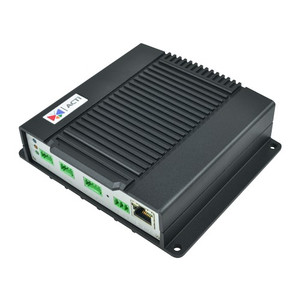
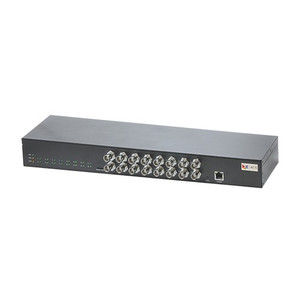
ACTi ECD-1100 16-Channel H.264 Video Decoder
Overview
The ACTi ECD-1100 is a 16-channel H.264 video decoder engineered for network-based surveillance deployments where IP camera streams must be consolidated, decoded, and displayed across a centralized monitoring infrastructure. Unlike NVRs or hybrid recorders, the ECD-1100 decodes live or archived H.264 video without recording — it acts as a video processor and display bridge. This architecture is valuable when your VMS (video management system) already handles recording and you need a dedicated decoder appliance to feed wall-mounted displays, redundant monitoring stations, or legacy analog display equipment via standard video outputs.
The ECD-1100 (often searched as ECD 1100) supports 16 simultaneous H.264 streams at 2MP resolution per channel, making it suitable for medium-scale control rooms, warehouse monitoring, and enterprise security operations that demand real-time multi-camera playback without the complexity of full recording architecture.
Key Features
- 16 H.264 Decode Channels: Process 16 independent IP video streams simultaneously, each decompressing H.264-encoded footage from compatible ACTi cameras or third-party ONVIF-compliant devices. Useful in scenarios where a single display or wall requires multiple camera feeds routed through one appliance.
- 2MP per Channel: Each decoded stream supports up to 2 megapixel (1920 × 1080) video output. Sufficient for identification-level detail in mid-range surveillance roles like hallway, parking lot, or dock monitoring. Not a limitation if your source cameras record at higher resolution — the ECD-1100 simply downsamples during decode.
- PoE Power (802.3af Class 3): Draws approximately 13W via standard 802.3af PoE, eliminating the need for a separate AC power supply. One network cable delivers both data and power, reducing infrastructure footprint in server rooms, network closets, or distributed monitoring stations. Verify your PoE switch has sufficient budget if deploying multiple units.
- Pole-Mount Form Factor: Designed for vertical or horizontal rack-style installation, fitting standard 19-inch rack environments common in control centers and server facilities. Pole mount also supports wall or shelf placement in compact spaces.
- H.264 Compression Support: Decodes standard H.264 video codec, the industry baseline for IP surveillance. Ensures compatibility with most ACTi camera lines and ONVIF-compliant devices already deployed in your network. No license fees or proprietary codec dependencies.
- ONVIF Integration: Works with ONVIF-compliant VMS platforms (Milestone XProtect, Genetec, etc.), allowing the decoder to appear as a networked endpoint within your existing management console. Simplifies multi-vendor deployments and reduces training overhead.
Integration & Compatibility
The ECD-1100 integrates into IP surveillance networks where H.264 streams originate from ACTi cameras or any ONVIF Profile-S compliant device. Deploy it downstream of your VMS — the decoder receives stream URIs or RTSP feeds and outputs decoded video via standard video connectors or network display protocols. Pole-mount configuration suits server racks, wall shelves, and control-room equipment stacks. PoE delivery means you avoid power-supply redundancy and simplify cabling to your network switch.
Because the ECD-1100 decodes without recording, it does not replace an NVR or dedicated recorder. Instead, it complements them: your NVR captures and archives; the decoder feeds live or playback streams to displays. This separation is often preferred in large operations where recording and display infrastructure must fail independently.
When to Choose a Different Model
If you need recording, local storage, or video analytics on the appliance itself, the ECD-1100 is not the right fit. Look instead for ACTi network video recorders or embedded NVR solutions in the same family. If you require 4K or 8MP decoding, ask for a higher-megapixel variant from ACTi — the 2MP limit is a hard constraint here. For very small deployments (2–4 cameras), a single display with built-in ONVIF decode or a software-based VMS client may be more cost-effective than a dedicated decoder.
Frequently Asked Questions
Q: Does the ECD-1100 record video?
A: No. The ECD-1100 decodes H.264 streams and outputs them to displays or downstream systems. Recording must occur upstream in your VMS or NVR. This separation is intentional — decoders are designed for display and real-time monitoring, not archival.
Q: What VMS platforms support the ECD-1100?
A: Any ONVIF-compliant platform (Milestone XProtect, Genetec, Axis Camera Station, etc.). The ECD-1100 appears as a standard ONVIF endpoint. Consult your VMS vendor and the ECD-1100 datasheet to confirm feature parity on display bridging or playback routing.
Q: Can I decode 4K or 8MP streams on the ECD-1100?
A: No. The ECD-1100 is rated for 2MP (1920 × 1080) per channel. If your source cameras record at 4K or 8MP, those streams will be downsampled during decode, which may waste bandwidth upstream. For higher-resolution decode, inquire about alternative ACTi decoder models.
Q: How much power does the ECD-1100 consume?
A: Approximately 13W via 802.3af PoE. Standard PoE switches deliver 15.4W per port at Class 3, so the ECD-1100 will not overload a compliant switch. Still, verify available PoE budget if deploying multiple decoders on the same switch.
Q: Is the ECD-1100 suitable for outdoor use?
A: No. The ECD-1100 is designed for indoor control rooms, server closets, and sheltered monitoring stations. It lacks weatherproofing and environmental ratings (no IP rating in the spec sheet). Deploy it indoors only.
Q: Can I wall-mount the ECD-1100, or does it require rack installation?
A: The pole-mount form factor allows wall or shelf placement as well as standard 19-inch rack mounting. No special bracket is required for wall mounting, though verify wall surface strength and vibration isolation if installing in high-traffic areas.
James EverettPerspective based on aggregated IP Security Depot and affiliated engineering team experience.
The ACTi ECD-1100 fills a specific but important role: it is a video decoder, not a recorder. I mention this upfront because too many integrators assume all appliances in the surveillance stack capture and store. The ECD-1100 consumes H.264 streams — 16 of them, simultaneously — and outputs decoded video for display. If your VMS is already recording to a central NVR or cloud repository, the ECD-1100 becomes the display bridge. This separation has real operational value when you need redundant monitoring stations, distributed display networks, or wall-mounted arrays fed by a single decoder appliance.
Technical Highlights:
- 16-Channel Parallel Decode: The ability to decompress 16 H.264 streams in real time at 2MP each means you can feed a multi-display wall or carousel display system without overwhelming a network switch or VMS client. At 13W PoE consumption, this is extremely efficient — one standard PoE port powers the entire 16-channel appliance.
- H.264 Codec Lock-In: The ECD-1100 decodes H.264 only. If your deployment is already H.264-centric (most legacy and mid-market ACTi deployments are), this is a non-issue. But if you are mixing H.265-encoded streams or planning a migration to H.265 to cut storage costs, you cannot use this decoder. Plan codec compatibility upfront.
- 2MP Output Ceiling: Each of the 16 channels maxes out at 2MP resolution. If you are sourcing 5MP or 8MP cameras and need to preserve that resolution at the display level, the ECD-1100 will downsample, wasting upstream bandwidth. Not a critical flaw in medium-range monitoring roles (parking lots, hallways, loading docks), but a constraint worth acknowledging in high-definition identification scenarios.
Deployment Considerations:
- PoE Budget Math: At ~13W per unit, you can stack 1 ECD-1100 on a typical 60W PoE switch and still have margin for other devices. But if you need 2 or 3 decoders in a single facility, audit your switch specifications and consider a dedicated PoE switch or injector to avoid contention.
- Display Output Variety: Consult the full datasheet to confirm which video output connectors (HDMI, DVI, composite, etc.) the ECD-1100 provides. The specification sheet does not detail outputs explicitly, so verify compatibility with your display infrastructure before ordering. A mismatch between decoder outputs and your wall-mount display inputs will force costly adapters or rework.
- No Analytics or Intelligence: This is a dumb decoder — it does not perform object detection, face recognition, or any on-appliance analytics. All intelligence must reside upstream in your VMS or in the source cameras. If you are building a networked surveillance system with edge or appliance-level analytics, the ECD-1100 is purely a display processor.
Deploy the ECD-1100 in large control rooms fed by a central NVR, or in distributed monitoring stations where multiple buildings or zones need independent display feeds from a single VMS. It is especially useful when legacy analog displays or specialized wall-mount systems require a digital-to-analog or protocol-bridging appliance. Avoid it if you need recording on the appliance or plan to migrate to H.265 in the next 12–18 months.