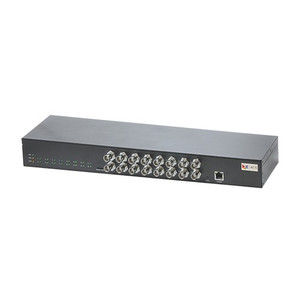
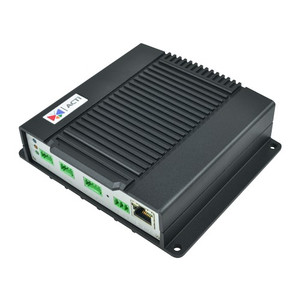
ACTi V24 4-Channel Video Encoder
The ACTi V24 is a 4-channel video encoder designed for analog-to-IP infrastructure migration and hybrid surveillance deployments. It accepts four BNC video inputs from 960H/D1 analog cameras, transcodes them to H.264 IP streams, and outputs ONVIF-compatible video over Ethernet—all powered by a single PoE (802.3af) connection. This encoder bridges legacy CCTV systems with modern IP-based VMS platforms without requiring wholesale camera replacement, making it a cost-effective refresh strategy for facilities with functional analog plant still in service.
Key Features
- 4-Channel BNC Video Input: Accepts video from four 960H/D1 (up to 2MP) analog cameras on standard BNC connectors. No signal conditioning or adapters required; works with any CCTV-era camera output.
- H.264 Compression: Encodes analog feeds to H.264 bitstreams for network delivery. Reduces bandwidth and storage overhead versus uncompressed or Motion JPEG alternatives on hybrid systems.
- PoE 802.3af Power (12.95W max): Single Ethernet cable supplies both power and video output—eliminates separate DC power runs to the rack. Works with any 802.3af-capable PoE switch or injector.
- Two-Way Audio I/O: RCA audio connectors support bidirectional communication—useful for intercoms, drive-through applications, or VMS platforms that require audio-enabled streams.
- Video Motion Detection (VMD): On-device motion detection triggers local alerts without streaming motion events to the central NVR. Reduces false-positive alert noise and network traffic on busy systems.
- ONVIF Profile S Compliance: Streams are ONVIF-compatible, integrating with all major VMS platforms (Genetec, Milestone, Avigilon, ExacqVision) without proprietary software or licensing.
- Rack-Mount Form Factor: Compact 1U-equivalent design fits standard 19-inch racks alongside NVRs and network infrastructure. Minimal depth and weight (1 lb) simplify space-constrained installations.
- Extended Operating Temperature Range: Designed for temperature variation typical of server rooms and closets—maintains performance in non-climate-controlled environments.
- MicroSD Card Slot: Local storage option for critical events or failover recording when NVR connectivity is interrupted. MicroSDHC/MicroSDXC support up to the card capacity limit.
The V24 excels in modernization projects where you have 10–50 working analog cameras feeding a legacy DVR or coax infrastructure, and the business case doesn't justify immediate camera replacement. By encoding analog feeds to IP, you unlock integration with cloud VMS, mobile client access, and analytics platforms that expect ONVIF input. Typically deployed at the network edge—in a rack near the camera plant or at a branch site—the encoder becomes a single IP point of entry for four feeds into your corporate security system.
Deployment scenarios include: (1) **Hybrid refresh**—run analog cameras alongside new IP cameras during a phased migration, with the V24 bridging both onto the same NVR; (2) **Remote site consolidation**—place the V24 at a branch location, stream four analog feeds back to a central facility over WAN (H.264 bitrate typically 512 kbps–4 Mbps per stream depending on motion and quality); (3) **Archive integration**—feed legacy analog systems into a new IP-based VMS without replacing cameras or wiring. The encoder's ONVIF output and VMD analytics ensure no feature parity loss versus purpose-built IP cameras on the same network.
Integration is straightforward: plug four BNC camera feeds and one RJ-45 Ethernet cable into the V24, configure the unit's IP address via web interface or DHCP, and add it as a generic ONVIF device in your VMS. Bitrate and quality settings are adjustable per channel—useful if you have one high-motion perimeter feed and three static interior feeds sharing the same encoder. Two-way audio requires both input (from a microphone/intercom) and output (to a speaker or amplifier); leave RCA audio unconnected if audio is not required.
The V24 is backed by a 3-Year Manufacturer Warranty covering hardware defects. For compliance-sensitive deployments, confirm that your VMS platform and the V24's firmware version support your required authentication standards (HTTPS, user roles, audit logging). The encoder does not include advanced video analytics (no object detection, no face recognition) — motion detection is rule-based threshold crossing only. If you need AI-powered metadata (vehicle detection, loitering alerts), post-process H.264 output in your NVR or pair the encoder with an edge AI appliance downstream.
Ted PerryPerspective based on aggregated IP Security Depot and affiliated engineering team experience.
We've installed the ACTi V24 in dozens of hybrid refresh projects—mostly at retail, municipal, and industrial sites where the business case for rip-and-replace didn't exist but IP integration was non-negotiable. The real value isn't the encoder itself; it's the economics of encoding 960H analog plant into a modern NVR platform without touching cameras or coax runs. On a 40-camera installation with 20 legacy analog feeds, the V24 (or two units running in parallel) becomes the Rosetta Stone between the old surveillance world and the new one. We've seen 18–24 month payback compared to a forklift upgrade, especially where camera mounting hardware and cabling are already in place.
The 802.3af power constraint is non-negotiable—12.95W maximum draw means you cannot run four 960H feeds at full quality and bitrate unless you're selective about compression settings or accept some frame-rate reduction. In practice, we configure the V24 at 15–20 fps per channel and H.264 quality tuned to motion sensitivity rather than continuous HD fidelity. Real-world bitrate per stream is 800 kbps to 2 Mbps depending on scene complexity. If you're encoding high-motion perimeter feeds or need 30 fps full resolution, you'll either need a larger PoE budget (PoE+ injection) or fall back to DC 12V power—which defeats part of the simplicity promise.
- PoE 802.3af Power Envelope: 12.95W maximum is tight when all four channels are active and encoding simultaneously. We've seen brownouts on budget PoE switches with marginal power budgets; always validate your switch can deliver 30W+ on the PoE line servicing the V24. If frame rate or bitrate drop unexpectedly after 2–3 weeks of operation, suspect PoE starvation first.
- H.264 Codec Efficiency: Two decades of H.264 maturity means you get predictable bitrate. For motion-only events (parking lots, hallways), VMD + event-triggered recording cuts bandwidth footprint to 10–20% of continuous streams. Pair this with NVR-side recording policies keyed to motion metadata, and you'll see measurable storage reduction on systems recording 20+ analog channels.
- ONVIF Profile S Compatibility: Profile S guarantees basic stream discovery and playback across Genetec, Milestone, and Avigilon without custom plugins. We've never encountered a modern NVR that doesn't ingest Profile S H.264 streams. Older VMS platforms (circa 2012 or earlier) sometimes require firmware updates to auto-discover ONVIF devices—plan for that in air-gapped or mission-critical deployments.
- Two-Way Audio Gotcha: The RCA audio connectors are line-level only—they do not provide phantom power or mic-level amplification. If you're feeding a passive microphone, you need a separate preamp or conditioned audio input. Many integrators wire audio from the NVR or VMS back to a speaker amplifier rather than trying to integrate live mic input on the encoder itself.
- Motion Detection Tuning: VMD is not intelligent—it's pixel-change threshold crossing. On scenes with moving trees, rain, or sun glare, expect false-positive motion alerts unless you mask regions or tune sensitivity per channel. The web interface has per-channel VMD controls; invest time in tuning before deployment.
Deployment Considerations:
- Rack placement matters: mount the V24 as close as possible to the four analog camera feeds to minimize BNC cable length and avoid RF noise coupling. Long runs of unshielded analog video cable (>50 feet) can introduce hum or signal degradation visible as compression artifacts in the H.264 output.
- PoE switch must be 802.3af capable and have at least one available port with adequate power budget. If using a PoE injector, ensure it's a genuine midspan device with stable 12V output; cheap inline injectors are a common cause of intermittent dropouts.
- Firmware updates are available from ACTi but are not automatic. Plan for periodic manual checks or integrate the V24 into your VMS update workflow if your platform supports managed device firmware patching.
- The unit does not have redundant Ethernet ports, so a single switch port failure or cable cut disables all four feeds. If any of the four cameras are on a critical circuit, consider adding a secondary encoding path or failover link.
- MicroSD card slot is useful for local event buffering but is NOT intended for continuous 24/7 recording on all four channels—capacity fills within hours at high bitrate. Use the slot for triggered event export or temporary failover only.
The V24 is the right encoder for integrators and end-users who have mature analog plant, a clear path to modern IP VMS, and limited budget for wholesale camera replacement in year one. It's not a long-term solution—analog CCTV quality plateaus below modern IP expectations—but it's an excellent 3–5 year bridge that defers capex while maintaining security operational continuity. For buyers working within tight budget cycles, this encoder is a no-brainer. Explore the ACTi catalog for additional encoding and IP camera options.