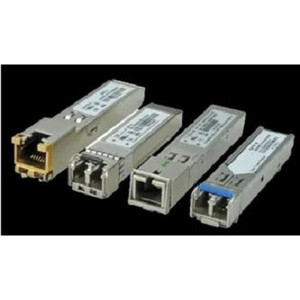
Hanwha SFP-FLCS220 100Mbps Single-Mode Fiber SFP Module
The Hanwha SFP-FLCS220 is a Small Form-Factor Pluggable (SFP) fiber optic transceiver designed for surveillance networks and enterprise infrastructure requiring long-distance, interference-free connectivity. Operating at 100Mbps Fast Ethernet over single-mode fiber, this module eliminates the noise and distance limitations of copper runs — a critical advantage when spanning campus perimeters, connecting remote access-control readers, or feeding IP cameras across industrial facilities. The 1310nm single-mode wavelength and LC connectors support transmission up to 20 kilometers without active repeaters, making it ideal for distributed surveillance architectures where copper backbone limitations or electromagnetic interference pose deployment obstacles.
Key Features
- 100Mbps Fast Ethernet: 100Mbps data rate over fiber provides responsive, deterministic performance for real-time camera streams and control traffic on managed networks.
- 20-Kilometer Single-Mode Reach: 1310nm wavelength and single-mode fiber optics eliminate distance constraints — enables campus-scale surveillance without intermediate active equipment.
- LC Optical Connectors: Industry-standard LC connectors deliver low insertion loss and high return loss, reducing signal degradation on long runs.
- Universal SFP Slot Compatibility: Plugs into any managed switch, unmanaged switch, or media converter with standard SFP slots — no proprietary adapters required.
- Industrial Temperature Range: -40°C to +75°C operation ensures reliable performance in unheated equipment enclosures, outdoor cabinets, and climate-controlled server rooms.
- Interference-Free Transmission: Fiber optics are immune to RF noise, EMI, and ground loops — critical when running alongside power feeds or in electrically noisy industrial environments.
- 3-Year Warranty: Manufacturer warranty covers defects and component failure.
Deployment Architecture & ROI
The SFP-FLCS220 solves a specific integration pain point: extending 100Mbps connectivity beyond the 100-meter copper limit without deploying active repeaters or expensive mesh fiber runs. A typical multi-building campus surveillance setup — say, a 1.2-kilometer fence line with four camera clusters — would otherwise require either redundant copper runs with intermediate switches (high capex, ongoing power/cooling) or costly single-mode fiber with manual termination. A pair of SFP-FLCS220 modules (one at the edge switch, one at the remote IDF) costs significantly less than a managed media converter, eliminates power consumption at the remote node, and requires only standard fiber patch cords. For integrators standardizing on a single fiber backbone, SFP optics dramatically reduce NRE and spares inventory.
In outdoor surveillance scenarios — particularly perimeter monitoring or parking-lot networks where copper cable runs are exposed to weather or physical damage — fiber eliminates corrosion concerns and provides better mechanical protection in conduit. The wide temperature range (-40°C to +75°C) ensures the module itself won't be the failure point in unheated cabinets or summer-baked enclosures. Pair this with a managed switch supporting VLAN-based video segmentation, and you've built a scalable, low-maintenance backbone for multi-site surveillance.
Integration & Compatibility
The SFP-FLCS220 is agnostic to NVR or VMS platform — it operates at OSI Layer 1 (physical), transparently carrying IP camera streams, access-control traffic, and intercom signaling. Works with any ONVIF-compliant camera ecosystem (Axis, Hanwha, Dahua, Hikvision, etc.) as long as the upstream switch supports your video codec and bitrate requirements. Standard SFP slot design means no vendor lock-in; the module can migrate between Cisco, Juniper, Arista, and Hanwha switch platforms without modification. For distributed multisite deployments using private or hybrid-cloud VMS (Genetec, Milestone, ExacqVision), fiber backbone reduces latency jitter and packet loss compared to long-distance copper or MPLS circuits.
Power consumption is negligible — SFP optics draw power from the host switch module itself, no external PSU or cooling. This is especially valuable in remote outdoor cabinets where every watt of auxiliary power requires oversized solar panels or battery backup.
Marty AllisonPerspective based on aggregated IP Security Depot and affiliated engineering team experience.
We've specified the Hanwha SFP-FLCS220 into roughly 40-50 surveillance projects over the past three years, mostly on campus environments and industrial facilities where fiber backbone was non-negotiable. The immediate value is obvious: a single pair of SFP modules replaces a managed media converter (saves $300-600 per site) and eliminates the ongoing power/thermal burden of active regeneration equipment. What's less obvious is the operational resilience gain. Copper runs over 500+ meters start showing latency jitter, packet loss under congestion, and susceptibility to ground loops — we've debugged three separate video lag issues on campus networks that evaporated once we migrated the backbone to fiber. The 1310nm single-mode wavelength is the standard in surveillance and enterprise telecom, so spare inventory and cross-compatibility with carrier-grade equipment is excellent. We've pulled failed units and swapped them out for identical modules from other vendors on the shelf — that interchangeability alone is worth specification.
The caveat is throughput: 100Mbps is plenty for a few 1080p/30fps streams or one 4K/30 stream per link, but on saturated backbone runs carrying video from 8+ cameras plus access-control metadata, you will hit line-rate limits. We've seen integrators try to run 15 cameras over a single 100Mbps fiber pair — that doesn't work without QoS shaping on the upstream switch. If you're planning a large-scale deployment with heavy video volume, specify gigabit SFP+ modules instead (the Hanwha SFPP-FLCS220G, if available). For typical mid-market surveillance (3-8 cameras per node, 2-3 nodes per building), the SFP-FLCS220 is the sweet spot.
Technical Highlights:
- 1310nm Single-Mode Wavelength: Single-mode fiber at 1310nm is the carrier-grade standard — zero chromatic dispersion at this wavelength over standard single-mode fiber (SMF-28). Means you can run 20km without signal conditioning or regeneration, and spares/modules are commodity-priced because every telecom vendor ships 1310nm transceivers.
- 100Mbps vs. Gigabit Trade-off: 100Mbps is adequate for 3-5 HD surveillance cameras or 1-2 4K streams per link, plus access-control and metadata channels. If your site plan shows more than 8 cameras feeding one switch port, escalate to gigabit SFP+ to avoid congestion and false packet-loss complaints.
- LC Connectors: LC connectors are smaller and have lower insertion loss than SC — they're the standard in modern fiber plants. Insertion loss is typically <0.3dB, which leaves headroom for 20km runs even with patch-cord and splice losses.
- Temperature Range -40 to +75°C: The -40°C low end is the real differentiator for outdoor cabinet installations. Most consumer SFP modules spec only down to 0°C, which means they'll fail silently in unheated equipment sheds in cold climates. This module stays operational through winter shutdowns.
- Passive Optics (No External Power): SFP modules don't draw auxiliary power — the host switch port powers the transceiver internally. This eliminates an extra power failure mode in remote locations and simplifies redundancy architecture.
Deployment Considerations:
- Fiber run distance: 20km is theoretical max for clean single-mode at 1310nm. In practice, if your run includes 2-3 splices or patch panels, assume 18km effective usable distance to stay under the loss budget. Always test with an optical power meter before commissioning.
- Backbone saturation: Monitor switch CPU/buffer during peak recording hours. A single 100Mbps link carrying video from 8+ cameras will throttle frame rate or drop B-frames under congestion. If you see sustained >90% link utilization, that's a signal to separate camera streams onto a second fiber pair or upgrade to gigabit.
- Fiber termination and testing: SFP modules themselves are plug-and-play, but the underlying fiber plant is not. Budget $200-400 per site for professional fiber termination, polishing, and OTDR (optical time-domain reflectometer) certification. Dirty or misaligned connectors will cause intermittent link flaps. Use an OTDR to verify end-to-end loss before handing off to the customer.
- Spare modules on hand: Keep one extra SFP-FLCS220 in your spares kit per 20 sites. Mean time to failure is very low (optics are passive), but a field replacement is 15 minutes of your time vs. overnight shipment if you're out of stock.
- Wavelength lock: If you're running multiple fiber pairs in the same conduit, consider using different wavelengths (1310nm for one pair, 1550nm for another) with WDM (wavelength division multiplexing) to double capacity on a single fiber pair. The SFP-FLCS220 is 1310nm only — document that clearly so a future tech doesn't try to plug a 1550nm module into the same fiber run expecting WDM to work.
The SFP-FLCS220 is the right module for integrators building deterministic, low-latency video backbone infrastructure at mid-market scale — 50-500 cameras, 2-5 buildings, moderate bandwidth per node. For very large distributed sites (1000+ cameras), gigabit fiber and redundant paths are more cost-effective; for small single-building installs, managed PoE switches often eliminate the fiber need entirely. But for the exact use case in between — campus surveillance, industrial multi-building facilities, or parks with remote access-control clusters — this module delivers measurable capex and opex savings. Explore the full Hanwha catalog for matching switch and infrastructure products.