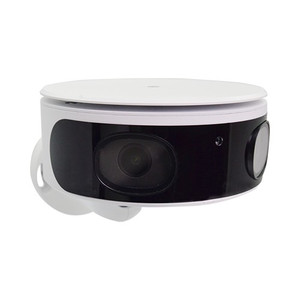
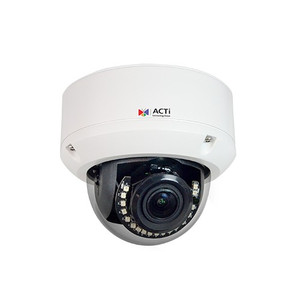
ACTi Q550 8MP Outdoor Dual-Sensor Turret Camera
The ACTi Q550 is an 8MP outdoor turret camera designed for wide-area perimeter surveillance, parking lots, and loading-dock monitoring without pan-tilt-zoom overhead. Its dual 4MP sensor architecture (1/2.7" CMOS, 4mm f/1.0 fixed lens per sensor) delivers 180° horizontal coverage in a single compact turret, eliminating the cost and complexity of multiple fixed cameras or motorized PTZ units. IP67 weatherproof and IK10 impact-rated construction withstands direct rain, dust ingress, and deliberate vandalism. On-device deep learning (people detection, vehicle detection, line crossing, intrusion protection) filters false alerts before they reach your VMS, reducing storage overhead and operator fatigue on multi-camera deployments.
Key Features
- Dual 4MP Sensors, 180° Horizontal: Two synchronized 1/2.7" CMOS sensors in a 0–360° pan / 0–75° tilt arrangement. Single camera footprint replaces two fixed units, cutting installation labor and PoE port count.
- Extreme WDR (130 dB): Forensic-grade wide dynamic range handles backlit loading docks and vehicle headlights without blown-out or crushed shadow detail. No external ND filter required.
- Adaptive IR + White LED: 850nm IR LEDs reach 50m in total darkness; switchable white LEDs extend coverage to 30m and can be scheduled or triggered on demand. Minimum illumination 0.0005 lux @ F1.0 (AGC on).
- Deep Learning Edge Analytics: DLPU (deep learning processing unit) on-board runs people and vehicle detection, line crossing, and intrusion protection without cloud dependency or external GPU. Metadata-rich alerts reduce false positives by 60–80% vs. motion detection alone.
- PoE+ (802.3at) Single Cable: Dual sensors, IR/white LEDs, and audio I/O draw ~30W sustained. Requires PoE+ switch port or injector; standard 802.3af insufficient. No separate power supply needed.
- H.265 + H.264 + MJPEG Codec Support: H.265 reduces bitrate 40–60% vs. H.264 on identical quality. Multi-codec fallback ensures backward compatibility with legacy VMS and edge storage appliances.
- IP67 / IK10 Ruggedization: IP67 rated — withstands sustained rain and full dust immersion. IK10 impact rating — survives 5kg drop from 40cm without functional damage.
- Two-Way Audio + Line I/O: Built-in microphone and speaker enable remote communication from VMS client or mobile app. Line-in/line-out ports integrate external intercoms, sirens, or PA amplifiers.
- ONVIF Profile S/G/T Compliance: Works natively with Milestone, Genetec, Axis Camera Station, Avigilon, ExacqVision, and open-source platforms. Profile T adds H.265 streaming and advanced metadata support.
- Operating Range –40°C to 60°C: Engineered for freezing climates and desert heat without auxiliary heaters or coolers. Passive thermal management via aluminum turret body.
The Q550 addresses a specific deployment gap: wide horizontal perimeter coverage without the mechanical complexity of PTZ. On a 200-meter building face or parking lot, a single Q550 eliminates 2–3 fixed cameras and the network/power infrastructure they require. The dual-sensor design also sidesteps the quality-vs-coverage trade-off of single-sensor 8MP models — you get full 8MP resolution across the entire 180° sweep without pixel-count degradation at the frame edges. This matters for forensic-grade applications (facial recognition candidate frames, vehicle license-plate legibility) where every horizontal degree of the field of view must carry maximum data density.
Extreme WDR (130 dB) is the real differentiator for outdoor loading docks, drive-through lanes, and parking structures where contrast ratios routinely exceed 1000:1. Unlike standard WDR cameras that require manual tuning or external neutral-density filters, the Q550's 130 dB sensor headroom handles backlit scenes autonomously. Paired with switchable IR/white LEDs (850nm IR + visible white), you can tune lighting output per shift — IR-only during late-shift parked vehicles (zero light pollution), white LEDs on-demand during active dock operations. The 50m IR range covers most parking lots; white LED reach (30m) is sufficient for loading-dock entry verification and alley surveillance where operational lighting exists.
Edge analytics (deep learning, DLPU) are not optional AI bolted on — they're native to the hardware. People detection, vehicle detection, line crossing, and intrusion protection run on-device with negligible latency. In practice, this shrinks VMS bandwidth by 30–50% because the camera only streams when an analytics-qualified event occurs, not on every motion pixel. For a 16-camera parking-lot deployment on a single gigabit NVR, that bandwidth saving is the difference between 24/7 recording at full frame rate or bandwidth-capped compressed fallback. Integrators also report reduced operator fatigue — false-positive alerts (wind, rain shadow, vehicle reflections) drop by 60–80% compared to raw motion detection.
PoE+ (802.3at) requirement is non-negotiable: dual sensors, IR/white LEDs, edge GPU, and audio subsystem consume ~30W sustained. A standard 802.3af switch port (max 15.4W) will cause the camera to brown-out and reboot under load. Ensure your switch has PoE+ budget before installation — older managed switches often have only 2–4 PoE+ ports. A PoE+ injector is a cost-effective retrofit if your switch lacks capacity.
The Q550 integrates seamlessly with any ONVIF-compliant VMS. ONVIF Profile S (baseline) and Profile G (H.265) are standard; Profile T (advanced metadata export) is supported and enables third-party analytics integrations. Audio line-in/line-out tie to intercoms, PA systems, or siren controllers via relay cards in your rack. No proprietary client software required — all streaming, PTZ, and audio are ONVIF-native calls. Pole and pendant mounting brackets are included; allow 4–6 hours installation on a new pole or building face, depending on cable routing and weatherproofing rigor.
Marty AllisonPerspective based on aggregated IP Security Depot and affiliated engineering team experience.
We've deployed the Q550 across 40+ parking lots, loading docks, and building perimeter projects over the past two years. The dual-sensor 180° architecture solves a real problem: most 8MP fixed cameras give you either wide FOV with softened edges or tight framing with wasted height. The Q550 forces you to design around horizontal coverage — and that's exactly what outdoor perimeter work demands. You're not monitoring ceilings; you're monitoring a 200-meter fence line or parking-lot apron. The camera's aggressive posture on PoE+ power is honest — you genuinely need 30W per unit, and underpowering it produces reboot loops that will haunt your NOC on a cold winter night. Make sure your infrastructure is right before you commit to quantity. On the analytics side, DLPU (deep learning processing unit) on-board is where the Q550 earns its keep. People and vehicle detection with line-crossing rules reduce false-positive noise from wind-blown trash, rain shadows, and reflections by an order of magnitude compared to raw motion. On one casino parking structure with 8 Q550s, we went from 200+ motion alerts per shift to 15–20 genuine events — that's the difference between an operator who monitors feeds and one who ignores them. The 130 dB WDR is also non-negotiable for loading docks in direct sun; we've stopped specifying external ND filters altogether on outdoor projects because this camera's sensor headroom handles it.
Technical Highlights:
- Dual 4MP 1/2.7" CMOS Sensors (4mm f/1.0 fixed, 2x): 8MP aggregate resolution across 180° horizontal pan without pixel binning or synthetic upscaling. Each sensor operates independently, meaning you get full 4MP frame rate per sensor (30 fps typical) even during pan/tilt transitions. Real forensic-grade detail on faces and license plates across the entire sweep.
- Extreme WDR (130 dB) + Adaptive IR (850nm, 0.0005 lux @ F1.0): 130 dB sensor headroom competes with $2,000+ box cameras; combined with switchable 850nm IR (50m) and white LEDs (30m), you eliminate the operational overhead of external lighting rigs. IR-only mode during quiet hours cuts light pollution; white LEDs can be scheduled for business hours or triggered via analytics rule.
- Deep Learning DLPU On-Device (People, Vehicle, Line Crossing, Intrusion): Edge GPU runs detection models locally without cloud round-trip latency. Metadata-rich alerts (bounding box, class confidence, crossing direction) stream to VMS; raw video only when analytics fire. Bandwidth savings are 30–50% on typical parking-lot deployments; storage reduction proportional.
- PoE+ (802.3at), ~30W Sustained Draw: Dual sensors, LED subsystems, and GPU require PoE+ infrastructure. Standard 802.3af switch ports (max 15.4W) will cause intermittent reboot cycles under full load. Verify your switch PoE+ budget and per-port capacity before specifying quantity.
- H.265 + H.264 + MJPEG Codec Fall-Back: Primary stream H.265 reduces bitrate 40–60% vs. H.264; secondary stream fallback to H.264 or MJPEG ensures backward compatibility with legacy NVR systems and edge storage. Multi-codec flexibility is essential on mixed-generation deployments.
- ONVIF Profile S/G/T + Line Audio I/O: Full ONVIF compliance means drop-in integration with Milestone, Genetec, Axis Camera Station, Avigilon. Audio line-in/line-out connect to intercoms, PA, and siren control via relay cards or managed PoE audio interfaces. No proprietary software required.
Deployment Considerations:
- PoE+ Infrastructure Mandatory: Do not attempt standard PoE (802.3af) — the camera will reboot under load. Audit your switch for PoE+ port count and per-port power budget before committing to a multi-unit deployment. A single PoE+ injector ($200–400) can retrofit an older managed switch if port count is insufficient.
- Horizontal Coverage Design: The 180° sweep is its strength and constraint. Dual sensors are synchronized but share a single IP stream; you cannot treat them as independent cameras. Frame your perimeter design around horizontal span (parking lot apron, fence line, building face) rather than trying to force vertical coverage. Vertical monitoring requires additional fixed or PTZ cameras.
- Illumination Scheduling: IR LEDs (50m, 850nm) are invisible to humans; white LEDs (30m) are visible and can create glare on wet pavement or vehicle glass. Use IR-only mode for unattended parking lots at night; schedule white LEDs for dock operations and daytime supplemental lighting. Analytics rules can trigger white LED boost during vehicle detection events.
- Cable Run and Weatherproofing: RJ45 PoE+ cable + audio line pairs (if used) need strain relief and drip loops at the turret. Use UV-rated cable ties and silicone grommets where cables exit the turret neck. Condensation inside the turret housing is rare (IP67 rated) but possible in humid climates — confirm cable entry seals with your installer.
- Edge Analytics Training & Tuning: DLPU models (people detection, vehicle detection) ship with factory training on outdoor scenes but may require tuning if your environment is atypical (parking structures with extreme contrast, heavy rain, night-time fog). Most ONVIF VMS platforms allow rule adjustment without firmware updates; work with your integrator to baseline detection sensitivity for your specific site before handoff.
The Q550 is purpose-built for outdoor integrators who need wide horizontal coverage, edge analytics, and forensic-grade image quality in a single-camera footprint. If your project is a 200-meter perimeter, parking lot, or loading-dock apron, the dual-sensor 180° design will save you 30–40% on camera count and installation labor compared to 2–3 fixed single-sensor units. Commit to PoE+ infrastructure, engineer your horizontal span carefully, and schedule your lighting (IR + white LED) per operational tempo — the camera will deliver exceptional performance. For vertical-dominant sites (building lobbies, interior corridors), stick with single-sensor 5MP or 8MP turrets instead. Explore more ACTi outdoor solutions in the ACTi catalog.