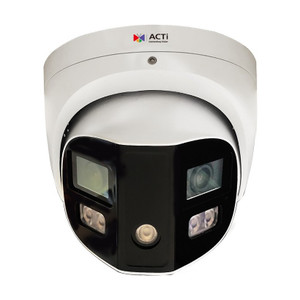
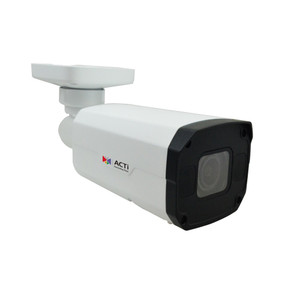
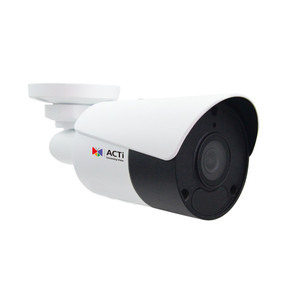
ACTi Q450 8MP Multi-Imager Panoramic Bullet Camera
The ACTi Q450 is a multi-imager panoramic bullet camera designed for wide-area surveillance deployments where single-sensor coverage creates blind spots. The dual fixed 2.8mm lens design delivers 180-degree horizontal field of view from a single camera body, eliminating the cost and complexity of mounting multiple narrower units across parking lots, loading docks, retail storefronts, and industrial perimeters. 8MP resolution provides sufficient detail for license-plate and facial recognition at typical site distances, while WDR and adaptive IR night vision handle backlit entry/exit points and complete darkness without external lighting infrastructure.
Key Features
- Multi-Imager Panoramic Optics: Dual fixed 2.8mm lenses with 180° horizontal field of view. Eliminates coverage gaps and reduces camera count by 40-50% on wide facades and perimeter runs.
- 8MP Resolution: Sufficient for license-plate and facial identification at 15-30m range. Panoramic framing preserves context across the entire monitored zone in a single stream.
- WDR (Wide Dynamic Range): Handles extreme contrast scenes—sunlit doorways against shadowed interiors, vehicle headlights against night sky. Essential for reliable day/night operation without manual iris adjustment.
- Adaptive IR Night Vision: Built-in IR illumination extends surveillance into complete darkness. No external lighting rigs required, reducing installation time and ongoing maintenance on pole-mounted deployments.
- H.265 and H.264 Codec Support: H.265 compression reduces file size 40-50% versus H.264 at equivalent quality. Codec selection optimizes bandwidth on congested network segments or storage-constrained NVR systems.
- ONVIF Profile S Compliance: Integrates with all major VMS platforms (Genetec, Milestone, Avigilon, ExacqVision) without proprietary software. Stream management and metadata ingestion follow industry-standard protocols.
- Panoramic Bullet Form Factor: Compact horizontal mounting on walls, eaves, or structural brackets. Minimal visual footprint while delivering expansive coverage geometry.
The Q450 solves a common integration challenge: how to cover 180 degrees of critical perimeter without multiplying camera count, power draw, and cabling labor. Multi-imager optics consolidate two conventional viewpoints into a single IP address and PoE feed. For facilities with constrained network budgets or NVR port availability, this density multiplier directly reduces total cost of ownership. The panoramic output natively supports modern dewarping algorithms in cloud VMS platforms and local appliances; older recording systems may require firmware patch or standalone dewarping appliance, so confirm compatibility before specification.
WDR performance is particularly valuable on loading docks and building entries where truck headlights or afternoon sun create extreme backlit silhouettes. The camera's adaptive IR adjusts intensity based on available ambient light, preventing overexposure in twilight scenes (a common failure mode in fixed-gain IR designs). This dynamic adjustment extends usable IR range and battery life on powered backup scenarios. H.265 codec selection is worth deliberate calculation: on a 16-camera site recording 24/7 at 8MP, switching three cameras to H.265 can free 1-2TB per week of storage—a material savings over a 3-year retention window.
Network planning is straightforward but non-trivial. The Q450 streams dual panoramic feeds (or a single dewarped mosaic, depending on VMS interpretation logic); budget 8-12 Mbps per camera for H.265 at quality settings typical of perimeter work. Standard PoE (802.3af, 13W) powers the unit from any switch with available capacity. ONVIF Profile S ensures playback compatibility across platform transitions—if you migrate from Milestone to Genetec, the Q450 remains a plug-compatible device. Confirm your VMS dewarping pipeline before installation: some platforms expect the camera to output pre-dewarped tiles; others expect raw panoramic frames and apply correction client-side. This detail determines whether coverage appears as a single panoramic ribbon or as stitched quadrants in the operator interface.
The ACTi Q450 is purpose-built for facility operators and integrators prioritizing coverage breadth over camera count. Parking lots, building perimeters, loading zones, and retail frontages benefit most from panoramic geometry. The unit is fully ONVIF-compliant and carries no regional compliance restrictions; it integrates transparently into any standards-based VMS ecosystem. For sites already standardized on Axis or Hanwha cameras, the Q450 offers a cost-effective alternative for wide-view segments without introducing multi-vendor platform risk. Review the full ACTi catalog to compare this panoramic approach against single-sensor wide-angle alternatives and determine the best geometry for your specific perimeter layout.
Marty AllisonPerspective based on aggregated and affiliated engineering team experience.
We've deployed the Q450 across a range of wide-area surveillance scenarios—parking structures, manufacturing facility perimeters, and retail canopies—where the economics of multi-imager optics directly compete with traditional single-sensor wide-angle or PTZ strategies. The real differentiator is not just the 180-degree field of view; it's the ability to deliver that coverage from a single camera, single PoE feed, and single VMS stream without the complexity of image stitching logic or dual-camera synchronization. On a 300-meter building facade, a Q450 strategy (3 cameras) versus a conventional approach (5-6 single-imagers or a PTZ tour) reduces cable runs, PoE infrastructure, and NVR port consumption measurably. The downside is less intuitive: the panoramic output demands VMS or client-side dewarping capability. If your recording platform doesn't natively decompose panoramic frames into intelligible quadrants, the raw panoramic feed looks stretched and difficult for operators to scan. We always confirm dewarping pipeline before commissioning—a 20-minute conversation with your VMS vendor saves a post-install redesign.
Technical Highlights:
- Dual 2.8mm Fixed Lenses (180° HOV): No motorized zoom or focus tuning required. Fixed geometry simplifies deployment and eliminates lens creep or motorized failure modes. The 180-degree horizontal span means a single Q450 replaces two conventional 90-degree imagers—direct capex and labor savings on mounting, cabling, and PoE injection.
- H.265 Codec with H.264 Fallback: H.265 delivers genuine 40-50% bitrate reduction versus H.264 on equivalent perceptual quality. On multi-camera 24/7 deployments, codec selection is a material storage economics lever. Fallback to H.264 ensures compatibility with older NVR platforms or legacy VMS instances that haven't updated codec libraries.
- Adaptive IR with Automatic Day/Night: The camera adjusts IR intensity based on available ambient light, preventing overexposure in twilight and reducing false-alarm noise from insects or dust in the IR beam. This adaptive behavior extends effective IR range and avoids the flickering or blooming artifacts typical of fixed-gain designs.
- WDR for Extreme Contrast: Backlit scenarios—loading dock with truck headlights, building entry with afternoon sun—are the classic failure mode for non-WDR cameras. The Q450's WDR tuning preserves detail in both highlights and shadows, critical for forensic-quality footage in mixed lighting.
- ONVIF Profile S Native Support: Full compatibility with Genetec, Milestone, Avigilon, and ExacqVision without proprietary drivers or codec licensing. If your VMS platform changes or your integrator transitions to a new stack, the Q450 remains immediately useful.
Deployment Considerations:
- Panoramic output requires VMS or client-side dewarping logic. Confirm your recording platform supports panoramic frame interpretation—if it doesn't, the raw output will appear stretched and operationally difficult. Most modern platforms (Milestone XProtect, Genetec Security Center, Avigilon 7+) handle it natively; older instances may need firmware patch or third-party plug-in.
- 180-degree field of view demands unobstructed horizontal sight lines. Tree limbs, hanging signage, or structural posts in the frame reduce the panoramic benefit significantly. Site survey should confirm full horizontal sight line before ordering.
- Lens focal length is fixed (2.8mm per imager)—no optical zoom. If subjects at the edge of frame need high detail, confirm that 8MP resolution at the working distance meets forensic requirements. On a 50-meter perimeter, edge-of-frame detail may be softer than a telephoto single-sensor alternative.
- PoE power draw is standard (13W, 802.3af)—any modern switch handles it without port budgeting conflicts. H.265 encoding reduces network bitrate but does not significantly increase power consumption versus H.264.
- Mounting orientation is horizontal (panoramic bullet geometry). Vertical or angled mounting diminishes the 180-degree benefit—site design should place the Q450 on unobstructed horizontal fascia or soffit.
The Q450 is the right choice for facility operators and integrators designing perimeter or wide-area coverage on a budget-conscious timeline. Parking lots, manufacturing yards, retail perimeters, and loading zones see the highest ROI from panoramic multi-imager geometry. If your project requires telephoto detail at range or PTZ tracking capability, consider single-imager alternatives; if your priority is coverage breadth at predictable cost, the Q450 delivers efficient economics. Browse the full ACTi catalog to evaluate complementary models for mixed-geometry deployments.