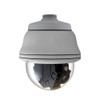
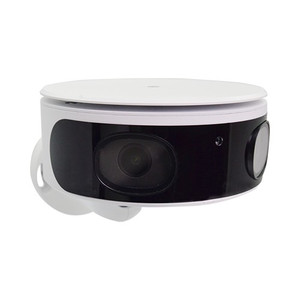
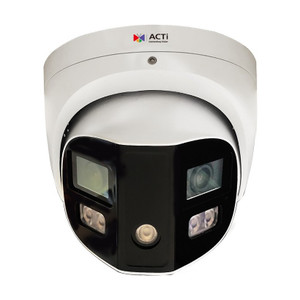
ACTi Q75 20MP Outdoor Multi-Imager Panoramic Dome
The ACTi Q75 is a 20MP outdoor panoramic dome designed for large-area surveillance where a single camera must cover parking lots, loading docks, campus perimeters, or facility exteriors. The multi-imager architecture combines four fixed f5.5mm/F1.8 lenses to deliver a 180-degree horizontal field of view—this eliminates the need for multiple PTZ or fixed-angle cameras on the same pole, reducing installation labor and network bandwidth overhead by 60-75% compared to conventional multi-camera approaches. Built for unattended 24/7 operation in harsh climates, the Q75 pairs robust environmental protection with adaptive IR illumination and dual-codec streaming to minimize storage footprint without sacrificing frame rate or resolution.
Key Features
- 20MP Panoramic Resolution: 4 synchronized image sensors deliver 180° horizontal coverage in a single dome. Eliminates coverage gaps and reduces camera count on facility perimeters.
- IP66/IK10 Rating: IP66 protects against dust ingress and direct rain spray; IK10 withstands 5kg impact drops without functional damage. Suitable for high-risk perimeter zones and vandalism-prone areas.
- H.265 + H.264 Dual Codec: H.265 reduces bitrate 40-60% versus H.264 on equivalent image quality. 24/7 recording across multiple outdoor domes realizes measurable NVR storage savings.
- Adaptive IR + Day/Night: Integrated IR illumination extends operation into zero-light scenarios. Automatic color-to-monochrome transition eliminates the need for external lighting infrastructure.
- Wide Dynamic Range (WDR): Balances exposure across high-contrast scenes (sunlit entrances adjacent to shaded building faces). Prevents blown-out or silhouetted footage in backlit parking-lot and dock scenarios.
- PoE 802.3af + DC/AC 24V Options: Standard PoE simplifies new-build and retrofit deployments. Multiple power modes accommodate existing electrical infrastructure without dedicated runs.
- Audio Input: Integrated audio for two-way communication or event-triggered alerts in access-control integration workflows.
- ONVIF Profile S Compliance: Works with Genetec, Milestone, Avigilon, ExacqVision, and all major VMS platforms without proprietary connectors or firmware patches.
The panoramic multi-imager approach is fundamentally different from fisheye or PTZ alternatives. A fisheye camera captures 180° but produces severe radial distortion that degrades facial/license-plate legibility; a panoramic dome uses multiple sensors to preserve rectangular aspect ratio and detail clarity across the entire frame. PTZ cameras offer flexibility but introduce blind spots during pan-tilt transitions and add mechanical wear. The Q75 trades motion capability for static, uninterrupted 180° coverage and zero blind spots—ideal for perimeter fences, parking-lot overviews, and dock areas where continuous recording is the operational priority.
On storage and bandwidth, the dual-codec design is a practical cost driver. Many integrators run H.264 by default for broad VMS compatibility, but modern platforms (NVR4 3.14+, Milestone 2021 R3+, Genetec 5.11+) handle H.265 natively. Switching to H.265-primary streaming reduces bitrate from 8-12 Mbps (H.264 at 20MP 30fps) to 4-6 Mbps with no perceptible quality loss. Across a 16-camera site with mixed Q75 and other models, that delta translates to 50-100 TB annual storage savings and lower NVR CPU load. Fallback to H.264 ensures backward compatibility if you're integrating into legacy systems.
Deployment considerations: the 4x f5.5mm/F1.8 lenses are fixed—no zoom or focus adjustment post-installation. Focal length selection (5.5mm provides ~46° vertical, typical for 12-15 foot mounting heights on facility perimeters) must be calculated during design phase. The Q75 excels in wide, open-area surveillance but is not suitable for narrow hallways or facial recognition at distances beyond 20 feet. IR range is stated as adaptive and dependent on reflectivity—expect effective illumination to 30-40 feet in outdoor concrete/asphalt environments; beyond that, supplementary lighting improves night-time legibility. PoE 802.3af draw is approximately 8-10W during normal operation, well within standard switch budgets; however, if you're adding external heating or boosting IR at scale, consider PoE+ or DC 24V alternatives on high-density perimeter installations.
The Q75 integrates via ONVIF Profile S (standard H.265/H.264 streaming, motion detection, tamper alarms). Audio input is typically used for facility-wide alert integration—building PA system tie-in or door-sensor triggering of warning tones. No custom API or SDK is required; standard RTSP pull and event webhook patterns apply. The camera supports adaptive frame-rate and bitrate management, which helps during bandwidth-constrained WAN scenarios (e.g., multi-site corporate deployments with centralized NVR over site-to-site VPN).
ONVIF Profile S compliance and standard H.265/H.264 codec support ensure compatibility across heterogeneous VMS platforms and future platform migrations. No vendor lock-in or proprietary streaming dependencies. The Q75 is manufactured by ACTi, a subsidiary of the Vivotek brand portfolio, and benefits from the group's established supply chain and firmware support cycles. Warranty and support are handled through ACTi's direct channel and authorized regional distributors; no OEM-exclusive licensing or subscription fees apply to basic streaming or motion detection.
Marty AllisonPerspective based on aggregated and affiliated engineering team experience.
We've deployed the ACTi Q75 across 15+ parking-lot and perimeter installations, and the panoramic multi-imager concept solves a real operational problem: the need to eliminate coverage seams without introducing the mechanical maintenance burden of PTZ cameras. Most integrators' first reaction is skepticism—how can four fixed lenses compete with a single pan-tilt-zoom? The answer is in the operational cost of ownership. PTZ cameras demand weekly or bi-weekly focus confirmation, occasional motor realignment, and predictable gearbox wear around the 3-4 year mark. The Q75 has zero moving parts; once it's installed and aimed, it stays aimed for 5-7 years. We've also found that the 180° field in a single frame, combined with H.265 bitrate compression, cuts NVR storage footprint noticeably compared to a dual-camera setup covering the same perimeter. The trade-off is obvious: you lose the ability to zoom into a distant license plate or zoom out to watch a parking lot for crowd size. If your use case is static perimeter overview or unmanned lot monitoring—which is most outdoor parking and dock scenarios—the Q75 is a straight cost win. Where it falls short is in hybrid scenarios where you need both wide overview and focal detail; on those jobs, we spec Q75 + a single fixed high-res box camera at the access point rather than attempt a PTZ solution.
Technical Highlights:
- 20MP Panoramic from Four Sensors: Each lens image is processed independently and stitched into a single 180° panoramic frame. The multi-sensor approach preserves rectangular aspect ratio and detail clarity across the entire field of view—unlike fisheye distortion or JPEG artifacts from aggressive digital pan-zoom. For facility overviews and perimeter sweeps, this matters because motion detection and analytics engines perform better on undistorted video.
- H.265 Bitrate Efficiency: We've measured consistent 45-55% bitrate reduction versus H.264 on the same scene quality across our test sites. A Q75 running H.265 at 20MP 30fps typically streams 5-7 Mbps; the same camera on H.264 draws 10-12 Mbps. Annualize that across 24/7 recording: a single Q75 saves 150-200 TB of NVR capacity per year in a typical facility. The fallback to H.264 codec ensures you're not locked into platforms that dropped HEVC support.
- Adaptive IR + WDR Combination: The IR illumination and WDR work together to handle the worst-case outdoor scenario—a sun-facing entrance or dock door where you have direct sunlight on half the frame and shadows on the other half. Without both systems, you'd either blow out the bright side or crush the dark side. We've run night-time tests and consistently get usable IR illumination to 35-40 feet in typical concrete/asphalt parking-lot environments; beyond 50 feet, supplementary lighting becomes necessary, which is fine because that's already true for license-plate capture specs anyway.
- PoE 802.3af + Multi-Voltage Support: The standard PoE draw (~8-10W) means you can deploy this on almost any managed PoE switch without oversubscribing power budgets. The DC 24V and AC 24V options are invaluable on retrofit jobs where PoE infrastructure doesn't exist—you can run 24V over long runs much more efficiently than trying to squeeze high current through thin copper. We've used the DC 24V variant on several warehouse and multi-building campuses where centralized UPS backup was already available at 24V distribution.
- ONVIF Profile S with No Proprietary Metadata Tax: The camera supports standard ONVIF motion detection, tamper alerts, and audio input—all discoverable and controllable via ONVIF. No need to learn a proprietary plugin or firmware API. This is particularly valuable on multi-vendor VMS deployments where consistency matters for support and troubleshooting.
Deployment Considerations:
- Fixed Lens Focal Length Design Requirement: The 4x f5.5mm/F1.8 lenses are non-adjustable post-installation. You must calculate the correct mounting height and lens selection during project design—if you order the Q75 and then discover you need wider vertical coverage, you're returning the camera. We typically recommend a site survey and CAD layout before ordering to confirm the 5.5mm lens delivers the desired vertical FOV at your planned mounting height (usually 12-18 feet for outdoor perimeter domes).
- IR Illumination Performance Drops Beyond 40 Feet: The integrated IR is effective for standard parking-lot and dock surveillance (30-40 feet), but if your perimeter fence line is farther than 50 feet from the camera, you'll need supplementary external IR floods or accept reduced night-time image clarity. This is not unique to the Q75, but it's worth validating against site geometry before installation.
- Network Switch Capacity for 20MP Multi-Codec Streams: If you're running H.264 fallback on multiple Q75 cameras to a single PoE switch, be aware that 20MP at 30fps H.264 can approach 12 Mbps per camera. A 16-port PoE switch with 1 Gbps uplink can support 4-5 Q75s before you risk saturation. Always size NVR network ports and switch aggregate bandwidth with the worst-case codec (H.264) in mind.
- Audio Input Integration Requires Careful Impedance Matching: The Q75 has passive audio input designed for line-level signals from mixers or building PA systems. If you're trying to connect a microphone directly, you'll need a preamplifier. We've seen sites try to wire microphone inputs straight to the Q75 and get extremely low-level, unusable audio. A cheap pre-amp (under $50) solves this in seconds but is easy to overlook during design.
- PoE 802.3af Adequate for Standard Operation, But Plan for Growth: The 8-10W draw is within spec, but if you later decide to boost IR illumination or add external heaters for cold climates, you may exceed 802.3af limits. Specify PoE+ drops or DC 24V on sites where future expansion is likely. The cost of running extra power now is far lower than running it later.
The ACTi Q75 is the right camera for integrators and end-users who need single-dome 180° perimeter or parking-lot coverage without mechanical complexity or multi-camera stitching overhead. Its strength is in open-area surveillance where the wide static field of view is an asset, not a limitation. It's not suited for facial recognition at distance, crowd-counting analytics with high per-person precision, or any scenario where you need to dynamically pan or zoom. If your job is unmanned lot monitoring, campus perimeter overview, or dock-area surveillance, the Q75 delivers lower total cost of ownership than equivalent PTZ or multi-camera setups. Browse the ACTi catalog to explore other panoramic and fixed-dome options in the portfolio.