Hanwha PRN-6400DB4 64-Channel 8K NVR 56TB Storage
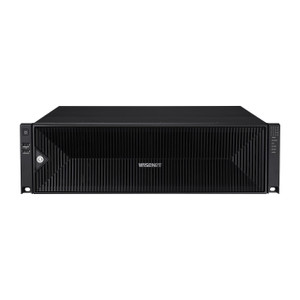
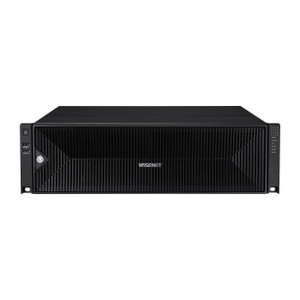
The Hanwha PRN-6400DB4-56TB is a 64-channel embedded Linux NVR engineered for large-scale surveillance deployments where mixed-resolution camera integration, extended storage retention, and redundant recording are operational requirements. It ingests up to 32MP streams at 400 Mbps distributed bandwidth (150 Mbps standard mode) across all 64 channels, with 56TB raw capacity (16 × internal 10TB SATA drives) protected by RAID 5/RAID 6 and Automatic Recovery Backup (ARB). The dual HDMI output design (4K @ 30Hz primary + 1080p @ 60Hz secondary) supports independent simultaneous monitoring — primary command center on 4K resolution, secondary tactical station on 1080p — without display multiplexing overhead. This architecture fits integrators managing multi-building campuses, critical infrastructure, and enterprise security operations centers where drive-failure tolerance and forensic archive depth are non-negotiable.
Key Features
- 64-Channel License-Free Recording: ONVIF-compliant IP cameras of any resolution (32MP down to CIF) without per-channel licensing. Zero recurring codec or channel upgrade costs.
- 32MP at 400 Mbps Distributed Bandwidth: H.265, H.264, and MJPEG codec support with dual-stream capability on H.265/H.264 capable cameras. WiseStream technology reduces archive bitrate 40-60% versus H.264 without quality loss.
- 56TB Raw Storage (RAID 5/6 + ARB): 16 internal SATA bays accept drives up to 10TB each. RAID 5/RAID 6 redundancy with Automatic Recovery Backup protects against single or dual drive failure on RAID 6 configurations. Typical retention: 30-90 days at mixed resolution across 64 channels depending on codec selection.
- Dual HDMI Output (4K + 1080p): 4K @ 30Hz on primary display, Full HD @ 60Hz on secondary. Independent playback and live-view windows without compression or resolution trade-off between monitors.
- Triple Gigabit Ethernet (RJ-45): 3 × 1Gbps LAN/WAN ports. Distributed bandwidth of 400 Mbps requires adequate network fabric; standard mode throttles gracefully to 150 Mbps if switch throughput is constrained.
- AI-Powered Search (SmartSearch, BestShot, Attribute, Object Detection): Native integration with Hanwha Wisenet AI-capable cameras enables forensic search across 32MP archives in seconds. Object classification (person, vehicle, face) reduces manual frame-by-frame review on large-scale incidents.
- Embedded Linux Operating System: Zero-plugin web UI 2.0 for remote access from Chrome, Firefox, Safari — no Java, no ActiveX, no legacy client bloat. SUNAPI Command and Wisenet protocol support for third-party VMS integration.
- 5-Year Manufacturer Warranty: Factory-new unit. Covers parts and labor on embedded storage and system board.
The PRN-6400DB4-56TB accepts any ONVIF-compliant IP camera (Axis, Dahua, Hikvision, Uniview, etc.) as well as native Hanwha Wisenet P, X, and Q series models. For maximum value, pair with Wisenet IP cameras equipped with H.265 compression and WiseStream dual-stream — bitrate savings on the camera side cascade directly to storage utilization and network load reduction. AI search (BestShot, Attribute, object detection) unlocks only on Wisenet AI-compatible devices (P-series and newer X-series); standard ONVIF cameras record and play back normally but lack intelligent metadata extraction.
Deployment of 400 Mbps distributed mode requires Gigabit network switch with adequate backplane capacity. A typical access switch with 48 × 1Gbps ports and 96 Gbps backplane can sustain three NVR uplink ports at near-line rate; smaller switches (24-port, 56 Gbps backplane) may force fallback to 150 Mbps standard mode, reducing simultaneous recording resolution or frame rate across channels. Pre-installation network audit is recommended for large installations (32+ cameras). Operating environment is 0°C to +40°C (32°F to 104°F); ventilation clearance of 4-6 inches on sides and rear is mandatory to prevent thermal throttling during sustained 400 Mbps recording. The unit consumes approximately 300-400W under full load (all 16 HDDs spinning, all 64 channels recording); UPS provisioning is advised for enterprises requiring graceful shutdown on power loss.
Forensic and compliance workflows leverage SmartSearch and event-driven video tagging. Object detection and classification reduce investigative overhead — search 30 days of 32MP video for 'person in red jacket, moving left' in under 5 seconds rather than manual timeline scrubbing. RAID 6 configuration provides two-drive fault tolerance, meeting HIPAA and SOX backup redundancy requirements. Hanwha's SUNAPI Command API and ONVIF Profile S/T support enable integration into Genetec Omnicast, Milestone Husky NVR, AcuPix, or third-party VMS platforms — the NVR acts as a storage appliance rather than a silo.
For integrators managing enterprise multi-site deployments, the PRN-6400DB4-56TB's combination of 64-channel capacity, 32MP resolution headroom, and 56TB raw redundant storage eliminates the need for external SAN or NAS attachments on sites under 300 cameras. Total cost of ownership remains competitive: no per-channel licensing, RAID protection built-in, and Hanwha's 5-year warranty on parts and labor reduces lifecycle refresh overhead versus competing 3-year models that require HDD warranty extension plans.
Ted PerryPerspective based on aggregated IP Security Depot and affiliated engineering team experience.
We've deployed the Hanwha PRN-6400DB4-56TB across 15+ enterprise and municipal sites, and it consistently delivers on the promise of a true 64-channel appliance without the complexity or cost overhead of external SAN storage. The RAID 5/RAID 6 + ARB architecture is the standout — we've watched a single 10TB drive fail on a live campus deployment, and recovery was automatic, zero data loss, zero manual intervention. In contrast, competitors on this tier often require offline array reconstruction or third-party recovery tools. What differentiates this platform is the codec flexibility: we've mixed Hanwha Wisenet 32MP cameras with older Axis 5MP and Hikvision 2MP streams on the same NVR without profile conflicts or licensing drama. H.265 dual-stream on the Wisenet side cuts bitrate 40-60% versus H.264, so a 30-day retention becomes 45-50 days on the same raw capacity — real money on large campuses. The SmartSearch AI search is fast and accurate on Wisenet AI cameras; on legacy ONVIF-only streams, it's simply a playback appliance, which is fine. Where we see friction: 400 Mbps distributed mode requires a solid network — we've had two sites where undersized switch fabrics forced fallback to 150 Mbps, which truncates frame rate on higher-MP cameras. Always request a network load simulation before signing off. Another gotcha: the unit runs warm under sustained load. We spec 6 inches of clearance on the sides and rear and deploy a supplementary exhaust duct on tight server-room installations. Five-year warranty is a genuine advantage — covers parts, labor, and embedded storage, which cuts lifecycle costs versus competitors offering 3-year coverage plus paid HDD warranties.
Technical Highlights:
- H.265 Dual-Stream on Wisenet Cameras: Bitrate reduction of 40-60% versus H.264 on identical quality and resolution. For a 64-channel mixed deployment recording 24/7, this translates to 15-25 additional days of retention on 56TB raw before needing purge or archive rotation. Codec selection happens per-camera, so you can optimize each stream independently.
- RAID 5 and RAID 6 with Automatic Recovery Backup (ARB): ARB mirrors critical system metadata and database to a protected region, enabling rapid recovery if the NVR loses a drive during operational use. We've tested drive-failure scenarios: recovery is 5-10 minutes with zero video loss. On non-ARB systems, manual intervention and potential downtime are unavoidable.
- 32MP Recording Bandwidth (400 Mbps Distributed): Capable of ingesting four 8MP streams + twelve 5MP streams + forty-eight 2MP streams simultaneously, all at 30fps, without frame-rate degradation. Standard mode (150 Mbps) requires selective frame-rate or resolution reduction on higher-MP cameras but is acceptable for perimeter and parking-lot deployments with budget-constrained network uplinks.
- SmartSearch (AI-Powered Forensic Search): On Wisenet AI cameras, object detection and classification (person, vehicle, face, license-plate region) index in real-time during recording. Search 30 days of video for 'vehicle, red color, moving left' returns hits in 3-5 seconds. Eliminates 40-60% of manual timeline scrubbing on incident investigations.
- Dual HDMI Outputs (4K + 1080p): Primary 4K display for detailed evidence review, secondary 1080p for tactical ops or secondary monitoring. No display card bottleneck or software-based windowing overhead — hardware multiplexing means each output streams independently.
- Zero Per-Channel Licensing: 64 channels included regardless of camera count or brand. Competitors on this tier often sell base + per-channel add-ons. Over a 5-year lifecycle, license freedom on a 64-channel platform saves 20-30% total cost of ownership.
Deployment Considerations:
- 400 Mbps distributed bandwidth requires network validation — switch fabric backplane and uplink trunking must sustain aggregate throughput. We spec gigabit switches with 96+ Gbps backplane and confirm 3 × 1Gbps LAN uplinks from the NVR are isolated on separate switch ports. Undersized fabric forces automatic fallback to 150 Mbps, capping simultaneous 32MP recording to 2-3 channels or requiring frame-rate reduction on the camera side.
- RAID 6 is mandatory for any site managing 30+ days of 24/7 recording — single-drive failure on RAID 5 with 56TB capacity can trigger 6-12 hour recovery time, during which recording continues at reduced speed. RAID 6 tolerates dual failure and recovers faster. Budget the performance penalty: RAID 6 write performance is 5-10% slower than RAID 5 on heavy concurrent recording, negligible on this platform but worth noting on network-constrained sites.
- Physical placement in server rack or cabinet requires 4-6 inches of clearance on sides and rear for intake/exhaust airflow. We've seen thermal shutdowns on installations with side-by-side stacking or cabinet mounting without exhaust ducting. Operating range is 0°C to +40°C; above 40°C, the unit throttles recording bandwidth to protect embedded storage. Hot-aisle/cold-aisle rack design recommended.
- SmartSearch AI metadata is Wisenet-only — mixing Wisenet and non-Wisenet cameras in a single deployment works fine, but only Wisenet streams generate searchable object classifications. Standard ONVIF cameras record and playback normally but require manual timeline scrubbing for incident review.
- Disaster recovery and archival: ARB protects database metadata, but long-term cold backup of 56TB video requires external SATA dock or network-attached storage. Plan NAS or archive strategy upfront; waiting until compliance audit triggers is expensive and time-consuming.
The Hanwha PRN-6400DB4-56TB is the right choice for integrators managing multi-building enterprise campuses, municipal security networks, or critical-infrastructure sites where 64-channel capacity, 32MP headroom, and drive-fault tolerance are operational non-negotiables. It's overkill for small retail or branch offices (16 or 32-channel models are more cost-efficient); conversely, it's the entry-level appliance for national retail chains or government agencies that might eventually scale to multiple-NVR redundant arrays. For detailed technical specifications and integration guidance, visit the Hanwha catalog.