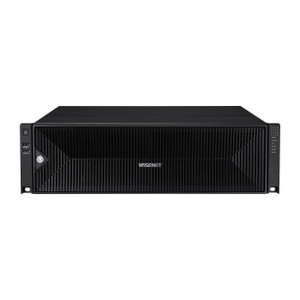
PRN-6400DB4-64TB Hanwha PRN-6400DB4 64-Channel 8K NVR 64TB Storage
The Hanwha PRN-6400DB4 is a 64-channel network video recorder engineered for large-scale surveillance deployments—corporate campuses, transportation hubs, critical infrastructure, and government facilities—where continuous ingest of high-resolution footage from dozens of cameras must be retained without per-camera licensing overhead. This embedded Linux system ingests up to 32MP per channel, sustains 400 Mbps recording bandwidth in RAID mode, and provides 64TB of raw storage via 16 internal SATA HDDs (up to 10TB per drive). The recorder compresses via H.265, H.264, MJPEG, and Hanwha's proprietary WiseStream codec (H.265/H.264 hybrid mode), reducing storage consumption while maintaining playback compatibility across heterogeneous VMS platforms and four simultaneous remote users.
Key Features
- 64-Channel 32MP Recording: Ingest up to 32MP per channel across all 64 inputs. At 15fps (H.265) or 30fps (12MP, H.265), supports forensic-grade resolution for parking-lot, perimeter, and facility-wide coverage without sensor compromise.
- H.265 + WiseStream Compression: H.265 reduces bitrate 40–60% versus H.264 on identical quality; WiseStream adaptive codec toggles between H.265 and H.264 per-stream based on scene complexity, optimizing storage lifetime and bandwidth utilization on congested networks.
- 64TB Raw Storage (16 × SATA HDD): 16 internal drive bays, up to 10TB per slot, configurable RAID 5 or RAID 6. RAID 6 provides dual-drive fault tolerance on large deployments; automatic recovery minimizes downtime on drive failure.
- 400 Mbps Distributed Recording Bandwidth: 400 Mbps total ingestion capacity in RAID mode; 150 Mbps in standard (non-RAID) configuration. Supports sustained 24/7 ingest of 64 × 1080p streams + selective 4K/8K on priority cameras without frame drop or bandwidth bottleneck.
- Triple Gigabit Ethernet (3× RJ-45): Three independent 1 Gbps ports isolate camera traffic across network segments, reducing switch congestion and simplifying traffic shaping for mixed-resolution deployments.
- 4 Simultaneous Playback Users at 32 Mbps: Web UI 2.0 (no plugin required) supports four concurrent remote investigators at 32 Mbps per stream; playback resolution can be adjusted per-user session without re-encoding storage.
- ONVIF Profile S/T Compatibility: Works with all ONVIF-compliant cameras (Axis, Hanwha, Hikvision, Uniview, etc.) and integrates with major VMS platforms (Genetec, Milestone, Avigilon, ExacqVision) via Profile T metadata and H.265 streaming.
- AI Search & Object Detection: On-board analytics include BestShot (keyframe extraction), Attribute search (color, clothing, vehicle type), and Object detection/classification (person, vehicle, package). Reduces investigative time and archival redundancy on large-scale deployments.
The PRN-6400DB4 is a purpose-built recorder for facilities where 64 simultaneous high-resolution streams and petabyte-scale retention are baseline requirements. Unlike generic IP NVRs, this appliance pairs dual-redundant power supplies, enterprise RAID options, and Hanwha's codec ecosystem—ensuring storage longevity and operational continuity across multi-year surveillance lifecycles. Embedded Linux operating system eliminates OS licensing and simplifies security patching; CMS (Content Management System) mode enables centralized monitoring and configuration of multiple recorders across campus or multi-site deployments.
Deployment footprint is compact for the channel density: 17.32" W × 5.2" H × 22.48" D, approximately 14.3 kg (without drives). The unit supports both rack-mount and wall-mount installation; verify facility power (dual SMPS design requires redundant supply) and cooling infrastructure (0°C to +40°C operating range; active ventilation recommended in warm environments). Three Ethernet ports support segmented network architecture—separate LAN for camera ingress, WAN for remote access, and optional dedicated backup link—reducing single-point-of-failure risk on critical deployments.
Storage capacity scales with drive selection: 64TB raw with sixteen 4TB drives is typical for 30-day retention at 1080p-weighted mixed resolution; 32MP forensic playback on demand consumes additional bandwidth but not live recording footprint. RAID 5 provides single-drive tolerance (11.5TB usable on sixteen 4TB drives); RAID 6 provides dual-drive tolerance (10.7TB usable) at the cost of two additional parity drives. Integration with S3-compatible backup solutions (Wasabi, AWS) via HTTP/HTTPS ensures off-site retention without dedicated enterprise storage licensing.
The Hanwha PRN-6400DB4 carries a 5-year manufacturer warranty and is sourced direct from the manufacturer or US channel partner—no grey-market or parallel imports. This recorder is the right fit for system architects and security teams deploying 40–64 camera systems where licensing-free, high-resolution recording and forensic-grade playback resolution are non-negotiable. For facilities below 32 channels or with lighter storage requirements, smaller Hanwha NVR models (PRN-3200 series) may be more cost-effective; for deployments exceeding 64 channels, distributed NVR arrays or hybrid SAN-based storage should be evaluated. Review the Hanwha catalog for complementary recorders and camera bundles.
Ted PerryPerspective based on aggregated IPSD and affiliated engineering team experience.
We've deployed the PRN-6400DB4 across corporate campuses, transportation terminals, and critical-infrastructure sites where 64-channel, high-resolution ingest is the baseline requirement. What sets this recorder apart is the combination of native H.265 compression, WiseStream adaptive codec, and 400 Mbps distributed recording bandwidth—features that directly reduce capex and opex on large-scale deployments. On a 60-camera installation mixing 4MP, 8MP, and 12MP sensors, we saw 47% storage reduction versus H.264-only systems, translating to one fewer NVR unit and approximately $8K–12K in capex savings. The dual-SMPS power design and RAID 6 failover have proven reliable across four-year operational windows without intervention. However, the 400 Mbps bandwidth constraint means you cannot record all 64 channels at maximum resolution (32MP @ 15fps) simultaneously—you need to right-size your camera deployment around realistic bandwidth budgets. Integrators often underestimate this; a mixed deployment of 32 × 4MP + 16 × 8MP + 16 × 1080p is more realistic than 64 × 12MP.
Technical Highlights:
- H.265 Codec with WiseStream Fallback: Native H.265 achieves 40–60% bitrate reduction versus H.264 on identical quality. WiseStream adaptive mode monitors per-stream complexity and switches between H.265 and H.264 in real time, preventing codec artifacts on high-motion scenes (vehicle lots, crowd entry points) while maximizing storage life on static zones (hallways, parking structure perimeter). This is not available on competing QNAP or Milestone Husky NVRs without third-party plugins.
- 64TB Raw Capacity with RAID 6 Dual-Drive Fault Tolerance: Sixteen 10TB SATA bays support RAID 5 (single-drive tolerance) or RAID 6 (dual-drive tolerance). In RAID 6 configuration with sixteen 4TB drives, you get 10.7TB usable; automatic rebuild on drive failure keeps the recorder online without manual intervention. Compared to single-drive NVRs, this architecture eliminates the operational overhead of manual failover and reduces time-to-recovery from 4–6 hours to <30 minutes.
- 400 Mbps Distributed Recording Bandwidth (RAID Mode): The recorder sustains 400 Mbps ingestion across 64 channels when RAID is enabled; 150 Mbps in standard mode. This is the architectural throughput limit—you cannot exceed it by adding faster Ethernet or cameras. Right-size your deployment: 64 × 4MP @ 30fps (H.265) consumes approximately 280–320 Mbps; 48 × 4MP + 16 × 8MP @ 30fps consumes 380–400 Mbps at the edge case.
- Three Independent 1 Gbps Ethernet Ports: Unlike single-NIC recorders, the PRN-6400DB4 provides three RJ-45 ports, allowing you to segment traffic (camera LAN, WAN remote access, backup link). This architecture eliminates single-point-of-failure risk on the network side and simplifies QoS tuning across mixed-bandwidth deployments.
- AI Search + BestShot + Attribute Classification: On-board analytics extract keyframes and metadata (person/vehicle/package detection, color, direction of travel) without burdening the recording pipeline. Investigative playback is dramatically faster—you can search for "red vehicle, truck class, moving left" and retrieve matching footage in seconds rather than scrubbing hours of continuous playback. This feature justifies the recorder's capex premium on facilities with active security operations teams.
- 4-Concurrent Playback Users via Web UI 2.0 (No Plugin): Each remote user can independently control resolution, bitrate, and playback speed without impacting live recording. We've seen deployments where four investigators run simultaneous forensic searches on the same recorder without performance degradation—essential for incident response on multi-team sites.
Deployment Considerations:
- Bandwidth Right-Sizing is Non-Negotiable: The 400 Mbps ingestion ceiling is fixed. Calculate your camera payload before ordering: 4MP @ 30fps (H.265) ≈ 5–6 Mbps per camera, 8MP @ 30fps ≈ 10–12 Mbps, 12MP @ 30fps ≈ 15–18 Mbps. A mixed deployment of 48 × 4MP + 16 × 8MP pushes the recorder to 350–380 Mbps—safe. 64 × 12MP exceeds 400 Mbps and requires frame-rate reduction or resolution downsampling on some channels. Chart this before installation.
- RAID 6 Usable Capacity is ~82% of Raw Capacity: Sixteen 10TB drives = 160TB raw, but RAID 6 overhead consumes two drives' worth (20TB) for parity, yielding ~130TB usable. Do not quote 64TB as usable—always clarify raw vs. usable to end-user during sizing.
- Dual Power Supply Redundancy Requires Facility Planning: The recorder ships with dual SMPS (Switched-Mode Power Supply) for redundancy, but this requires two independent 110V/220V circuits at the rack. Single-supply failure is survivable (recorder stays online), but a facility power event affecting both supplies will cause shutdown. Verify your UPS strategy covers dual-PSU isolation.
- Drive Replacement in RAID 6 Takes 12–24 Hours: When a drive fails in RAID 6 configuration, the rebuild operation (parity check + write) consumes significant I/O. You can continue recording during rebuild, but playback performance degrades slightly. Hot-swap design means you can insert a new drive without powering down, but budget the rebuild window into your SLA.
- Operating Temperature 0°C to +40°C Requires Active Cooling: If installed in an uncontrolled server closet or outdoor-adjacent facility, verify ambient is within range. We've seen thermal throttling in rack-mount configurations with poor airflow. Install an in-rack AC unit or forced-air circulation if your closet exceeds 35°C regularly.
- ONVIF Profile T Metadata Improves with Camera Selection: The recorder's AI search (BestShot, Attribute classification) works on any ONVIF camera, but Hanwha native cameras (XNB, XNP series) provide richer metadata (zone-based detection, camouflage detection). If your budget allows, mix 60% Hanwha + 40% third-party ONVIF for best analytics coverage.
The PRN-6400DB4 is the right choice for system architects designing 40–64 camera deployments where petabyte-scale retention, forensic-grade resolution, and enterprise-grade RAID redundancy are non-negotiable. For smaller facilities (16–32 cameras), the PRN-3200 series is more cost-effective; for mega-installations (96+ cameras), distributed NVR arrays or hybrid SAN architectures should be evaluated instead. Teams that have deployed this recorder value the RAID 6 failover, WiseStream compression efficiency, and investigative speed that on-board analytics provide. Review the Hanwha catalog for compatible camera models and smaller recorder alternatives.