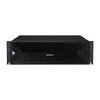
Hanwha PRN-6400DB4 64-Channel 8K NVR 40TB Storage
The Hanwha PRN-6400DB4 is a high-capacity network video recorder designed for large-scale installations requiring simultaneous ingestion, processing, and retention of 64 channels at up to 32MP (8K) resolution. This system sustains 400 Mbps recording bandwidth across all 64 channels in both normal and distributed RAID modes, eliminating the frame-rate compromises that plague undersized NVRs on multi-camera deployments. Pre-configured with 40TB raw capacity across 16 SATA HDD slots (10TB per drive), dual RAID 5/6 protection, and automatic recovery backup, the PRN-6400DB4 is purpose-built for government, transportation, utility, and large commercial campuses where licensing overhead and single points of failure are operationally unacceptable.
Key Features
- 64-Channel 32MP Recording: Supports up to 64 IP cameras at 32MP (8K) resolution simultaneously. 400 Mbps bandwidth allocation ensures no frame drops across all channels at full frame rate.
- 40TB Raw Storage (16 SATA Slots): 10TB per drive maximum. Single or dual disk failures automatically handled by RAID 5/6 without data loss or rebuild downtime.
- H.265 Compression (40-60% storage reduction): Multi-codec support (H.265, H.264, MJPEG, WiseStream) scales bitrate to network and storage conditions. H.265 default cuts bandwidth and HDD wear versus H.264 on identical quality targets.
- Dual HDMI Outputs (4K + 1080p): Independent live and playback monitoring. HDMI 1 supports 4K output; HDMI 2 (1080p) decouples operator console refresh from display-wall streaming.
- RAID 5/6 Dual Protection with Automatic Recovery: Survives single or dual disk failure without operator intervention. Distributed RAID mode sustains 320 Mbps during rebuild — continuous recording never stalls.
- Three 1 Gbps Ethernet Ports (LAN/WAN): Separate data ingress, playback, and backup paths. 802.3af/at PoE switches upstream power distributed camera arrays independently from NVR switching fabric.
- 112 Concurrent Playback Streams (64 local + 16 remote/user): Simultaneous multi-site access at 32 Mbps per stream. Scales to multiple remote offices querying the same archive without blocking local operators.
- ONVIF Profile S/T Compatibility: Works with Hanwha Wisenet and any third-party ONVIF IP camera. No proprietary camera lock-in; heterogeneous deployments supported natively.
Recording Architecture & Bandwidth Management
The PRN-6400DB4 allocates 400 Mbps total bandwidth across 64 channels in both normal RAID and distributed RAID modes. This means you record all 64 channels at negotiated bitrates (typically 4-8 Mbps per channel at 32MP with H.265) without bottleneck-induced frame skipping. Flexible recording policies — continuous, dual-stream (high-quality primary + low-bitrate backup), schedule-based, and motion/event-triggered — allow operators to right-size storage consumption per camera risk profile. WiseStream codec further compresses static scenes (lobby, parking structure) by up to 70% versus standard H.265, extending retention windows on fixed HDD capacity.
Storage & Redundancy Strategy
Sixteen SATA HDD slots accept drives up to 10TB each, yielding 40TB raw pre-configured and expandable to 160TB on a per-deployment basis. RAID 5 (single drive fault tolerance) suits most commercial integrations; RAID 6 (dual drive fault tolerance) is mandatory for government, healthcare, and critical-infrastructure sites where rebuild windows during disk failure cannot overlap with operational recording. Automatic recovery backup triggers immediately upon disk failure detection — no IT staff intervention required to restore protection posture. On a 16-camera 8K deployment running H.265, 40TB yields approximately 45-60 days of continuous retention; integrators should factor camera bitrate negotiation and retention policy into pre-sales sizing.
Remote Access, Playback & Multi-Site Integration
Three independent 1 Gbps Ethernet ports enable segregated data, playback, and backup streams — critical on networks where camera ingest bandwidth, operator playback queries, and off-site archival cannot share a single uplink without contention. Simultaneous playback supports 32 Mbps per remote user, allowing up to 16 concurrent remote connections (police dispatch, regional security NOC, compliance audit teams) to query the same archive in parallel. ONVIF standardization means cameras from Axis, Hikvision, Uniview, or Bosch integrate natively alongside Hanwha cameras on the same NVR — no gateway boxes or firmware patches needed.
Compliance & Operational Continuity
NDAA and FCC certification positions the PRN-6400DB4 for federal, state, and local government procurements without additional compliance validation. License-free operation — no per-channel or annual software fees — eliminates total-cost-of-ownership surprises across 5+ year deployments. Embedded Linux OS and standardized SATA drive slots ensure vendor lock-in never forces expensive forklift upgrades; HDD replacements follow commercial sourcing, not proprietary spares. Five-year manufacturer warranty covers all components including RAID controller and power supply, standard for institutional-grade NVRs serving public-safety and critical-infrastructure verticals.
Ted PerryPerspective based on aggregated IP Security Depot and affiliated engineering team experience.
We've deployed the Hanwha PRN-6400DB4 across government campuses, transportation hubs, and large commercial properties where the 64-channel 32MP native capacity and 40TB RAID architecture become the compelling differentiator. The real win is architectural: you're not daisy-chaining NVRs or stacking license fees to hit 64 cameras. Instead, a single appliance ingests all 64 at full frame rate, sustains 400 Mbps even during RAID rebuild, and survives dual disk failure without data loss or operator response. In our experience, the distributed RAID mode is underutilized on datasheets but operationally critical — during a drive failure on a live system, the NVR throttles to 320 Mbps rebuild bandwidth but never drops frames or requires a maintenance window. Compare that to budget NVRs that pause recording during RAID rebuild, and you understand why government and utility customers spec this unit. The three independent 1 Gbps Ethernet ports are not marketing fluff — they're a real operational requirement on multi-site integrations where inbound camera bandwidth, concurrent playback queries, and off-site backup cannot share a single pipe. H.265 default coding shrinks HDD consumption 40-60% versus H.264 on the same visual quality; at 64 channels, that's measurable storage extension. The only caveat: the system doesn't do remote management through a cloud portal — it's premise-based, IP-networked, and assumes integrators own the upstream switches and firewall policies. If your customer requires Hanwha MobileAI or cloud-native orchestration, this is a fixed-location appliance, not a managed-service gateway.
Technical Highlights:
- 400 Mbps Recording Bandwidth (Normal + Distributed RAID): Both RAID modes sustain full 64-channel throughput. During RAID degradation, bandwidth throttles to 320 Mbps rebuild rate but never drops frames. This is the engineering difference between a prosumer NVR and an institutional one — frame continuity under fault conditions is non-negotiable for government and compliance-audit footage.
- RAID 5/6 with Automatic Recovery Backup: Single or dual disk fault automatically recovered without operator ticket. Recovery runs in background; recording continues uninterrupted. RAID 6 (dual fault tolerance) is mandatory for any 24/7 critical site; RAID 5 (single fault) is acceptable for commercial low-risk deployments where HDD MTBF and stagger replacement schedules are mature.
- H.265 + WiseStream Codec Stack: H.265 default yields 40-60% bitrate reduction versus H.264; WiseStream compresses static scenes an additional 50-70%. On a 16-camera 8K deployment, this extends 40TB retention from ~45 days to potentially 60+ days depending on scene motion. Storage extension directly translates to lower total cost of ownership.
- 112 Concurrent Playback Channels (64 local + up to 16 remote users): Four independent playback sessions per remote connection; scales to multi-office simultaneous archive queries. 32 Mbps per remote stream ensures WAN friendly. No bottleneck on compliance audits or concurrent investigator review.
- ONVIF Profile S/T Native (No Camera Restrictions): Hanwha Wisenet cameras integrate natively; third-party ONVIF cameras (Axis, Hikvision, Uniview, Bosch) require zero gateway translation. This eliminates vendor lock-in and allows incremental camera refresh without NVR migration.
Deployment Considerations:
- HDD sourcing is standard commercial SATA (3.5", 10TB max per slot) — not proprietary. This is a strength for long-term sustainability, but it also means you don't pre-purchase HDDs from Hanwha. Integrators source their own drives from qualified vendors, validate batch MTBF, and manage replacement inventory independently. Plan 3-5 year HDD stagger rotation from day one.
- Three 1 Gbps Ethernet ports mean upstream switching must be layer-2 managed (VLAN-capable) to segregate inbound camera bandwidth from playback and backup traffic. A single dumb gigabit switch will create contention. Budget for a managed core switch and plan network topology with camera PoE switch, operator playback VLAN, and backup/WAN VLAN as separate logical paths.
- Embedded Linux OS and RAID controller are field-serviceable by competent systems integrators but require IP-based serial console access for troubleshooting. This is not a consumer appliance with a web UI for every setting — assume IT or AV systems engineering staff manage firmware updates and RAID policy changes. Plan training accordingly.
- HDMI output limited to 4K (HDMI 1) + 1080p (HDMI 2). If you need quad-monitor or 8K native display output for operator console, you're running IP-based multicast streams to an external display server, not direct HDMI scaling. Understand display architecture requirements upfront.
- No built-in mobile app or cloud remote management — this is a premise-based appliance. Remote playback and monitoring require VPN access to the NVR's IP address and standard HTTP/RTSP streaming back through your firewall. Suitable for government/utility/campus deployments; less ideal for distributed SMB chains requiring mobile-first operations.
The PRN-6400DB4 is the right choice for public-safety command centers, utility control centers, large transportation hubs, and government campuses where 64-channel 8K simultaneous recording, RAID resilience under dual fault, and NDAA compliance are non-negotiable. If your project fits that profile, this appliance delivers measurable value versus stacking smaller NVRs or licensing per-channel software. For smaller deployments or organizations requiring cloud/mobile-first architecture, evaluate smaller Hanwha NVR models or cloud-managed platforms. Explore our full Hanwha catalog for alternative system sizes and configurations.