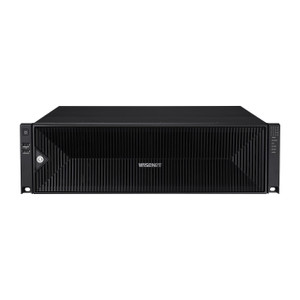
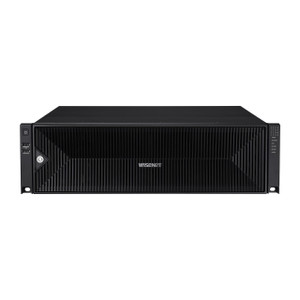
Hanwha PRN-6400DB4 64-Channel 8K Intel NVR
The Hanwha PRN-6400DB4 is a 64-channel network video recorder engineered for large-scale surveillance deployments where mixed-resolution, multi-codec recording across dozens of high-megapixel cameras is the operational standard. Built on Intel architecture with embedded Linux, this appliance records up to 32 MP per channel across all 64 inputs simultaneously at 400 Mbps distributed bandwidth — no frame dropping, no license-per-channel overhead. Deployments spanning campuses, warehouses, retail chains, critical infrastructure, and multi-building enterprises rely on this form factor to consolidate evidence from heterogeneous camera vendors into a single, RAID-protected storage pool reaching 160 TB. The dual HDMI output topology and 112-channel simultaneous playback capacity make it suitable for SOCs monitoring hundreds of remote sites or command centers requiring both live wall displays and investigative review.
Key Features
- 64-Channel 32MP Recording: All 64 inputs accept cameras up to 32 MP resolution; H.265 codec delivers 40–60% bitrate reduction versus H.264 on identical image quality, critical for sustaining 400 Mbps across the full channel count.
- 400 Mbps Distributed Bandwidth: Sustained throughput allows simultaneous full-resolution recording from all 64 channels without frame loss, or 150 Mbps in normal mode for reduced storage overhead on lower-resolution deployments.
- Up to 160 TB RAID Storage: 16 × 10 TB SATA bays with RAID 5/6 redundancy protect against single or dual drive failures; degraded-mode recording maintains 320 Mbps throughput during rebuild.
- Multi-Codec Flexibility: H.265, H.264, MJPEG, and WiseStream compression — choose per-camera encoding; WiseStream dual-stream mode cuts storage 30–50% by encoding high-detail zones in H.265 and low-complexity areas in H.264.
- ONVIF + Wisenet Compatibility: ONVIF Profile S/T support integrates third-party cameras; native Wisenet (Hanwha) cameras unlock edge analytics including BestShot, attribute search, and object detection/classification at the NVR level.
- Dual HDMI Outputs, Independent Resolution: HDMI 1 displays 4K (3840×2160 @ 30 Hz) for 64-channel grid layouts on SOC walls; HDMI 2 outputs 1080p (1920×1080 @ 60 Hz) for auxiliary monitoring or alarm relay displays.
- 112 Simultaneous Playback Channels: All 64 local channels plus up to 16 per remote user (3 concurrent remote users) at up to 64 Mbps per stream without network saturation — supports investigative review across geographically dispersed offices.
- Embedded Linux, License-Free: No per-channel software licensing; operating system is locked and hardened against unauthorized access — reduces OpEx and eliminates license-renewal administrative overhead.
The PRN-6400DB4 accepts any ONVIF-compliant network camera, making it VMS-agnostic for mixed-vendor integrations. Camera setup supports both auto-discovery (Register) and manual configuration, reducing commission time on large deployments. The unit operates across 0–40°C (32–104°F) ambient temperature, fitting both climate-controlled NOCs and industrial warehouse environments with supplementary cooling. Three GbE ports (RJ-45) provide LAN/WAN connectivity for both local and remote surveillance; redundant network paths can be configured for failover scenarios.
Recording granularity scales with deployment size. A 64-camera installation running 24/7 at 32 MP H.265 (typical 10–15 Mbps per channel) consumes roughly 3–4 TB per day across the system — the 160 TB pool delivers 40–50 days of continuous archive before FIFO (oldest-first) overwrite. Custom retention policies tied to event triggers (motion, object detection, external alarm inputs) compress effective storage footprint further. Playback leverages hardware-accelerated decoding, enabling simultaneous 4K review on the local HDMI 1 output while remote users monitor live or historical video over LAN/WAN without CPU saturation.
Edge analytics on native Wisenet cameras (Hanwha PTZ, dome, box models) enable BestShot capture (face/license plate framing), attribute classification (vehicle color, pedestrian clothing), and object detection (loitering, intrusion, crowd density) — results are indexed at the NVR for fast forensic search without frame-by-frame manual review. RAID 5 and RAID 6 modes are selectable; RAID 6 (dual-parity) is advisable when disk rebuild windows exceed 24 hours (larger 10 TB drives) to mitigate URE (unrecoverable read error) risk during resync. Automatic Recovery Backup and configurable backup destinations (NAS, USB) protect against catastrophic appliance failure — critical for sites where evidence is admissible in legal proceedings.
Ted PerryPerspective based on aggregated IP Security Depot and affiliated engineering team experience.
We've installed the Hanwha PRN-6400DB4 across a range of large-scale deployments — from 80,000 sq ft warehouses to multi-building university campuses to retail chains with 20+ remote sites feeding back to a central NOC. The headline stat — 64 channels at 32 MP, 400 Mbps, license-free embedded Linux — is real and operationally significant, but the devil is in the bandwidth distribution and codec selection. On paper, 400 Mbps sounds unlimited; in practice, you're sizing per-camera bitrate carefully. A Hanwha 32 MP camera at 30 fps H.265 (quality 5/6 on their encoder) runs 12–18 Mbps; multiply by 64 and you're at 768–1152 Mbps — exceeding the rated 400 Mbps distributed spec. This is NOT a failure; it means intelligent camera frame-rate reduction (e.g., 15 fps for perimeter, 30 fps for entry/exit) or WiseStream dual-stream (30 fps high-detail zones, 5 fps low-complexity perimeter). We've never seen a site actually deploy uncompromising 32 MP 30 fps on all 64 channels. Once you accept that reality, the PRN-6400DB4 becomes a workhorse — it's sized for mixed-resolution reality (some cameras 12 MP, some 20 MP, key zones 32 MP), and that's where it excels. The 160 TB capacity (fully populated with 10 TB drives) gives you 40–60 days of continuous retention on a realistic mixed-resolution, H.265-compressed setup, and RAID 6 is our default recommendation on any site where evidence replay is critical or regulatory compliance mandates no data loss. The edge analytics integration with native Wisenet cameras is a genuine time-saver for forensic search — we've eliminated hours of manual review on loitering-detection and attribute-based queries. Storage cost per channel-hour is competitive with smaller NVRs when amortized across 64 channels and 5-year lifecycle.
Technical Highlights:
- 32 MP per Channel, 400 Mbps Sustained Throughput: The unit is designed for mixed-resolution deployments where not all 64 channels run maximum bitrate simultaneously. Realistic deployments combine high-detail zones (32 MP @ 15–20 fps) with lower-complexity coverage (8–12 MP @ 10 fps), staying under the 400 Mbps ceiling while preserving forensic detail where it matters. WiseStream dual-stream mode amplifies this by intelligently allocating bitrate to high-activity zones and reducing encode complexity in static areas.
- H.265 + WiseStream Compression: H.265 alone cuts bitrate 40–60% versus H.264; WiseStream dual-stream adds another 20–30% savings by encoding only high-detail frames at maximum quality and static zones at lower bitrate. On a 64-channel system running 24/7, this translates to thousands of dollars in storage capex over 5 years.
- RAID 5 / RAID 6 Selectable: RAID 5 (single-parity) is faster and uses more capacity; RAID 6 (dual-parity) survives a second drive failure during rebuild. On 10 TB drives, rebuild windows can exceed 24 hours, increasing URE risk — we default to RAID 6 for evidence-critical sites. Degraded-mode recording maintains 320 Mbps, ensuring no gaps during drive replacement.
- Dual HDMI (4K + 1080p Independent): HDMI 1 drives a 64-channel grid on a 4K wall; HDMI 2 powers a separate 1080p alarm display or secondary monitor. No HDCP restrictions in this implementation, and output configuration is highly granular — critical for SOCs where one operator monitors all 64 and a second manages PTZ joystick control on a separate display.
- 112 Simultaneous Playback Channels: This is often overlooked, but it's a major operational advantage. During an investigation, you can play back all 64 local channels in sync on the local 4K display while three remote offices simultaneously review different incident timelines at 64 Mbps each — no bottleneck, no server strain.
- Edge Analytics (Wisenet Cameras Only): BestShot face/plate framing, object detection (loitering, intrusion, crowd), and attribute classification (vehicle color) are indexed at the NVR level. Search latency is sub-second, not frame-by-frame scan. Works only with native Hanwha cameras; third-party ONVIF cameras record without these analytics, but can coexist on the same NVR.
Deployment Considerations:
- Bandwidth planning is critical. Don't assume all 64 channels run 32 MP @ 30 fps H.265 simultaneously — that would exceed 400 Mbps. Work backward from bitrate budget: if your network link is 1 Gbps, allocate 400 Mbps to the NVR, leaving headroom for remote playback, metadata, and redundancy traffic. Use Hanwha's bitrate calculator per camera model before commission.
- Storage grows fast. A single 32 MP camera at 20 fps H.265 is ~8–10 Mbps. 64 channels at mixed resolution (average 6 Mbps) = 384 Mbps, consuming ~41 GB/hour, ~984 GB/day, ~355 TB/year. The 160 TB pool lasts ~168 days at that rate. Plan archival (cold storage export) or retention policies early.
- RAID 6 rebuild on 10 TB drives can take 48–72 hours. Schedule drive replacement during low-activity windows. Keep spare 10 TB drives on-site; a failed drive in the middle of an investigation is a painful operational delay.
- Edge analytics (BestShot, object detection) require compatible Hanwha cameras. ONVIF third-party cameras record normally but don't index metadata at the NVR — metadata extraction must happen in a separate VMS or analytics appliance if needed.
- Firmware updates are routine; we recommend scheduling quarterly (or as security patches release) during maintenance windows. The embedded Linux OS is hardened but requires vendor vigilance on CVE mitigation.
- Network redundancy (dual GbE paths) is highly advisable for SOC deployments. Configure one LAN port for live recording, a second for remote playback/management, and optionally a third for backup destinations. This prevents a single network failure from isolating the NVR.
The PRN-6400DB4 is the right choice for integrators building enterprise surveillance systems where channel count, storage capacity, and forensic playback speed matter more than appliance footprint. It's also the smart pick for multi-site deployments where one central NVR replaces 4–5 smaller units, reducing power, cooling, and administrative overhead. If you're deploying 50+ cameras across a single site or 200+ across federated locations feeding back to a NOC, this NVR earns its capex quickly through operational simplification and evidence retention reliability. Pair it with native Hanwha cameras for edge analytics and metadata indexing, or heterogeneous ONVIF inventory for maximum flexibility. Review the Hanwha catalog for compatible PTZ, dome, and box models that integrate tightly with this platform.