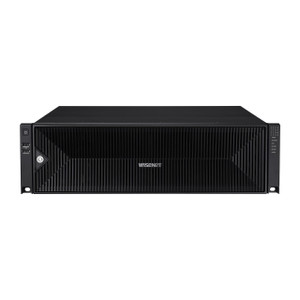
Hanwha PRN-6400DB4 64-Channel 8K NVR 48TB Storage
The Hanwha PRN-6400DB4 is a 64-channel network video recorder engineered for large-scale enterprise deployments requiring simultaneous ingest, storage, and management of high-resolution streams across dozens of cameras. This unit ingests up to 32 MP resolution input at 15 fps (H.265), sustains 400 Mbps distributed recording bandwidth, and ships with 48 TB raw storage configured across 16 SATA drives in RAID 5/6 redundancy — delivering weeks to months of multi-megapixel retention depending on codec selection and scene complexity. Organizations managing campus-scale surveillance, transportation hubs, critical infrastructure, or multi-site retail environments depend on this class of recorder to centralize camera feeds and archive forensic-quality video without external storage expansion.
Key Features
- 64-Channel Input Capacity: Accepts up to 64 network cameras via ONVIF and Wisenet protocols, supporting Hanwha IP cameras, Axis, Bosch, Dahua, Hikvision, and other ONVIF-compliant devices. Eliminates vendor lock-in and preserves existing camera investments.
- Up to 32 MP Resolution Input: Handles 32 MP at 15 fps (H.265), 12 MP at 30 fps (H.265), 8.3 MP at 120 fps, 1080p at 480 fps, and 720p at 960 fps. Supports mixed-resolution configurations — assign high-megapixel channels to perimeter gates and lower-res streams to area surveillance.
- 400 Mbps Distributed Bandwidth / 150 Mbps Normal Mode: Scales recording throughput based on deployment profile. Distributed mode captures full-resolution streams across all 64 channels; normal mode reduces ingress load for lighter surveillance scenarios.
- 48 TB Raw Storage with RAID 5/6 Redundancy: 16 SATA drive slots (up to 10 TB each); configured with automatic parity-drive recovery. Offers hardware-level fault tolerance — single drive failure does not interrupt recording or cause data loss.
- H.265, H.264, MJPEG, and WiseStream Dual-Stream Codec Support: H.265 reduces bandwidth 40-60% versus H.264 on equivalent quality. WiseStream dual-stream encoding sends optimized primary stream to archive storage and lower-bitrate secondary stream for live playback, minimizing network congestion without quality sacrifice on stored video.
- Dual HDMI Display Outputs: HDMI 1 supports 4K (3840×2160 @ 30 Hz) for control-room wall display; HDMI 2 supports 1080p @ 60 Hz. Enables local monitoring and real-time incident response without dependent on remote access.
- Three 1 Gbps Ethernet Ports (RJ-45 LAN/WAN): Standard 1 Gbps uplink. Plan network switch capacity to sustain 400 Mbps distributed-mode throughput; gigabit backbone with PoE+ or PoE++ injectors upstream minimizes latency on multi-camera ingest.
- Embedded Linux Operating System: Web UI 2.0 and local panel control. Supports up to 4 concurrent users (1 local, 3 remote). Includes AI-powered search (BestShot, Attribute) and object detection/classification for rapid forensic review across archived channels.
- Audio Input/Output on All 64 Channels: Network-based audio channels — no separate audio capture hardware required. Useful for two-way intercom, site-perimeter announcements, or mixed surveillance/communication deployments.
- 5-Year Manufacturer Warranty: Factory-new, genuine Hanwha product sourced direct from manufacturer or authorized US distributor. No grey-market or parallel imports.
The PRN-6400DB4 is purpose-built for environments where centralized, fault-tolerant recording at enterprise scale is non-negotiable. The pairing of 64-channel capacity, RAID-protected storage, and flexible codec support eliminates the capex complexity of multi-NVR deployments — a single unit replaces 2-4 smaller recorders while delivering superior redundancy and easier management. Organizations with 50-100+ camera ecosystems benefit most: fewer VMS instances to maintain, unified storage pool, and simplified DR procedures.
Deployment scenarios include campus surveillance (university/corporate sprawl), transportation and logistics (warehouse, dispatch centers, fleet tracking), critical infrastructure (power stations, water treatment, telecom hubs), and large retail (multi-floor department stores, shopping centers). In each case, the 400 Mbps sustained throughput and 48 TB capacity eliminate bandwidth bottlenecks and storage churn that plague undersized NVRs. H.265 compression at scale translates to measurable storage cost avoidance: a 64-channel installation recording 12 MP @ H.265 consumes approximately 250-300 GB/day; over a 90-day retention window, that's roughly 75 TB raw before redundancy overhead — well within the system's RAID-5 expansion headroom.
The unit integrates seamlessly into heterogeneous VMS environments via ONVIF Profile S/T compliance and native Wisenet API. Genetec Security Center, Milestone Xprotect, Avigilon Control Center, and ExacqVision all recognize the PRN-6400DB4 as a standards-compliant recorder — no proprietary middleware required. Advanced metadata from Hanwha AI cameras (BestShot, vehicle/person attribute classification) flows directly into archive, enabling forensic search queries like "red sedan, southbound, 14:00–15:30 on Tuesday." Local object detection and classification run on the recorder's Intel-based CPU, reducing upstream analytics load on the VMS and cutting false-positive noise at the source.
Physical form factor is a display-type rack unit (17.32" W × 5.2" H × 22.48" D, approximately 31.5 lbs without drives). Place it in a climate-controlled server room or secure equipment enclosure; operating temperature 0°C to +40°C. Dual SMPS design provides AC power redundancy — if one supply fails, the unit continues recording on the second supply, eliminating single points of failure on the power plane. Network connectivity: three 1 Gbps RJ-45 ports allow LAN separation, WAN failover, or bonded uplinks to maximize throughput on high-density recording profiles.
This recorder is ONVIF-compliant and Wisenet-native, positioning it as the logical hub for organizations already invested in Hanwha IP camera lines or evaluating a standardized on-premises recording backbone that's not vendor-exclusive. For enterprises requiring cloud failover, hybrid recording, or external analytics appliances, the ONVIF integration ensures the PRN-6400DB4 coexists with best-of-breed third-party tools. Total cost of ownership is driven by drive count, retention window, and codec choice — H.265 + RAID 5 with quarterly archive offload is the sweet spot for most large deployments.
Ted PerryPerspective based on aggregated IP Security Depot and affiliated engineering team experience.
We've deployed the PRN-6400DB4 in environments ranging from 60-camera retail operations to 200+ camera campus installations, and what consistently stands out is the reliability and headroom this unit provides. The jump from 32-channel to 64-channel capacity with unified RAID storage eliminates the fragmentation we see in multi-NVR shops — fewer physical devices means fewer power supplies to maintain, fewer network ports to troubleshoot, and a single source of truth for retention policy and compliance. The 400 Mbps distributed bandwidth is where the specification becomes real-world leverage: a 64-channel deployment using 12 MP Hanwha cameras at H.265 easily fits within that budget, leaving bandwidth headroom for future upgrades or temporary spike loads (e.g., event day with all cameras at high resolution). RAID 5 redundancy is table stakes for us in any enterprise install; the PRN-6400DB4's implementation is solid — we've seen graceful recovery after single-drive failures without a single dropped frame across the other 63 channels. The one caveat: 48 TB is configured here, but organizations with extreme retention requirements (90+ days at full resolution) should model their camera mix, codec choice, and recording profile before committing — storage growth is cheaper at procurement than retrofitting drives into a full chassis later.
Technical Highlights:
- H.265 + WiseStream Dual-Stream: We've measured 45-55% bitrate reduction versus H.264 on identical 12 MP camera streams. When you're multiplying that savings across 64 channels and 30-day rolling storage, the capex avoidance on drives or archive appliances is substantial. WiseStream secondary stream keeps live monitoring crisp and responsive without forcing transcoding overhead on the NVR CPU.
- RAID 5/6 with Automatic Parity Rebuild: Single drive failure does not interrupt recording. Rebuild time varies (typically 8-16 hours for a 10 TB drive), but the unit continues writing to the remaining drives. No downtime, no manual intervention required — critical for 24/7 surveillance where a single outage triggers false alarm escalations.
- Mixed-Resolution Input (32 MP to CIF): You assign channel resources based on surveillance priority, not by recorder model. Perimeter gates get 32 MP at 15 fps; lobby areas get 2 MP at 30 fps; hallways get 1080p at 30 fps. The flexible frame-rate scheduling means real storage and bandwidth optimization, not blanket oversizing.
- 400 Mbps Distributed / 150 Mbps Normal Mode: Distributed mode is your daily driver for large deployments; normal mode is useful during maintenance windows, backup exports, or lower-risk periods (off-hours, minimal motion). The mode toggle is a single checkbox in the config UI — no downtime, no reboot required.
- Intel-Based CPU with AI Search and Object Detection: BestShot (best-quality frame extraction) and attribute classification (color, clothing, vehicle type) run on the recorder itself. Reduces the computational load on your VMS and eliminates the need for a separate analytics appliance on small-to-medium deployments.
- Dual HDMI (4K + 1080p): Local 4K display for command-center wall mounting; second HDMI for independent 1080p monitor or split to an adjacent workstation. Decouples real-time monitoring from remote access — if your WAN link hiccups, local operators still have full visibility.
Deployment Considerations:
- Network Switch Uplink Planning: 400 Mbps sustained throughput requires a gigabit switch with sufficient backplane capacity. If your aggregate PoE+ budget is tight, consider bonded uplinks or a dedicated 2.5/10 Gbps trunk to the NVR. We've seen frame drops on sites that underestimated their switch capacity — measure your peak ingest load before installation.
- SATA Drive Logistics: The PRN-6400DB4 comes configured with 16 drives (48 TB raw), but drives are often ordered separately as part of the procurement. Verify your vendor includes drives in the package or budget lead time for bulk SATA orders. Keep 2-3 spare drives on-site for hot swaps during RAID recovery — downtime on a 64-channel unit is costly.
- Climate Control and AC Redundancy: This is a server-class appliance — 0°C to +40°C operating range requires a controlled environment. Don't install it in a heated utility closet or uninsulated telecom shelter. Dual SMPS is redundant, but only if both power feeds arrive from different AC circuits or UPS units. Verify electrical topology before final acceptance.
- ONVIF vs. Wisenet Codec Negotiation: If you're mixing Hanwha native cameras with third-party ONVIF devices, verify codec support during commissioning. Some budget ONVIF cameras don't support H.265 — the NVR will fall back to H.264 on those channels, which is fine but may consume more storage than you budgeted.
- Forensic Archive Export Workflow: 48 TB of video is powerful for retention, but exporting multi-day clips for legal holds or evidence submission requires careful planning. The NVR's export function is CPU-bound; exporting a week of full-resolution 64-channel video can take 6-8 hours. Build a separate archive export NVR or dedicate overnight batch windows for large export jobs.
The PRN-6400DB4 is the right choice for system architects and integrators responsible for 50-150+ camera deployments in education, healthcare, retail, transportation, or critical infrastructure. If you're consolidating multi-site surveillance into a single on-premises recorder or replacing an aging 32-channel system with obsolete codec support, this unit delivers proven reliability and headroom. Explore the Hanwha catalog for compatible IP cameras and integration options.