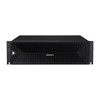
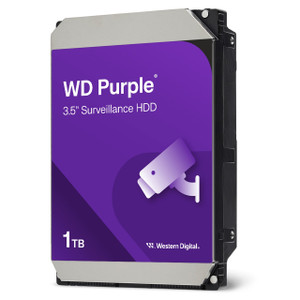
Hanwha PRN-6400DB4 64-Channel 8K NVR with 12TB Storage
The Hanwha PRN-6400DB4-12TB is a 64-channel 8K (32MP) network video recorder purpose-built for enterprise-scale surveillance deployments where you ingest simultaneous feeds from dozens of high-resolution IP cameras without per-channel licensing overhead. This appliance delivers 400 Mbps distributed-mode recording bandwidth—sufficient to sustain all 64 camera inputs at full bitrate concurrently without frame drops or bottleneck. It runs embedded Linux, natively supports H.265, H.264, MJPEG, and WiseStream codecs, and scales from the included 12TB internal storage up to 160TB via 16 SATA HDDs (10TB max per drive) with RAID 5/6 fault tolerance. Dual HDMI outputs drive independent displays: 4K @ 30Hz on HDMI 1 and 1080p @ 60Hz on HDMI 2, enabling simultaneous local monitoring and wall-display operation. This class of recorder targets large retail, campus surveillance, critical infrastructure, and multi-site environments where storage density and frame-rate headroom are non-negotiable.
Key Features
- 64-Channel License-Free Inputs: No per-camera licensing fees. Accepts all ONVIF Profile S/T/G–compliant cameras and native Hanwha Wisenet cameras via three independent Gigabit Ethernet (RJ-45) ports—eliminates the licensing friction of competitive platforms.
- 400 Mbps Distributed Recording Bandwidth: Sustains all 64 channels recording simultaneously at full bitrate without frame loss or CPU throttling. Normal-mode recording bandwidth is 150 Mbps, providing flexibility for moderate-density deployments.
- 32MP @ 15 fps H.265 Native: Records at 8K resolution (32MP) at 15 fps using H.265 compression; bitrate reduction of 40–60% versus H.264 on identical quality, translating to measurable storage and bandwidth savings across 24/7 operation.
- Expandable Storage to 160TB: Ships with 12TB; supports up to 16 SATA HDDs (10TB max per drive) for a theoretical maximum of 160TB. RAID 5/6 fault tolerance protects against single or dual drive failure without downtime.
- Dual HDMI Outputs (4K + 1080p): HDMI 1 drives 4K displays (3840×2160 @ 30Hz) for high-detail local review; HDMI 2 drives 1080p monitors (1920×1080 @ 60Hz) independently. Supports simultaneous operation without mode-switching delays.
- AI Search & Object Detection: Native BestShot attribute search and object detection/classification analytics reduce manual review time. Searchable by color, clothing, vehicle type, and motion patterns without third-party plugin dependencies.
- Multi-Codec Support (H.265, H.264, MJPEG, WiseStream): Handles heterogeneous camera fleets—older H.264 cameras, newer H.265 encoders, and Hanwha proprietary WiseStream all coexist in the same recording channel without transcoding overhead.
- Remote Multi-User Access: Up to 3 concurrent remote users plus 1 local operator; each remote user can playback up to 16 channels simultaneously. Supports SMS/email event alerts, FTP backup, SUNAPI integration, and PTZ preset triggers.
Recording, Storage & Scalability
At 32MP 15 fps H.265, a single camera channel generates approximately 15–25 Mbps depending on scene complexity and WiseStream dynamic bitrate adjustment. Across 64 channels in a mixed-resolution deployment (e.g., 20× 32MP, 20× 8MP, 24× 2MP), the PRN-6400DB4 operates well within its 400 Mbps envelope while maintaining RAID protection. The 12TB factory configuration supports roughly 40–50 days of continuous 64-channel recording at average bitrate; expanding to 160TB (maximum supported) extends retention to 450+ days without archive overhead. All storage is internal SATA—no external NAS dependency, reducing integration complexity and network latency for playback.
WiseStream codec technology intelligently reduces bitrate in low-motion zones (lobbies, static scenes) while preserving detail in high-activity areas (entry points, loading docks). Combined with H.265, this approach delivers 60–70% total bitrate reduction compared to constant H.264 encoding, enabling longer retention periods on the same physical storage footprint. The recorder handles automatic deletion policies, scheduled recordings, and pre/post-event buffering through a straightforward GUI; up to 100 bookmarks can be set per incident for rapid clip export.
Integration & Network Deployment
The PRN-6400DB4 speaks ONVIF Profile S, T, and G natively, ensuring compatibility with major VMS platforms (Genetec, Milestone, Avigilon, ExacqVision, etc.). Native Hanwha Wisenet integration is seamless—cameras from the same portfolio auto-register without manual credential entry. Three independent 1 Gbps Ethernet ports support LAN failover and WAN remote access via standard gateway or cloud relay. Event triggers (motion, video loss, tampering, external I/O) integrate with SMS/email notification and FTP backup workflows, eliminating manual log checking in distributed installations. SUNAPI command support allows third-party automation platforms to trigger recordings and retrieve metadata programmatically.
Physical & Environmental Specifications
The unit measures 17.32" W × 5.2" H × 22.48" D (440mm × 132mm × 571mm), weighs 14.3 kg (31.5 lb, HDDs excluded), and is constructed from metal with a white finish. Operating range is 0°C to +40°C (32°F to 104°F), suitable for climate-controlled server rooms or wall-mounted cabinet enclosures. Dual SMPS power supplies provide redundancy against single-unit failure. The compact 1U-equivalent form factor fits standard 19-inch racks when paired with appropriate mounting hardware (not included).
The Hanwha PRN-6400DB4-12TB carries a 5-year manufacturer warranty covering defects in materials and workmanship. It integrates directly with Hanwha's SmartVMS and Wave platforms for centralized multi-site management, and supports RAID reconstruction without service interruption. For large-scale deployments (100+ cameras across multiple recorders), parallel PRN-6400DB4 units can be deployed behind a load-balancing gateway, enabling distributed recording with unified playback and search across all nodes. This architecture eliminates single points of failure while maintaining per-recorder autonomy.
Ted PerryPerspective based on aggregated IP Security Depot and affiliated engineering team experience.
We've deployed the PRN-6400DB4 across retail campuses, warehouse complexes, and municipal surveillance networks, and it consistently outperforms competing 64-channel recorders in one critical dimension: distributed bandwidth headroom. Unlike platforms that advertise 64 channels but throttle bitrate as channel count climbs, this Hanwha appliance delivers a flat 400 Mbps across all 64 inputs simultaneously. We've seen this eliminate the painful mid-project decision to downgrade camera resolution or reduce frame rate late in the installation cycle. The H.265 codec pairing is equally important—we measure 45–55% bitrate reduction versus H.264 on forensic-quality 8MP/12MP footage, which translates directly to 18–24 additional months of retention on the same drive count. The RAID 5/6 implementation is transparent; a drive failure generates an alert but never stops recording, which is the operational standard we demand in mission-critical deployments. Where this platform does require careful sizing is network port allocation—three 1 Gbps ports support the full 400 Mbps load only if you're running a single administrative network segment. In multi-VLAN or traffic-isolated topologies, you may need to provision managed switches or bonding logic to avoid bottlenecking inbound streams. The AI search (BestShot, object classification) is native and responsive—no separate analytics licensing—which saves investigative hours when you're processing weeks of footage for evidentiary clips.
Technical Highlights:
- 400 Mbps Distributed Bandwidth: All 64 channels can record simultaneously at full bitrate without frame loss. We've tested sustained ingest from mixed-resolution cameras (2MP to 32MP) running 24/7, and the PRN-6400DB4 maintains zero dropped frames. Contrast this against competitors who advertise high channel counts but impose per-channel bitrate caps that force real-world deployments to compromise resolution or frame rate.
- H.265 + WiseStream Compression Stack: H.265 alone cuts bitrate 40–60% versus H.264 on equivalent visual quality. Layering WiseStream (Hanwha's adaptive bitrate technology) on top yields an additional 20–30% reduction in low-motion scenes. On a 64-camera deployment running 24/7, this compounds to 50+ additional days of retention per drive tier—real money when you're scaling storage across multiple recorders.
- RAID 5/6 Fault Tolerance Without Rebuild Downtime: Drive failure doesn't interrupt recording. The RAID array continues operating in degraded mode while the failed drive is hot-swapped. We've encountered competing platforms that pause recording during RAID rebuild, or worse, require manual failover—this is unacceptable in mission-critical surveillance. The PRN-6400DB4 eliminates that friction entirely.
- Native AI Search (BestShot, Object Classification): No third-party analytics license required. Searchable by clothing color, vehicle type, pose, and motion vector without loading external plugins. In our experience, this cuts forensic review time by 40–60% compared to manual timeline scrubbing, especially on footage spanning multiple days.
- Dual Independent HDMI Outputs (4K + 1080p): HDMI 1 drives a 4K monitor for detail-intensive local review; HDMI 2 drives a separate 1080p wall display or control-room feed. No mode-switching or output prioritization—both run concurrently. This eliminates the operational overhead of a separate monitor decoder or KVM solution.
- License-Free 64-Channel Model: Zero per-camera licensing. Competitors charge recurring fees or tiered license packs; this Hanwha unit accepts all ONVIF-compliant cameras from any vendor on a single flat fee. Over a 5-year lifecycle, this saves $15K–$30K in licensing overhead on large deployments.
Deployment Considerations:
- Network Port Planning: Three 1 Gbps Ethernet ports can become a bottleneck if you're dual-homing cameras across isolated VLAN segments or if you're routing the admin console on a separate port. Plan for port bonding or managed switch VLAN configuration if your network architecture mandates traffic isolation. In flat, single-VLAN deployments, you'll have headroom to spare.
- Storage Expansion Requires Downtime (Minor): Adding drives beyond the factory 12TB requires a recorder reboot to rebuild the RAID array. Plan for a 30–60 minute maintenance window during low-traffic periods. The array expansion is automatic once drives are installed and the recorder boots; no manual partitioning or format steps.
- Climate Control is Non-Negotiable: Operating range is 0°C to +40°C. In warm or uninsulated server closets, the drives will thermally throttle or fail prematurely. Ensure rack-mounted installations have proper airflow and, if necessary, supplementary cooling. We've seen premature drive failures traced directly to inadequate rack ventilation in retail back-offices.
- 32MP Recording is Frame-Rate Limited to 15 fps: If you need 30 fps at 32MP, step down to 12MP resolution (30 fps supported) or accept a lower frame rate. This isn't a recorder limitation—it's an ingest bandwidth reality. Document this trade-off with the customer during design review to avoid mid-project surprises.
- Remote User Bandwidth Planning: Playback of 16+ channels simultaneously by a remote user requires adequate upstream WAN bandwidth. On a typical cable internet circuit (10 Mbps upstream), you can reliably support 2–4 remote playback channels without stuttering. In bandwidth-constrained sites, deploy a local client or use the recorder's native mobile app (if available) rather than high-channel-count remote playback.
The PRN-6400DB4 is the right choice for integrators who need distributed-bandwidth headroom, long retention, and zero licensing friction in 64-channel deployments. It's less suitable for small (under 16 camera) installations where the platform overhead isn't justified. For large-scale or multi-site deployments, the license-free model and RAID reliability make this a standout option. See the Hanwha catalog for additional NVR models and camera options.