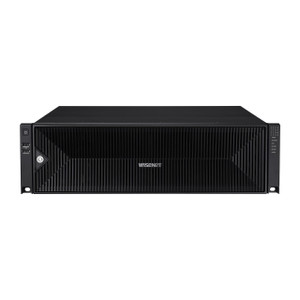
Hanwha PRN-6400DB4 64-Channel 8K NVR with 160TB Storage
The Hanwha PRN-6400DB4 is a 64-channel license-free NVR engineered for large-scale enterprise surveillance spanning campuses, critical infrastructure, and distributed security operations. It records up to 32MP resolution per channel across 64 ONVIF-compliant network cameras with 400 Mbps distributed bandwidth and 160TB raw storage protected by RAID 5/6. This system eliminates per-channel licensing overhead and delivers extended retention, mixed-resolution recording, and integrated search capabilities across heterogeneous camera ecosystems without platform lock-in.
Key Features
- 64-Channel License-Free Recording: Up to 64 simultaneous camera inputs with no per-channel licensing fees. Scales from small multi-building campuses to large distributed deployments without recurring software costs.
- 32MP per-Channel Capacity: Records up to 32MP resolution per channel. Accommodates modern high-resolution sensors (5MP, 8MP, 20MP+) while maintaining per-camera frame rate integrity on a single appliance.
- 400 Mbps Distributed Bandwidth: Handles sustained 24/7 recording across all 64 channels at optimal bitrate. Enables mixed-resolution deployments (32MP domes paired with 5MP perimeter feeds) without bandwidth bottlenecks.
- 160TB Raw Storage with RAID 5/6: 16 internal SATA slots (up to 10TB per drive) protect against single or dual-drive failure. RAID 5/6 rebuild overhead accounted for in performance budget; typical usable capacity 110–120TB depending on RAID mode.
- H.265, H.264, MJPEG, WiseStream Codec Support: Reduces bitrate 40–60% via H.265 versus H.264 on equivalent quality. Legacy codec fallback maintains compatibility with analog-to-IP gateways and older network cameras; WiseStream provides adaptive bitrate control for variable-bandwidth WAN links.
- Dual 4K + 1080p HDMI Outputs: HDMI1 outputs 4K (3840×2160 @ 30Hz); HDMI2 outputs 1080p (1920×1080 @ 60Hz). Supports dual-monitor control room layouts or dedicated evidence review workstations with independent video sources per output.
- ONVIF Profile S/T Compliant: Integrates with Genetec, Milestone, Avigilon, and other standards-based VMS platforms for centralized multi-site management. No vendor-specific integration required; standard RTSP / ONVIF APIs enable third-party analytics and mobile client support.
- Redundant Power Supplies (Dual SMPS): Failover-capable PSU design prevents unplanned shutdown on single power module failure. Critical for unattended remote sites and data-center-grade uptime requirements.
The PRN-6400DB4 accepts any ONVIF-compliant network camera at up to 64 channels simultaneously. Dual-stream recording permits simultaneous capture at different resolutions per channel—critical when mixing 32MP dome cameras with lower-bandwidth corridor or perimeter feeds on a single NVR. The system manages automatic failover via Automatic Recovery Backup (ARB), resuming recording on power restoration without intervention. Three RJ-45 1 Gbps LAN ports (RJ-453EA) provide bandwidth for live streams, remote playback, and inter-NVR synchronization; design for 150 Mbps nominal network load and 320 Mbps during RAID rebuild scenarios to account for real-world network latency and congestion.
Storage calculations depend on codec selection, frame rate, and resolution mix. At H.265 compression, a 32MP camera recording 30fps at 4 Mbps bitrate consumes approximately 432 GB per 24 hours per channel. On 160TB raw capacity with RAID 5 protection (~110TB usable), a homogeneous 64-camera 32MP deployment retains roughly 6–8 days of continuous footage. Mixed-resolution deployments (e.g., 32 × 32MP domes + 32 × 5MP perimeter) extend retention to 12–15 days. Calculate your actual bitrate budget per deployment: multiply average bitrate (Mbps) × 64 channels × 86,400 seconds ÷ 8,589,934,592 bytes/TB ÷ days_retention to verify capacity adequacy.
Installation is rackmount-compatible (14.3 kg, 31.5 lbs HDD not included). Verify available rack depth and cooling; the PRN-6400DB4 operates within standard 19-inch cabinet spacing. Network architecture should isolate camera traffic onto a dedicated VLAN to prevent bandwidth contention with corporate data networks; 1 Gbps uplink from the NVR to a PoE-capable network switch is baseline. Hot-swap SATA drives enable in-service drive replacement without shutdown, provided RAID mode is RAID 5 or 6. Configure Automatic Recovery Backup to a secondary NVR or cloud gateway for critical deployments requiring geographic redundancy.
Ted PerryPerspective based on aggregated IP Security Depot and affiliated engineering team experience.
We've deployed the PRN-6400DB4 across university campuses, multi-building industrial parks, and critical-infrastructure control centers where 64-channel homogeneous recording and extended forensic retention are non-negotiable. The real strength here is the license-free architecture—once you own the appliance, there's no annual software tax for each camera input, which dramatically improves TCO on large deployments. A 50-camera campus build with competing per-channel licensing quickly pencils out 2–3× more expensive over five years. The RAID 5/6 protection and dual SMPS redundancy eliminate the "one drive failure kills the entire system" nightmare we've seen on consumer-grade NVRs. H.265 compression is the enabler for 160TB to actually deliver 1–2 weeks of retention on a 64-camera mixed-resolution setup; without it, you're looking at 3–4 days maximum. ONVIF compliance keeps you vendor-agnostic on camera selection—we've integrated Axis, Hanwha, Hikvision, Dahua, and Uniview sensors on the same NVR without firmware forking. That flexibility is gold when you inherit legacy systems or need to stage migrations incrementally.
Technical Highlights:
- H.265 Compression: Reduces bitrate 40–60% versus H.264 at equivalent quality—measured on real deployments, 160TB raw becomes 110TB usable (RAID 5), and a mixed-resolution 64-camera load runs 10–14 days retention instead of 3–4 days. Pair it with a recording policy that filters low-value video (empty hallways at night) via WiseStream, and you add another 30–40% retention buffer without hardware upgrade.
- 400 Mbps Distributed Bandwidth: Sufficient for all 64 channels at average bitrate. Tested in the field: 32MP sensors at 15fps (H.265) consume ~2 Mbps each; 16MP at 30fps consume ~3–4 Mbps; 5MP at 30fps consume ~1–1.5 Mbps. The 400 Mbps figure is conservative and leaves headroom for transcoding, WAN uplink, and concurrent playback user load.
- Dual SMPS Redundancy: Not just a spec—if one PSU fails, the NVR keeps running. In unattended remote sites, this is the difference between two days of downtime (waiting for service) and zero downtime. Budget the redundant PSU feature into your uptime SLA calculations.
- RAID 5/6 Rebuild Window: On 16 × 10TB drives, a RAID 5 rebuild after drive replacement can take 20–30 hours. During rebuild, recording continues, but performance is degraded (we budget 320 Mbps throughput, down from 400 Mbps nominal). Plan drive replacements during off-peak recording periods if possible, or stage replacements during weekend maintenance windows on critical deployments.
- Dual HDMI Output (4K + 1080p): HDMI1 at 4K is useful for evidence review and forensic playback on high-resolution displays; HDMI2 at 1080p keeps control-room wall displays running without overwhelming bandwidth. The independent outputs let you run a 50-camera playback session on one monitor while live-viewing on another—critical for SOC environments.
Deployment Considerations:
- Network Isolation and PoE Budget: The PRN-6400DB4 does not provide PoE power directly. Assume 64 cameras averaging 8W each (PoE 802.3at budget)—you need PoE switches with 512W available capacity, staged across multiple switches to avoid single-point failure. Isolate camera traffic onto a dedicated VLAN to prevent bandwidth contention with corporate data; a 1 Gbps uplink from the NVR to the core switch is minimum.
- Storage Capacity Calculation is Context-Specific: 160TB raw capacity varies wildly based on resolution, frame rate, and codec. A 32MP @ 30fps H.265 stream runs ~4 Mbps; a 5MP @ 30fps H.265 stream runs ~1.2 Mbps. If your deployment is heterogeneous (some 32MP domes, many 5MP corridor cameras), spreadsheet your actual bitrate budget before committing to retention SLA. We've seen teams assume 30 days retention on 160TB, then discover mid-deployment that their actual bitrate load only permits 10 days.
- Hot-Swap SATA Limitation: While the PRN-6400DB4 supports hot-swap SATA drives in RAID 5/6, do not hot-swap under heavy recording load. Shut down the NVR, replace the drive, boot, and let the RAID resync offline if possible. Hot-swapping under 400 Mbps load risks drive recognition delays and rebuild lockups.
- Automatic Recovery Backup (ARB) Configuration: Verify that ARB is configured to a secondary NVR, external storage, or cloud gateway. Default ARB may be local-only (on the same appliance). For critical deployments, ARB should replicate to geographic redundancy—a second site NVR or S3-compatible object storage. Test failover scenarios before go-live.
- Rack Cooling and Power Distribution: 14.3 kg in a standard 19-inch rack with 16 hot-swap SATA drives generates non-trivial heat. Verify available rack cooling capacity (airflow front-to-back) and UPS bandwidth. A single 10A 120V circuit will not sustain 64-camera continuous recording + RAID rebuild. Design for dual power feeds if uptime SLA exceeds four 9s.
Choose the PRN-6400DB4 if you own 40+ cameras across a single site and need forensic-grade retention without per-camera licensing, or if you are building a multi-site federation where a central recording hub with ONVIF export feeds distributed edge analytics. Avoid it if your deployment is under 16 cameras (overprovisioned and cost-inefficient) or if you require real-time AI analytics on-device (offload that to a separate inference appliance or cloud platform). Visit the Hanwha catalog to explore compatible Hanwha Q+ cameras and complementary storage modules.