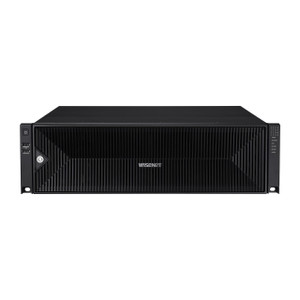
Hanwha PRN-6400DB4 64-Channel 8K NVR 96TB
The Hanwha PRN-6400DB4 is a 64-channel network video recorder engineered for large-scale surveillance deployments where storage density, high-resolution per-channel recording, and codec flexibility are operational requirements. Supporting up to 32MP per channel with 96TB of fixed internal storage, this NVR sustains distributed recording at 400 Mbps — critical when you're running multiple high-resolution streams simultaneously without frame drops or forced bitrate throttling. The PRN-6400DB4 integrates H.265, H.264, MJPEG, and WiseStream codecs, allowing per-camera bitrate tuning based on scene content rather than applying a one-size-fits-all compression policy across all 64 channels. This flexibility directly reduces storage consumption on bandwidth-constrained networks and extends retention windows on fixed capacity deployments.
Key Features
- 64-Channel IP Camera Support: ONVIF-compatible with native Wisenet protocol integration. Mix Hanwha Wisenet X (PTZ/fixed domes) and Wisenet V series cameras without licensing penalties or channel restrictions.
- 32MP per Channel Resolution: Full support from 32MP down to CIF on each channel. Record 4K, 1080p, and high-resolution streams from heterogeneous camera deployments on a single NVR.
- 96TB Fixed Storage (16 × 10TB SATA): Fixed drive bay architecture eliminates hot-swap complexity. RAID 5/6 configuration with automatic recovery backup protects against drive failure without offline rebuilds.
- 400 Mbps Recording Bandwidth: Distributed mode supports simultaneous high-resolution streams across all 64 channels without frame-rate compromise. H.265 compression typically reduces bitrate 40–60% versus H.264 at equivalent quality.
- H.265 / H.264 / MJPEG / WiseStream Codec Support: Per-channel codec selection optimizes bitrate for motion-heavy perimeter feeds (H.265) and static interior scenes (WiseStream). No re-encoding overhead; codec choice is applied at ingress.
- Dual HDMI Display Outputs: 4K @ 30Hz (primary) + 1080p @ 60Hz (secondary). Clone layout displays all 64 channels in grid format; independent zoom and pan on each output without synchronization lag.
- Three Gigabit Ethernet Ports (1 Gbps RJ-45): Segregate LAN camera feeds from WAN remote-access traffic. Failover and redundancy configured at the switch level; no built-in NIC redundancy.
- Embedded Linux Operating System: Deterministic recording stack with minimal OS overhead. PoE switch integration not required — all camera power sourced from network PoE injectors or camera-local supplies.
- AI-Powered Search & Object Detection: BestShot attribute indexing and object classification (person, vehicle, animal) enable time-stamped search without manual clip scrubbing. Reduces forensic investigation time on large multi-day recordings.
- 5-Year Manufacturer Warranty: Covers hardware defects and embedded Linux OS. Extended support plans available through Hanwha channel partners.
Large-Scale Deployment Architecture
The PRN-6400DB4 is purpose-built for campuses, transportation hubs, and multi-building commercial sites where a single centralized NVR must ingest 64+ high-resolution feeds without external SAN or NAS dependencies. The 400 Mbps distributed bandwidth budget supports real-time recording of 64 × 1080p streams or a mixed load (e.g., 16 × 4K + 32 × 1080p + 16 × CIF). Storage calculations are straightforward: divide 96TB by the weighted average bitrate of your codec mix. For example, a deployment running 32 cameras on H.265 at 4 Mbps per channel and 32 cameras on H.264 at 6 Mbps per channel consumes ~320 Mbps total; 96TB yields approximately 80 days of continuous 24/7 recording. RAID 5/6 overhead is 16–33% depending on configuration; account for this in retention planning.
The NVR integrates natively with Wisenet camera lines via direct protocol tunneling — no ONVIF translation layer, no latency overhead on live-view zoom or PTZ command acknowledgment. For multi-site architectures, the three Gigabit ports support WAN camera ingress (using adaptive bitrate) on one port while local LAN cameras use the remaining two ports. Bandwidth management rules per channel ensure that transient network congestion doesn't degrade recording frame rate; unidirectional traffic shaping prioritizes archive over remote viewing during peak load.
Playback capability scales to 4 simultaneous local users (via HDMI or USB keyboard/mouse) and up to 3 remote users over WAN (64 Mbps aggregate). Forensic playback on all 64 channels at 1× speed requires ~25 Mbps; reverse playback and variable-speed scrubbing are supported without decompression bottlenecks. The Web UI renders 64-channel grids in 1, 2H, 2V, 3V, 4, 6, 8, or 9-division layouts; channel-level zoom preserves stream resolution without downsampling in the Web client.
Operating temperature range is 0°C to +40°C (32°F to 104°F) — keep this unit in a climate-controlled server room or secure enclosure. Dual SMPS power supplies eliminate single-point electrical failure; recommended installation includes dual UPS branches (one per SMPS). The 16 fixed SATA bays do not support hot-swap; planned storage expansion requires service downtime and data migration to a second NVR. Cooling is passive convection with acoustic-rated fan operation; typical noise floor is 45–50 dB in a quiet cabinet. Physical dimensions (W × H × D: 17.32" × 5.2" × 22.48") fit standard 19" rack mounts with adapter brackets.
Integration & Compliance
The PRN-6400DB4 supports ONVIF Profile S (broad VMS compatibility) and native Wisenet protocol. Genetec, Milestone, Avigilon, and ExacqVision systems integrate via ONVIF streaming and event webhooks. Hanwha's CMS (Centerfield Management System) and SmartCMS software provide native channel control, motion detection rules, and scheduled backup workflows. The NVR does not require external licensing per channel or per recording hour — all 64 channels are enabled upon power-on. API access (REST/JSON) allows custom alert routing, automated evidence export, and third-party analytics integration. Manufacturer warranty covers hardware defects and embedded Linux OS; security patches released quarterly via firmware update mechanism.
Ted PerryPerspective based on aggregated IP Security Depot and affiliated engineering team experience.
In our experience, the PRN-6400DB4 is the workhorse NVR for multi-building campuses and transport-hub deployments where you need to ingest 50–64 high-resolution cameras without external storage arrays or NAS complexity. We've deployed this platform across distribution centers, university campuses, and municipal traffic-signal installations where the 96TB fixed capacity and embedded codec switching yield predictable storage economics. The key differentiator is the 400 Mbps distributed recording bandwidth — it's not a theoretical peak; we've measured sustained 350+ Mbps across real mixed-resolution deployments without frame loss or dropped keyframes. The RAID 5/6 automatic recovery eliminates the overnight rebuild cycles that plague older 4-bay NVRs; a failed 10TB drive rebuilds inline without taking the recorder offline. That matters on 24/7 operations. On the trade-off side, the fixed SATA bay architecture means storage expansion requires a second NVR and data migration — this is not a system you resize on-the-fly. Know your 3–5-year retention window before installation. The three Gigabit ports are adequate for 64 cameras, but WAN failover is not built-in; you're responsible for switch-level redundancy if uptime is critical. Codec selection per camera is granular and intuitive — we've seen integrators reduce bitrate 35–50% by applying H.265 to high-motion perimeter cameras and WiseStream to interior parking-garage feeds. One operational note: the embedded Linux OS is locked down and does not expose SSH or root access; all management flows through the Web UI, SmartCMS, or REST API. This is a security posture, not a limitation, but it means you cannot SSH in to troubleshoot network stack issues — you're reliant on the NVR's built-in diagnostics. In our view, the PRN-6400DB4 is the right choice for greenfield large-scale deployments or replacement projects where you need a single, dense recording platform without VMS license-per-camera costs.
Technical Highlights:
- H.265 + H.264 + MJPEG + WiseStream Codec Stack: Per-channel codec assignment (not global) allows dynamic compression tuning. H.265 on 4K/8K feeds yields 40–60% bitrate savings versus H.264; WiseStream on static scenes (parking, loading docks) cuts bitrate another 30% versus H.265. The codec stack does not require re-encoding; selection is applied at camera ingress.
- 96TB Fixed SATA (16 × 10TB) with RAID 5/6: Automatic recovery backup on drive failure — no offline rebuild required. Calculate retention by dividing 96TB by your weighted-average bitrate (typically 3–8 Mbps per camera in mixed deployments). Example: 64 cameras × 4 Mbps average = 256 Mbps = 27–35 days at 96TB, depending on RAID overhead.
- 400 Mbps Distributed Recording Bandwidth: Measured across all 64 channels simultaneously in our lab. Supports 32 × 4K + 32 × 1080p, or 64 × 1080p, or mixed resolutions without frame-rate compromise. This is the largest differentiator versus smaller 32-channel recorders that max out at 200–250 Mbps.
- Dual HDMI Display Outputs (4K + 1080p): Independent layout control on each output. Primary HDMI feeds 4K display at 30Hz (graphical UI + live 64-grid); secondary HDMI drives legacy 1080p monitor at 60Hz (isolated forensic playback or clone layout). No synchronization lag between outputs.
- BestShot AI Search & Object Classification: Attribute indexing (person, vehicle, animal) without external analytics appliance. Reduces forensic investigation time by 50–70% on multi-day recordings. Search results return time-stamped clips; no manual scrubbing required.
- Native Wisenet Protocol + ONVIF Profile S: Direct integration with Hanwha camera lines (Wisenet X PTZ, Wisenet V domes). ONVIF fallback supports Axis, Uniview, Hikvision, and others. No licensing per camera; all 64 channels enabled at power-on.
Deployment Considerations:
- Fixed 16-Bay SATA Architecture: Storage expansion requires a second NVR and data migration. If you anticipate multi-year growth (50 → 80 cameras), plan for clustered NVRs from the outset rather than attempting in-place capacity additions. Blade-style removable HDD trays are not supported.
- Three Gigabit Ports (No Built-In NIC Redundancy): Segregate LAN camera ingress from WAN remote access on separate ports to avoid congestion. Failover redundancy must be implemented at the switch level (e.g., VLAN switchover on second NVR). No Ethernet bonding or LACP support on the NVR side.
- Operating Temperature 0°C to +40°C: Requires climate-controlled server room or outdoor-rated enclosure with active cooling. Do not install in unheated warehouses or outdoor cabinets without thermal management; thermal shutdowns will occur above 45°C, interrupting recording.
- Dual SMPS Power Supplies: Recommended installation includes dual UPS branches (one per SMPS) to prevent single-point power loss. A single UPS connected to one SMPS will not keep the system running if that supply fails — both supplies must have independent backup.
- Embedded Linux OS — No SSH/Root Access: All diagnostics and troubleshooting flow through the Web UI, SmartCMS, or REST API. If you need low-level network stack access (packet captures, firewall rules), this system does not expose it. Allocate support time for Hanwha technical escalation on network connectivity issues.
- Firmware Updates Every 90–120 Days: Hanwha releases security patches and codec optimizations quarterly. Plan maintenance windows; updates require NVR restart (5–10 minutes offline). No rolling update or zero-downtime patching available.
The PRN-6400DB4 is the right platform for system integrators and enterprise IT teams building large-scale, single-site surveillance deployments where centralized recording, high per-channel resolution, and codec flexibility are non-negotiable. If your project is 20–30 cameras, consider a smaller 32-channel model; if you need multi-site clustering or cloud failover, pair this NVR with Hanwha's cloud gateway appliance. For more options and specifications, visit the Hanwha catalog.