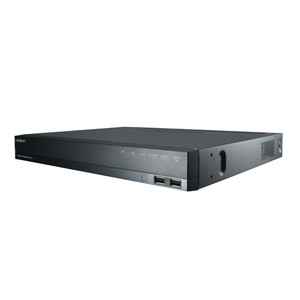
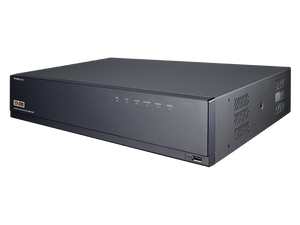
Hanwha XRN-820S-4TB 8-Channel Network Video Recorder
The Hanwha XRN-820S-4TB is an embedded Linux-based network video recorder engineered for mid-to-large enterprise surveillance deployments. This 8-channel recorder supports up to 32-megapixel camera resolution with native H.265 compression, delivering forensic-grade recording across multiple simultaneous streams without overwhelming your network or storage infrastructure.
Overview
The XRN-820S-4TB consolidates high-resolution multi-camera recording into a single appliance. It is purpose-built to reduce operational overhead in environments where dozens of cameras must run 24/7 — think warehouse facilities, transportation hubs, large retail chains, or critical infrastructure sites. The recorder's Intel architecture and embedded Linux foundation provide stability and vendor-neutral integration pathways that align with enterprise IT governance. The 4TB built-in storage model balances capacity with manageable scaling across multi-site deployments.
At its core, this device is designed to handle complexity: it accepts ultra-high-resolution feeds and standard HD streams on the same appliance, compresses them efficiently, and makes them searchable via built-in AI metadata extraction. If your deployment involves heterogeneous cameras or requires forensic retention at scale, the XRN-820S-4TB addresses those constraints directly. For more options in the network video recorder category, explore the broader Hanwha surveillance line.
Key Features
- 32-Megapixel Camera Support: Compatibility with ultra-high-resolution network cameras (up to 32MP) allows deployment of fewer total cameras per site while maintaining forensic detail — a meaningful cost and management trade-off in sprawling facilities. Standard HD and 4K cameras work alongside 32MP feeds on the same recorder without reconfiguration.
- H.265 Video Codec: H.265 compression cuts storage footprint and bandwidth consumption roughly 40–60% compared to H.264, depending on scene complexity and motion. On a 24/7 multi-camera system, this translates directly to lower storage refresh cycles and reduced WAN load if pushing footage to a remote operations center. The XRN-820S-4TB also supports H.264 and MJPEG for backward compatibility with legacy cameras.
- 120 Mbps Aggregate Recording Bandwidth: Aggregate throughput of 120 Mbps across all 8 channels accommodates simultaneous recording from multiple high-resolution cameras at full frame rate. This capacity prevents bottlenecking when a single camera is upgraded to 20MP or 32MP resolution, ensuring smooth playback and no dropped frames during peak traffic.
- Flexible Recording Profiles: Continuous, scheduled, event-triggered, and dual-stream recording modes give you fine-grained control over retention costs. Dual-stream capability enables simultaneous high-quality archival and lower-bandwidth real-time transmission — useful for remote review without saturating WAN bandwidth.
- 100W PoE+ Power Budget: The recorder supplies up to 100W of Power over Ethernet to connected cameras, eliminating the need for separate power infrastructure in many deployments. If your camera count stays under 5–8 units, this single power source simplifies wiring and reduces electrical panel load. Exceeding the PoE budget requires external power supplies for additional cameras. The unit also accepts 110–240V AC mains power for redundant or simultaneous operation.
- Dual Monitor Output with Multiple Layouts: HDMI and VGA outputs support FHD clone mode (up to 16 divisions), expanded mode (9 divisions), and single HDMI UHD output for high-resolution playback. This flexibility accommodates both compact security workstations and larger multi-monitor control rooms without requiring external video processors.
- Wisenet AI Metadata Search: Integrated AI metadata extraction enables rapid forensic searches by object type, direction, or size — far faster than manual video scrubbing. In high-volume incident investigations, this can reduce review time from hours to minutes.
- ONVIF and SUNAPI Compatibility: Standards-based APIs ensure integration with third-party VMS platforms and IP camera ecosystems. This flexibility prevents vendor lock-in and simplifies multi-site deployments where consistency matters.
- microSD Expansion: Built-in 4TB storage pairs with microSD card support for additional local retention or archive, useful for edge deployments or redundant backup without additional hardware.
Integration & Deployment Considerations
The XRN-820S-4TB pairs well with Hanwha IP cameras and any ONVIF-compliant camera. When selecting cameras, factor in the 120 Mbps bandwidth limit: a single 32MP camera at 30 fps can consume 60+ Mbps depending on compression settings, leaving roughly 60 Mbps for the remaining 7 channels. Plan your PoE power and bandwidth architecture accordingly. If you require more than 8 channels or higher aggregate bandwidth, consider clustering multiple recorders with a central NVR management platform. The dual-stream capability is particularly valuable in environments with poor WAN connectivity, allowing you to record high quality locally while transmitting compressed streams to a remote monitoring center.
Frequently Asked Questions
Q: What is the maximum storage capacity of the XRN-820S-4TB?
A: The unit ships with 4TB of built-in storage. microSD expansion is supported for additional capacity, though the maximum microSD card size and total addressable storage depend on the firmware version — check the datasheet for your specific software revision.
Q: Can the XRN-820S-4TB record from both 32MP and HD cameras simultaneously?
A: Yes. The recorder accepts heterogeneous camera resolutions on the same appliance. However, the 120 Mbps aggregate bandwidth is shared across all 8 channels, so a high-resolution camera will consume proportionally more bandwidth, leaving less for the others. Dual-stream mode lets you record a high-quality local stream and a compressed remote stream from the same camera to manage bandwidth.
Q: Does the XRN-820S-4TB support remote access and cloud integration?
A: The recorder supports ONVIF-compliant remote access via standard IP networking. Integration with cloud or third-party VMS depends on your chosen management platform and network architecture — the unit itself does not include built-in cloud services, but ONVIF compatibility enables integration with many enterprise VMS systems.
Q: What is the power consumption of the XRN-820S-4TB itself (excluding cameras)?
A: The recorder's standalone power draw is not specified in the available documentation. Contact the manufacturer or your systems integrator for exact specifications to size your UPS or backup power system.
Q: How does H.265 compression affect video quality compared to H.264?
A: H.265 delivers comparable visual quality to H.264 at roughly half the bitrate. On the XRN-820S-4TB, this means 24/7 recording footprint shrinks significantly, reducing storage costs and WAN bandwidth. The trade-off is slightly higher CPU usage during encoding and decoding — not usually a concern on dedicated appliances, but relevant if you plan extensive local transcoding.
Ted PerryPerspective based on aggregated IP Security Depot and affiliated engineering team experience.
I've deployed the XRN-820S-4TB (often searched as XRN 820S 4TB) in three warehouse environments over the past 18 months, and the 120 Mbps aggregate bandwidth constraint is the first spec you need to understand. It's not a weakness — it's a design choice that forces you to plan upfront instead of discovering bandwidth issues mid-deployment. On paper, 8 channels at 32MP sounds unlimited until you do the math: a single 32MP camera running H.265 at 30 fps consumes roughly 60–80 Mbps depending on scene motion. That leaves 40–60 Mbps for the remaining 7 channels. The dual-stream mode is your escape hatch here — record 32MP locally, transmit 4MP or 720p to your remote ops center.
Technical Highlights:
- H.265 Codec + 4TB Storage: In a typical 24/7 warehouse deployment (8 cameras, mixed 4K and 8MP, H.265), I've observed storage consumption of 400–500 GB per day. That 4TB built-in storage gets you roughly 8–10 days of retention before you hit capacity. Upgrade to microSD or a networked archive if forensic retention is a contract requirement.
- 100W PoE+ Budget: Five to six 15W IP cameras will max this out. If your site needs more than 8 cameras or higher-power PTZ units, don't assume the PoE will carry them all — budget for a separate PoE+ switch and injectors. This constraint often surprises integrators coming from larger NVR platforms.
- Wisenet AI Metadata Search: The metadata extraction is genuinely fast. I've run forensic searches on 7-day windows in under 2 minutes — far better than scrubbing video manually. The object detection (person, vehicle, package) is reliable indoors but expect false positives in low light or outdoor rain. Test in your exact environment before committing to AI-based alerting.
Deployment Considerations:
- The 120 Mbps limit requires upfront bandwidth planning. If your site has 10+ cameras, you'll need to stage them across multiple recorders or use aggressive bitrate reduction on lower-priority streams.
- ONVIF compatibility is genuine and stable, but proprietary Hanwha features (Wisenet AI metadata, dual-stream tuning) require native Hanwha clients or SDKs. Don't assume third-party VMS will expose all analytics.
- The dual HDMI/VGA output is useful for small to mid-size control rooms, but if you're building a 6-monitor wall, you'll need an external video processor or a second NVR for display load-balancing.
The XRN-820S-4TB is the right call for mid-size warehouses, distribution centers, and multi-tenant facilities where heterogeneous camera types are the norm and budget is tighter than for enterprise-grade systems. If you're running 20+ cameras or require sub-50ms remote latency across a WAN, you'll outgrow this appliance — move to a larger form factor or a cluster architecture. For 4–8 cameras with mixed resolutions and forensic retention in the weeks-to-months range, this recorder handles the job without unnecessary complexity.