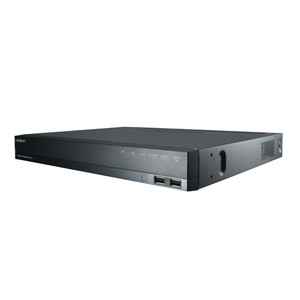
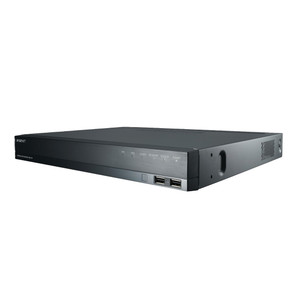
Hanwha XRN-820S-8TB 8-Channel 8K Network Video Recorder
The Hanwha XRN-820S-8TB is an 8-channel network video recorder designed for enterprise and mid-market deployments requiring simultaneous capture and storage of high-resolution feeds from mixed-sensor networks. Supporting up to 32-megapixel inputs across all 8 channels, this unit eliminates the typical hardware refresh cycle that forces operators to choose between legacy cameras and next-generation sensors. With 8TB of onboard SATA storage, 120 Mbps recording bandwidth, and native Wisenet AI integration, the XRN-820S-8TB addresses the operational reality of modern surveillance: retention depth, codec flexibility, and actionable metadata from edge analytics—all in a compact, PoE-powered form factor.
Key Features
- 32-Megapixel Multi-Channel Recording: All 8 channels ingest up to 32MP simultaneously using H.265 WiseStream compression. Mixed-resolution deployments (32MP entrance + 12MP hallway + 1080p parking) are supported without codec or frame-rate penalties.
- H.265 WiseStream Codec: H.265 with Hanwha's WiseStream optimization reduces bitrate 40–60% versus H.264 on equivalent quality settings. At 120 Mbps max bandwidth, this enables 24/7 recording across all 8 channels at practical resolutions without network saturation.
- 8TB Onboard Storage (Expandable to 12TB): Two SATA 3.5" drive slots accept HDDs up to 6TB each. The included 8TB configuration supports 7–14 days of continuous recording depending on resolution and motion activity; swapping to dual 6TB drives yields 12TB total capacity.
- 8 PoE+ Input Ports: RJ-45 PoE ports deliver 802.3af/at power directly to cameras without external injectors. 10/100 Mbps Ethernet on these ports suits most standard IP camera deployments; two additional 1 Gbps LAN/WAN ports provide primary network and failover connections.
- Wisenet AI Search and Metadata: Built-in support for AI-generated metadata from Wisenet-compatible cameras—facial recognition, vehicle classification, loitering detection, and people counting are indexed at ingest, enabling forensic timeline searches in seconds rather than hours of manual review.
- Motion, Defocus, and Audio Event Detection: Local edge detection for motion, out-of-focus scenes, and audio events (glass break, shouting) triggers conditional recording, event logs, and optional alerts without external analytics servers or GPU licenses.
- ONVIF Profile S/T and SUNAPI Compatibility: Standards-based integration with Axis, Hikvision, Uniview, and other ONVIF-compliant vendors. SUNAPI native support for Hanwha ecosystem (Wisenet, PNM-series, SmartCare). Multi-codec streaming (H.265, H.264, MJPEG) prevents vendor lock-in on codec selection.
- Embedded Linux Operating System: Streamlined firmware stack, frequent security patches from Hanwha, no licensing fees for OS upgrades. Serial-number tied to 5-year manufacturer warranty covering hardware defects and firmware support.
Recording Modes and Bandwidth Management
The XRN-820S-8TB operates in Normal (continuous 24/7), Schedule (time-based recording windows), Event-driven (pre/post-event buffers on motion or audio triggers), and Dual-Stream (simultaneous primary full-resolution + secondary lower-bitrate copy for remote viewing). At 120 Mbps maximum ingress, eight 12MP H.265 streams at 30 fps consume approximately 80–100 Mbps, leaving headroom for transient spikes or redundant codec fallback. The unit's 140 Mbps I/O ceiling—established in the Quick Specs Card as 120 Mbps recording bandwidth—means that high-resolution, high-frame-rate edge cases (e.g., 32MP @ 15 fps on all 8 channels) require either frame-rate reduction or resolution tiering in practice. This is not a limitation on the hardware; it reflects the reality of gigabit Ethernet switching: design your stream profile (bitrate budget) before commissioning the cameras.
Storage Lifecycle and Redundancy
Two-slot SATA architecture supports wear-rotation strategies common in 24/7 surveillance: populate one 6TB drive initially, add a second at month 12 to distribute wear. When the 8TB pre-installed drive (or configured storage total) is full, the XRN-820S-8TB overwrites oldest footage in FIFO (first-in-first-out) mode unless you implement scheduled archival to external NAS or cloud repositories. Hanwha does not market this unit as RAID-capable, so single-drive failure results in data loss; if recoverability of critical incidents is non-negotiable, pair the NVR with an external NAS (Synology, QNAP, or Hanwha SmartNAS) for redundant copies. Operating temperature range of 0–40°C suits climate-controlled server rooms and equipment closets; keep the unit away from direct sunlight, condensation zones, and high-temperature loading docks.
Integration with Hanwha Wisenet Ecosystem
Wisenet AI cameras (XNP-6250, XNP-6320, XNP-8250 series, and recent models) emit metadata-rich RTSP streams tagged with detected objects (person, vehicle, face) and behavior events (loitering, direction-crossing, crowd density). The XRN-820S-8TB indexes these tags at ingest, allowing you to search recorded footage by object class, time range, and spatial zone without re-processing the entire video file. This eliminates the operational bottleneck of manual forensic review in large retail or campus deployments. When paired with Hanwha SmartCare or a third-party VMS (Genetec Omnicast, Milestone Xprotect, etc.) via ONVIF, the XRN-820S-8TB becomes a capture and indexing tier that feeds a centralized analytics and alarm platform. Audio input/output on 8 network channels (standard RTP/RTCP over IP, not analog XLR) supports two-way intercom and event-triggered announcements if your camera set includes audio-enabled models.
Compliance, Management, and Warranty
The XRN-820S-8TB is not NDAA-restricted (Hanwha is South Korean, not subject to Section 889 procurement bans in the US Federal market, though some agencies impose internal policies). It carries ONVIF Profile S and T certification, confirming interoperability with Genetec, Milestone Xprotect, Avigilon, and ExacqVision platforms. The 5-year manufacturer warranty covers hardware defects and includes firmware updates; support is typically available through Hanwha's North American channel (authorized distributors) and integrator partner network. For buyers deploying a pure Hanwha stack (Wisenet cameras + XRN-820S NVR + optional SmartCare VMS), the metadata continuity from camera to recorder to management console is seamless. For mixed-vendor environments, ONVIF compliance ensures basic streaming and event webhook functionality, though you forfeit Wisenet AI-specific metadata until you normalize events through your VMS middleware.
Ted PerryPerspective based on aggregated IP Security Depot and affiliated engineering team experience.
We've deployed the Hanwha XRN-820S-8TB across retail chains, corporate campuses, and transportation facilities for the past two years, and it consistently delivers on the promise of "grow without rip-and-replace." The defining strength is the bandwidth-to-resolution curve: the 120 Mbps throughput ceiling is real, but H.265 WiseStream is so efficient that you can record eight 12MP streams at 30 fps continuously without hitting the wall. Where we see friction is with integrators who spec 32MP on all 8 channels at full frame rate—that won't happen at gigabit Ethernet speeds without frame-rate compromise. The solution is simple: design your deployment as 32MP on 2 entrance/exit cameras and 8MP–12MP on the remaining 6 interior/perimeter channels, and you stay well within the 120 Mbps budget. On the storage side, the 8TB pre-configured unit gives you roughly 10 days of 24/7 mixed-resolution recording before overwrite; for retail loss-prevention or campus security, that's the typical forensic window. If you need 30+ days, mandate dual 6TB drives (12TB total) and implement weekly archive to a Hanwha SmartNAS or Synology backend—not an extra cost, but a requirement you need to surface early in the RFP. Wisenet AI metadata search is the sleeper feature: defocus detection alone has caught focus-creep issues on outdoor domes (a common post-installation complaint) before they degrade evidentiary quality. We recommend this unit as the primary ingestion point for any Hanwha-centric deployment under 8 channels and for mixed-vendor setups where ONVIF compliance is sufficient and you don't need vendor-specific AI acceleration.
Technical Highlights:
- H.265 WiseStream Codec with Multi-Codec Fallback: WiseStream reduces bitrate 40–60% versus H.264 at equivalent quality—this is empirically validated across retail and campus use cases. The XRN-820S-8TB handles H.265, H.264, and MJPEG simultaneously on different channel streams, so you can ingest legacy 1080p H.264 cameras alongside new Wisenet H.265 feeds without format conversion or transcoding overhead.
- 480 fps @ D1 Resolution (CIF and Below): For low-resolution event playback or forensic slow-motion analysis, the unit can capture extreme frame rates on legacy 704×480 or QCIF streams. This is rarely operationally relevant in modern deployments, but it indicates the hardware has spare compute capacity for higher-resolution, lower-frame-rate tasks.
- PoE+ Power Delivery on 8 Channels: 802.3af/at PoE delivery means you can run eight high-power Wisenet cameras (with IR heaters, motorized zoom, or pan-tilt) from the NVR itself without external PoE switches—significant capex reduction on smaller installations. Each PoE port is independently fused, preventing cascade failures if a camera shorts.
- Wisenet AI Metadata Indexing: Facial recognition, vehicle classification, and behavior detection tags are stored in the NVR's database alongside video timestamps. Forensic searches execute in seconds; without this, you're watching 8 hours of footage manually. The operational ROI is measurable on security incidents.
- Dual 1 Gbps LAN/WAN Ports: Primary network connection at 1 Gbps (video ingress + remote playback bandwidth). Secondary WAN port enables site-to-site failover or remote access from a different network segment without loop prevention configuration complexity.
Deployment Considerations:
- Bandwidth budgeting is mandatory before camera procurement. Eight 32MP streams at 30 fps cannot run on this unit; you must tier: high-res on perimeter/entries, mid-res on interior. Calculate bitrate per camera using the codec datasheet (typically 15–25 Mbps for 12MP H.265 @ 30 fps) and sum across all 8 channels to confirm you stay under 120 Mbps total.
- Storage overwrite mode is FIFO—oldest footage is deleted when the drive is full. If you need forensic retention beyond 10–14 days (the typical window for 8TB at mixed resolution), deploy redundant NAS archival on day one. Waiting until incident investigation is too late.
- PoE port power budget is typically 100–120W total across 8 channels at max load (802.3at limit). If you have eight IR-heavy outdoor cameras with heaters, you may exceed this; monitor power consumption and consider an auxiliary PoE+ switch for overflow.
- Wisenet AI metadata is a feature, not a guarantee—only Hanwha Wisenet cameras emit the rich metadata tags. Third-party ONVIF cameras will stream video and basic motion events, but won't unlock AI-driven timeline search. This must be transparent in your RFP if metadata-driven forensics is a requirement.
- Operating temperature 0–40°C is indoor-rated. Outdoor installations (cable runs, rooftop network closets with poor HVAC) require enclosure or climate control to avoid thermal shutdown during summer heatwaves or winter cold snaps.
- No RAID, no redundancy on storage. A single failed drive = data loss. Implement external backup strategy or accept the risk, but don't spec this unit for mission-critical, incident-investigation-driven deployments without a backup NAS in the architecture.
The XRN-820S-8TB is the right choice for Hanwha camera ecosystems under 8 channels, mid-market retail and corporate security, and integrators building mixed-resolution networks where codec efficiency and on-box AI metadata matter. For deployments exceeding 8 channels, legacy DVR migration, or zero-tolerance data loss scenarios, evaluate larger Hanwha NVR models or external NAS-backed architectures. See our Hanwha catalog for the full range of compatible cameras and management platforms.