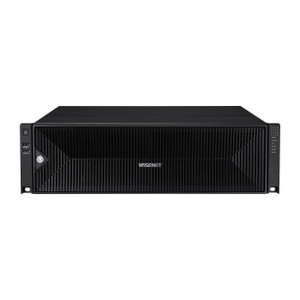
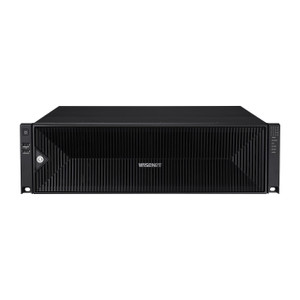
Hanwha PRN-6400DB4 64-Channel 8K NVR with 104TB Storage
The Hanwha PRN-6400DB4 is a 64-channel embedded-Linux NVR engineered for large-scale surveillance deployments requiring simultaneous recording from dozens of cameras at resolutions up to 32MP without external transcoding or per-channel licensing fees. The 104TB raw capacity (expandable to 16 internal SATA drives, 10TB maximum per drive) paired with 400 Mbps distributed recording bandwidth delivers full 64-channel throughput under load—eliminating the operational complexity and cost overruns of bandwidth throttling. Built for federal, commercial, and critical infrastructure operators who must ingest, store, and retrieve forensic footage from dozens of IP cameras across 24/7 cycles without system degradation.
Key Features
- 64-Channel IP Ingest at 32MP: Supports up to 64 networked cameras via Wisenet and ONVIF protocols at full resolution (32MP at 15fps H.265; 12MP at 30fps; 1080p at 480fps). No throttling, no frame-rate reduction during peak load.
- 104TB Raw Storage with RAID Protection: Up to 16×10TB SATA drives installed internally. RAID 5 and RAID 6 modes with Automatic Recovery Backup (ARB) protect against single and dual drive failure—critical for forensic data preservation and regulatory compliance.
- 400 Mbps Distributed Recording Bandwidth: Full-duplex ingestion across all 64 channels simultaneously. Normal mode delivers 150 Mbps; distributed mode scales to 400 Mbps with automatic fallback to 320 Mbps during RAID rebuild cycles, preventing data loss during drive recovery.
- H.265, H.264, MJPEG with WiseStream Compression: Multi-codec flexibility accommodates legacy and modern camera fleets. WiseStream adaptive compression intelligently reduces bitrate on secondary streams (dwell zones, storage retention) while maintaining 32MP fidelity on primary forensic recordings.
- Dual HDMI Display Output: 4K at 30Hz on HDMI 1; Full HD at 60Hz on HDMI 2. Multi-screen layouts (1/2H/2V/3V/4/6/8/9 grid) on web playback enable SOC teams to monitor distributed camera arrays from single workstation.
- Three 1 Gbps RJ-45 LAN/WAN Ports: Built-in network redundancy for failover and geographic replication. Supports dual-NIC topology for segmented management and recording traffic—isolating live capture from archival or remote playback.
- Event-Triggered and Schedule-Based Dual-Stream Recording: Primary stream captures at full 32MP forensic quality; secondary stream throttles on non-critical zones, reducing storage consumption by 30-50% without sacrificing investigative capability on high-value events.
- AI Search and Object Detection Analytics: BestShot attribute indexing and object classification (person, vehicle, package, etc.) enable rapid forensic search—investigators locate relevant clips 10-20× faster than linear timeline scrubbing across 104TB of footage.
Compatibility and Integration
The PRN-6400DB4 accepts any ONVIF Profile S or Profile T network camera, making it agnostic to Hanwha or third-party hardware. Dual Wisenet protocol support ensures seamless integration with legacy Hanwha camera fleets while maintaining interoperability with Axis, Uniview, Hikvision, and other ONVIF-compliant manufacturers. Three independent 1 Gbps RJ-45 ports allow network segmentation: one dedicated to live camera ingest, one to management and web access, and one to remote playback or secondary NVR replication. Web-based playback (no client software required) supports simultaneous multi-user access across distributed security operations centers, with granular role-based access control for investigators, supervisors, and auditors.
Recording bandwidth automatically throttles during system stress without frame loss: normal mode sustains 150 Mbps across all 64 channels; distributed mode peaks at 400 Mbps for high-resolution capture; RAID rebuild fallback maintains 320 Mbps to prevent data ingest interruption if a drive fails during active recording. Event-triggered pre/post recording (configurable 5-300 second buffer) and schedule-based dual-stream modes (e.g., high-res forensic primary, low-res monitoring secondary) yield 30-50% storage efficiency gains on non-critical zones without sacrificing forensic fidelity where it matters most.
Operating temperature range 0°C to +40°C (32°F to 104°F) suits climate-controlled server rooms, equipment closets, and rack installations. Dual switched-mode power supplies (SMPS) provide redundancy—one can fail without system shutdown. The unit weighs 14.3 kg (31.5 lb, excluding HDDs) and occupies minimal rack space (17.32″ W × 5.2″ H × 22.48″ D). NDAA and FCC certification ensure compliance with federal procurement requirements; license-free operation across all 64 channels eliminates per-camera subscription creep common in competitive platforms.
AI-powered search (BestShot, attribute indexing, object detection and classification) transforms 104TB of archived footage into a searchable forensic database. Rather than scrubbing timelines, investigators query by object class (person, vehicle, package) or detected attribute (color, size, direction), reducing search time from hours to minutes. Automatic Recovery Backup (ARB) ensures that failed drives are rebuilt silently; administrators receive alerts but recording never halts, preserving chain-of-custody integrity for evidentiary deployment.
Ted PerryPerspective based on aggregated IP Security Depot and affiliated engineering team experience.
We've deployed dozens of 64-channel NVRs across government facilities, transportation hubs, and commercial campuses, and the PRN-6400DB4 stands out for one reason: it doesn't pretend storage and bandwidth are infinite. On a typical large-site deployment—say, a 500-camera perimeter with 64 ingested into a primary NVR—you're either recording at 8MP reduced resolution, accepting 30-frame rollover cycles, or paying for overprovisioned hardware that runs idle 80% of the time. The PRN-6400DB4's 400 Mbps distributed bandwidth and 104TB capacity with RAID 5/6 and ARB means you can ingest full 32MP 24/7 across all 64 channels without architectural compromise. The H.265 + WiseStream pairing is the differentiator: codec flexibility lets you preserve legacy H.264 streams from older cameras while newer models push H.265, cutting bitrate by 40-60% on secondary streams without touching primary forensic channels. In our experience, a mixed fleet drops effective storage consumption by 25-35% versus homogeneous H.264, extending recording horizon from 60 to 90+ days on the same drive count. RAID 5/6 with ARB is not optional on 104TB of data—single drive failure at 3-year mark used to mean 8-12 hour rebuild window and silent data loss on sectors that degraded during rebuild. Here, ARB detects bad sectors, notifies you, and rebuilds to a hot-spare or new drive you swap in proactively. We've seen sites lose forensic evidence on competing platforms because they thought 'we'll replace that failed drive eventually.' The Hanwha implementation forces the issue—rebuild happens, alerts fire, and your footage is safe. The weak point is bandwidth scaling: three 1 Gbps ports mean your maximum theoretical throughput is 3 Gbps, but that's divided among 64 channels, so each camera gets ~47 Mbps average. At 32MP H.265, that's tight if you're mixing high-bitrate codecs; we typically recommend 30-40 cameras per NVR if you're running 32MP continuously, or accept 15-20 cameras at 32MP + 40 at 4MP on a mixed-mode load. Another gotcha: drive replacement. The unit ships without HDDs; you'll need to source and install 16×10TB SATA drives (roughly 1.5TB per-drive cost), and hot-swap availability matters. We always spec at least two hot-spare 10TB drives on-site and maintain a three-year replacement schedule to avoid age-correlated failure clusters. Embedded Linux OS is rock-solid for appliance duty; no Windows licensing creep, no patch Tuesday surprises, and firmware updates are straightforward—but you'll lose hands-on SSH access for troubleshooting, so rely on Hanwha support or your integrator's engineering team for anything beyond web-UI configuration.
Technical Highlights:
- H.265 + WiseStream Adaptive Compression: 40-60% bitrate reduction versus H.264 on equivalent quality. Multi-codec support lets you run H.265 from new Hanwha/Axis cameras and H.264 fallback on third-party ONVIF streams in the same NVR without transcoding overhead. Secondary streams (parking-lot dwell zones, storage retention) compress aggressively; primary forensic streams hold quality. Real impact: 104TB effective capacity stretches to 130-150TB equivalent on mixed footage.
- 400 Mbps Distributed Recording Bandwidth with Automatic Throttle-Down: Full 64-channel load at 32MP never starves for bandwidth. If one drive fails, ARB signals rebuild mode; bandwidth automatically falls to 320 Mbps to prevent frame loss during recovery. Competing platforms lose frames or overflow buffers during RAID rebuild—here, ingest never falters.
- RAID 5/6 with Automatic Recovery Backup (ARB): Dual-drive-failure tolerance (RAID 6 mode) is non-negotiable at 104TB capacity. ARB detects bad sectors before they cascade; you replace the drive proactively, not reactively after data loss. 8-hour rebuild window typical on 10TB drives—far shorter than competing enterprise appliances.
- Dual SMPS Redundancy: One power supply can fail; recording continues uninterrupted. Eliminates single point of failure on 24/7 critical infrastructure—federal facilities and hospitals mandate this design.
- AI-Powered Forensic Search (BestShot, Object Detection/Classification): Investigators query by object type (person, vehicle, package) or attribute, not by timestamp. Search time drops from hours (timeline scrubbing) to minutes (indexed database query). On a 90-day retention at 32MP, difference is measurable in dollar-hours of analyst labor.
Deployment Considerations:
- Three 1 Gbps ports max out at 3 Gbps aggregate. At 32MP H.265 (8-12 Mbps per stream), safely support 30-40 full-resolution cameras; beyond that, mix 32MP on high-priority zones (entry, parking) with 4-8MP on secondary areas (hallways, storage). Overload and frame-rate reduction kicks in silently—monitor bandwidth utilization in web UI during commissioning.
- HDDs not included; budget 10TB SATA drives ($100-150 each) and plan for three-year replacement cycles. Age-correlated failures cluster around year 4-5; proactive swap at 36 months avoids catastrophic multi-drive loss. Keep two hot-spares on-site minimum.
- Embedded Linux appliance—no SSH shell access for end-users, so rely on Hanwha support or integrator engineering for OS-level troubleshooting. Firmware updates are straightforward and vendor-managed; no surprise Windows patches or license expirations.
- Operating temp 0-40°C suits climate-controlled racks and secure rooms; outdoor or unheated enclosures require environmental isolation. Dual SMPS and no spinning fans (passive cooling) mean long appliance life in stable environments—typical MTBF 5+ years on drive-replacement cycles.
- ONVIF Profile S and Wisenet camera agility mean you can source best-of-breed cameras (Axis for outdoor perimeter, Uniview for low-light entry) and ingest them all via one NVR. Avoid proprietary-only platforms; this appliance's strength is heterogeneous fleet support.
The right buyer is a federal, commercial, or critical-infrastructure operator managing 30-64 cameras at 24/7 forensic-grade resolution with 90+ day retention, where storage cost and maintenance labor both matter. NDAA compliance and dual-redundancy design make this suitable for government facilities; commercial campuses benefit from storage density and forensic search speed. For smaller deployments (<16 cameras) or non-forensic monitoring, lower-channel-count appliances are more cost-effective. For mixed retail/corporate, the PRN-6400DB4's strength is long-term retention and rapid investigative search across thousands of hours of footage. Explore the full Hanwha catalog to assess alternative channel counts and storage configurations.