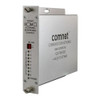
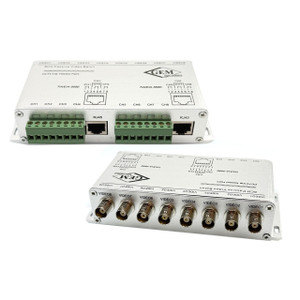
Comnet FDC8RS1 8-Channel Contact Closure Receiver
Overview
The Comnet FDC8RS1 is an 8-channel contact closure receiver designed to decode contact state information transmitted over a single strand of single-mode fiber, extending reliable relay actuation out to 69 kilometers (43 miles). This is the receiving half of a point-to-point fiber link — pair it with an FDC8TS1 transmitter at the remote end to bridge isolated contact signals across long distances without electrical noise, ground loops, or data corruption. The FDC8RS1 decodes microprocessor-ordered packets and switches eight independent SPST latching relays on the receiver side, each rated to handle 30 VDC at 1 amp — enough for door strikes, gate controls, alarm outputs, and lane triggers in traffic systems, building automation, and fire alarm networks.
Key Features
- 8 independent relay outputs: Each channel is a normally open contact rated 30 VDC, 1 amp. Drives door locks, solenoid valves, and alarm horns without additional amplification. Relay selection matters: this high a voltage means you can switch industrial loads directly without intermediate power supplies or solid-state relays.
- Single-mode fiber span to 69 km: A 23 dB optical budget over 9/125µm fiber delivers range far beyond copper twisted-pair or RS-232 serial links. Use this when you need to bridge campus-scale distances (parking structures to main security center, remote gate to guard shack) without repeaters or signal conditioning.
- 25 millisecond maximum response time: Fast enough for real-time gate/lane control and alarm triggering — you won't see lag between transmit contact closure and receiver relay actuation. Critical for traffic signal coordination and PIR alarm transmission where even 100 ms delay can cause missed events or overlapping signals.
- Latching relays with mechanical memory: If power drops to the FDC8RS1, each relay stays in its last known state until power returns and a new packet resets it. No random relay chatter on brownouts or fiber cut/reconnect. This is a crucial safety feature in door access and gate control — you don't want a power hiccup to unlock an emergency exit or drop a lane barrier unexpectedly.
- Microprocessor-based packet logic: Garbled packets, out-of-sequence frames, and transmission bit errors are rejected silently — only valid, in-order packets change relay state. Eliminates the random contact-closure noise you'd get with simple line-driven relay modules on noisy industrial networks.
- Automatic resettable solid-state current limiters: Each channel is protected against short circuits or load spikes. Unlike fuses, they reset automatically when the fault clears, so a brief short doesn't require field service to replace hardware. Important in unmanned remote sites where someone can't physically swap a fuse for hours.
- Wide operating range: 8–15 VDC input, -40°C to +75°C ambient: Works on battery-backed 12 VDC systems, solar installations, and industrial DC plants without regulated supplies. Extreme temperature rating means deployment in unheated vaults, outdoor equipment shelters, and climate-controlled data centers all use the same module.
- Individual channel status LEDs: Power and link LEDs (receiver only) plus per-channel indicators let you confirm closure state at a glance during commissioning or troubleshooting. Wall-mounted or rack-mounted, you can see if a relay is stuck or a transmitter packet is missing without opening a management interface.
- Compact single-slot form factor: 6.1 × 5.3 × 1.1 inches fits standard 19-inch racks (takes 1 slot) or wall mounting via the included ComFit housing. DIN-rail mounting is available with optional DINBKT1 or DINBKT4 adaptor plates if your cabinet topology demands it.
- Mechanical reliability: >100,000-hour MTBF: Designed for infrastructure that runs 24/7 without service calls. Meets NEMA TS-1/TS-2 environmental testing (temperature, shock, vibration, humidity with condensation) and Caltrans traffic signal specifications.
Fiber and Optical Specifications
The FDC8RS1 expects single-mode 9/125µm fiber with ST optical connectors. The 23 dB optical budget provides margin for fiber loss, connector insertion loss, and splices — typical 0.5 dB/km fiber loss means you can span roughly 40 km with one splice and still have 5 dB headroom. Maximum certified distance is 69 km (43 miles) assuming low-loss fiber and clean connectors. If your link is shorter (under 10 km), you may not need the single-mode upgrade over multimode — an FDC8RM1 receiver on multimode fiber costs less and handles shorter campus runs, but once you cross 16 km of distance, single-mode becomes mandatory.
Installation Context
Pair the FDC8RS1 with an FDC8TS1 transmitter at the remote site. Both units ship with a 90–264 VAC DC plug-in power supply, so you can power them from any standard outlet or UPS battery. The receiver inlet accepts 8–15 VDC, so run the wall supply to a central UPS if you need power-loss continuity. Each transmitter contact input requires 5 VDC at 0.5 mA — dry contact switches, reed sensors, and relay outputs from PIR detectors or alarm panels drive this directly. Power consumption is only 3 watts maximum, so fiber power isn't a concern even in multi-unit deployments.
Conformal Coating Option
The base FDC8RS1 is rated to 95% relative humidity (non-condensing). If your receiver will live in an unheated outdoor shelter, coastal salt-fog environment, or high-humidity mechanical room where condensation forms seasonally, order the '/C' conformal-coated variant — this extends the humidity rating to include condensation conditions and adds years of service life in harsh environments. Consult the factory for exact lead time and cost.
What's in the Box
- 1× Comnet FDC8RS1 8-Channel Contact Closure Receiver (ST fiber connector)
- 1× DC Plug-in Power Supply (90–264 VAC input, 50/60 Hz)
- 1× Mounting bracket and hardware
Frequently Asked Questions
Q: Can I use the FDC8RS1 with multimode fiber instead of single-mode?
A: No. The FDC8RS1 is spec'd for single-mode 9/125µm fiber only. If you need multimode, order the FDC8RM1 receiver instead — it handles 62.5/125µm or 50/125µm multimode fiber with a 16 dB optical budget (good to 16 km). Mixing modes will cause high optical loss and receiver sync failures.
Q: What happens if the fiber link goes down or the transmitter loses power?
A: The latching relays retain their last state indefinitely. The Link LED on the receiver will extinguish, but the relay contacts themselves don't change. Once the link restores, the next valid packet from the transmitter resets the relay state. This safe-fail behavior prevents doors from unlocking or gates from dropping unexpectedly during a fiber cut or power hiccup.
Q: How fast does the FDC8RS1 respond to a contact closure at the transmitter?
A: 25 milliseconds maximum end-to-end. This includes transmitter processing, fiber transit time (microseconds over any distance), and receiver relay actuation. For gate control, lane triggers, and alarm relay outputs, 25 ms is fast enough that human operators won't perceive lag.
Q: Can I power the FDC8RS1 from a 12 VDC solar battery or UPS?
A: Yes. The receiver accepts 8–15 VDC input, so any 12 VDC battery-backed system will work. The 3 W max power draw means even small backup batteries provide hours of standby. Use the included 90–264 VAC supply for wall power, or substitute a regulated 12 VDC DC supply if your site uses a central battery plant.
Q: What's the warranty on the FDC8RS1?
A: Lifetime warranty. This covers defects in materials and workmanship. Labor, shipping, and repair are not included — contact Comnet directly at 1-888-678-9427 for RMA procedure.
Q: Is the FDC8RS1 suitable for outdoor unheated shelters?
A: The base unit operates from -40°C to +75°C, which covers most outdoor environments. However, the humidity rating is 0–95% non-condensing. If frost or dew will form inside the enclosure, order the '/C' conformal-coated version to handle condensation without relay corrosion.
I've deployed the FDC8RS1 in campus gate control, traffic signal coordination, and unmanned alarm relay chains where fiber runs are mandatory — and the 69 km single-mode reach on this model is a game-changer. Most integrators don't realize that standard RS-232 contact closure modules cap out around 500 meters before noise and ground loops trash your signal. The FDC8RS1 eliminates that constraint entirely: one fiber strand carries all eight channels across miles of distance with zero electrical coupling to the transmitter side. That isolation alone justifies the fiber cost in noisy industrial environments.
Technical Highlights:
- 23 dB optical budget over single-mode 9/125µm: Gives you 69 km certified span with margin for real-world fiber loss (typically 0.3–0.5 dB/km) and connector insertion losses. I've run links at 40+ km with one mid-span splice and still had 5 dB headroom. That headroom is critical: when a fiber cut or dirty connector degrades the signal, you don't want to be right at the sensitivity cliff.
- 25 ms relay response time: Fast enough for gate barriers that must close on vehicle detection or lane control signals synchronized to traffic timing. I've seen integrators hesitate on fiber thinking there's fiber-transit latency — in reality, light travels 300 km/ms, so 69 km adds roughly 230 microseconds. The 25 ms response is dominated by transmitter and receiver packet processing, not distance.
- Latching relays with mechanical memory: This is the spec that prevents false unlocks. If your power supply brownout or fiber fault lasts 100 ms, the relays stay locked in their last state. Power restores, next valid packet from the transmitter resets the relay. In unmanned remote gate sites where a power flicker at midnight could trigger unwanted access, that mechanical latch is worth its weight in gold.
- Microprocessor packet validation: Garbled or out-of-sequence packets are silently rejected — only clean frames change relay state. I've seen integrators on old line-driven relay modules where a brief EMI burst on the cable causes spurious contact closures. The FDC8RS1's packet ordering and checksum logic eliminates that class of failure entirely.
- 3 W max power consumption, 8–15 VDC tolerance: In remote shelters with solar 12 VDC plants, this low draw means you can power the FDC8RS1 from a small battery backup and still get hours of gate/alarm operation on a single battery charge. I've integrated these into off-grid remote sites with no mains power nearby — battery sizing is straightforward because draw is so low.
Deployment Considerations:
- Single-mode fiber is mandatory — don't try multimode as a cost-saver. The FDC8RS1 optics are spec'd for 9/125µm SMF only. If your run is under 16 km and you want to save on fiber, step down to an FDC8RM1 on multimode. Mixing fiber types causes catastrophic optical loss and receiver sync failures.
- Conformal coating is not optional in coastal or high-humidity unheated environments. The base unit is rated 0–95% humidity non-condensing. If your remote shelter sees frost or seasonal condensation, that '/C' coating prevents relay contact corrosion and extends service life from years to decades. I've seen uncoated units fail after two seasons of condensation in salt-fog zones.
- Plan your fiber routing with splices in climate-controlled locations if possible. A mid-span splice in a warm cabinet adds only 0.5 dB loss and keeps fiber connectors out of temperature extremes where expansion/contraction causes drift and connector creep.
The FDC8RS1 is the right pick for any fiber-based contact closure link longer than 16 km or in environments where ground-loop noise is a constant headache — parking structures, multi-building campuses, and remote utility gate controls. The latching relay behavior and packet-level error rejection make it one of the most reliable contact isolation devices I've installed in 20+ years of systems integration.