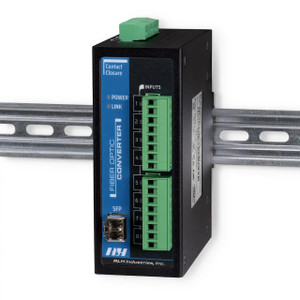
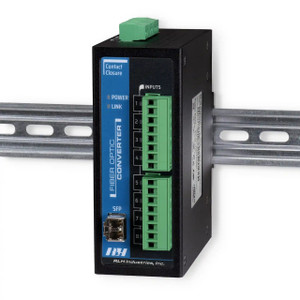
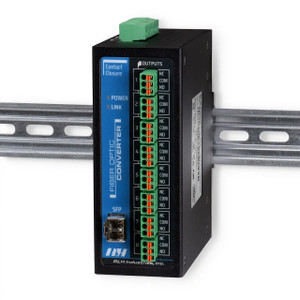
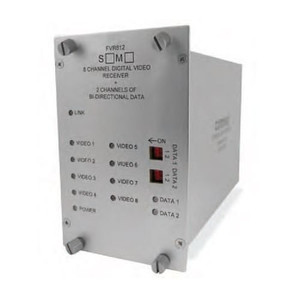
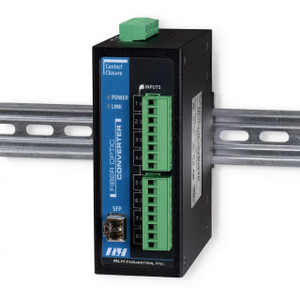
Comnet FDC80TS1 8-Channel Contact Closure Transmitter, Single-Mode Fiber
Overview
The Comnet FDC80TS1 is an 8-channel supervised contact closure transmitter designed to relay dry switch and relay contact states over a single strand of single-mode optical fiber. Built for fire alarm systems, intrusion detection, building automation, and industrial controls, the FDC80TS1 delivers contact closure transmission over distances up to 69 km (43 miles) with microprocessor-based logic that prevents random relay states if the fiber link is interrupted or power is lost. Paired with a compatible Comnet receiver (FDC80RS1 or FDC80NLRS1), this transmitter provides the isolation, distance reach, and supervision needed for mission-critical facility systems.
Key Features
- 8 independent supervised input channels: each input supports normally open or normally closed dry contacts, with built-in supervision to detect short and open circuit faults—critical for fire and intrusion systems where a severed wire must trigger an alarm, not silence the system.
- Single-mode optical fiber (9/125 µm): 23 dB power budget enables reliable transmission up to 69 km, making this unit viable for campus-scale or wide-area deployments where copper RS-485 wiring would be impractical or susceptible to EMI and lightning strike.
- Microprocessor-based packet transmission: contact closure information is encoded and sequenced; garbled or out-of-order packets are rejected before reaching the receiver relay outputs, preventing false alarm triggers or unintended equipment control.
- 25 millisecond typical response time (35 msec max): fast enough for real-time alarm signaling and automated door/gate control systems where sub-50ms latency is the standard for life-safety equipment.
- Low power draw (3 W max): runs on 8–15 VDC input voltage, allowing integration into battery-backed fire alarm control panels or UPS-powered security racks without requiring dedicated power infrastructure.
- Summary fault alarm output (Form C relay, 30 VDC 1A): receiver unit triggers a non-latching dry relay contact on any system fault (fiber break, power loss, transmitter failure), alerting the main control panel to a link problem so technicians can intervene before critical channels are offline.
- Wide operating temperature range (-40°C to +75°C): suitable for outdoor fiber termination cabinets, unheated equipment shelters, and industrial environments where standard commercial electronics would fail.
- Hot-swappable rack-mount design: fits 1 rack slot (transmitter) and integrates into standard 19-inch racks alongside fire panels, access control hardware, and network equipment without requiring removal of adjacent modules.
Integration & Compatibility
The FDC80TS1 works exclusively with Comnet single-mode fiber receivers in the FDC80 family—specifically the FDC80RS1 (latching relay, holds state on power loss) or FDC80NLRS1 (non-latching relay, returns to quiescent state). Both receivers accept the same fiber and produce the same 8 supervised output relay contacts, rated 30 VDC @ 1A resistive load. The choice between latching and non-latching depends on your control logic: latching receivers preserve contact state across power cycles (useful for fire alarm silencing or manual override logic), while non-latching receivers reset on power recovery (preferred for safety-critical systems that require positive action to re-enable after a fault).
External series and shunt resistors are factory-supplied for each of the 8 input channels, enabling the transmitter to detect open-circuit and short-circuit conditions on supervised inputs. This is a non-optional design requirement for UL-listed fire alarm and intrusion systems that demand supervised loops.
The system is certified to NEMA TS-1 and TS-2 standards for traffic signal equipment and Caltrans specifications, ensuring compliance with the environmental durability and electromagnetic compatibility requirements of transportation and public-safety deployments.
What's in the Box
The FDC80TS1 ships as a single transmitter module with screw-terminal connections for contact inputs, power, and alarm outputs. Receiver units and optical fiber are ordered separately. External supervision resistors are included with the transmitter for each of the 8 input channels.
Frequently Asked Questions
Q: What is the maximum transmission distance of the FDC80TS1?
A: 69 km (43 miles) over single-mode optical fiber (9/125 µm). This range assumes a 23 dB optical power budget. Actual distance depends on fiber quality, splice losses, and connector performance—have the fiber plant tested by your installer before deployment.
Q: Can the FDC80TS1 detect a severed fiber or failed transmitter?
A: Yes. The receiver unit includes a summary fault alarm relay (Form C, dry contacts, 30 VDC 1A) that triggers whenever the transmitter link is lost. This non-latching relay output can be wired to the fire or intrusion alarm panel's trouble or supervisory input to alert technicians to the fault.
Q: Does the FDC80TS1 work with both normally open and normally closed inputs?
A: Yes. Each of the 8 input channels can be programmed or configured for normally open or normally closed contacts. External resistors provided with the unit support this supervision mode.
Q: What happens to the relay outputs if power is lost to the transmitter?
A: The receiver relay behavior depends on the receiver model: FDC80RS1 (latching) holds its state through a power cycle; FDC80NLRS1 (non-latching) returns all relays to their quiescent (open) state. For life-safety systems, non-latching is often preferred to ensure a positive re-engage after power is restored.
Q: What is the response time between an input contact change and the output relay closing?
A: Typical 25 milliseconds, maximum 35 milliseconds. This latency is acceptable for fire alarm and intrusion signaling; check your control panel's timing specifications if sub-20ms response is required.
Q: Is the FDC80TS1 suitable for outdoor installations?
A: The FDC80TS1 itself operates -40°C to +75°C and can be mounted indoors or in an outdoor-rated enclosure. Fiber termination cabinets, splice closures, and mating connectors must be rated for your climate. Work with a qualified fiber contractor to specify environmental protection at the termination points.
I've spec'd the FDC80TS1 into a handful of campus fiber backbone projects, and the 69 km single-mode reach is the real differentiator here. If you're stringing supervised alarm contacts across a distributed facility—parking structures, remote gate houses, perimeter sensors—copper RS-485 is going to bleed signal over distance and pick up EMI noise from power lines. The FDC80TS1 eliminates that problem entirely, and the microprocessor-based packet validation means you won't get false state changes if the link glitches.
Technical Highlights:
- 23 dB optical power budget on single-mode fiber: translates to 69 km transmission over industry-standard 9/125 µm cabling—twice the distance of the multimode variant and a material advantage if you're feeding signals across a large university campus or industrial park without intermediate repeaters.
- 25 ms typical response time with microprocessor packet sequencing: ensures contact closures are transmitted in order and validated before the receiver relay closes, preventing random state changes from garbled frames—a hard requirement for UL-listed fire alarm and intrusion panels that demand a supervised control loop.
- 8 VDC minimum operating voltage on 3 W max draw: runs comfortably off the auxiliary power of most fire alarm control panels or a small 12 VDC UPS battery, no dedicated supply needed. The low current draw also means you won't tax the backup battery during a power outage.
Deployment Considerations:
- Single-mode fiber requires professional termination and testing; don't attempt field splicing unless you have OTDR equipment and documented loss budgets. A bad splice can choke the 23 dB budget and shorten your effective range.
- The summary fault relay is non-latching by default—it resets when power or the fiber link is restored. Confirm with your fire panel integrator whether you need the latching receiver variant (FDC80RS1) to hold alarm state across a restore cycle.
Position the FDC80TS1 in large-scale fire alarm or intrusion systems where contact closures must cross campus backbones or where EMI immunity and distance are non-negotiable. For a smaller building with all sensors within 500 meters, standard copper supervision circuits are simpler and cheaper.