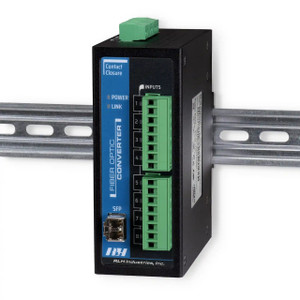
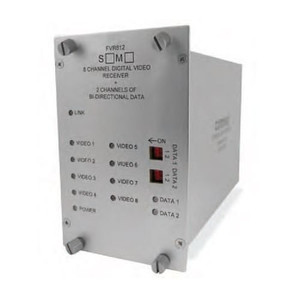
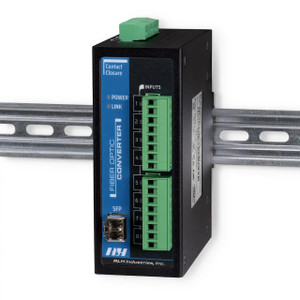
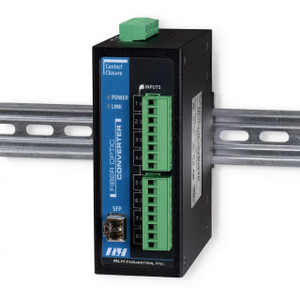
Comnet FDC8TS1 8-Channel Contact Closure Transmitter
Overview
The Comnet FDC8TS1 is an 8-channel contact closure transmitter designed to reliably encode and transmit discrete alarm and status signals over singlemode optical fiber. Built for industrial security and utility automation environments, this module uses microprocessor-based logic to convert up to eight independent contact closures into ordered data packets—eliminating the false relay triggers that plague unencoded serial transmission over long distances. The FDC8TS1 pairs with a corresponding receiver (FDC8RS1) to restore those signals at the remote end, maintaining state integrity even during power loss via mechanical latching relays.
Key Features
- 8-channel independent closure transmission: Each channel carries its own digital state. Useful for transmitting alarm zones, door triggers, gate status, or utility substation discrete inputs across distances where copper runs would introduce noise or require expensive shielding.
- Microprocessor-encoded packet logic: Closures are encoded into ordered data packets with built-in validation. Garbled or out-of-sequence packets are rejected before they reach the receiver relay—meaning a corrupted fiber signal or electromagnetic interference won't cause a false alarm.
- Singlemode fiber (1-fiber simplex): Transmits over a single strand of singlemode fiber, reducing cabling cost compared to multimode or dual-strand deployments. Singlemode fiber spans longer distances (10+ km typical) with lower loss, so this is the right choice for sprawling industrial sites or utility corridors where receivers sit far from control houses.
- Mechanical latching relays: Each output relay maintains its state even if power is lost. Critical in security and utility scenarios—a momentary power hiccup won't reset your door lock or trigger a false gate alarm.
- Per-channel and system status LEDs: Power LED and individual channel LEDs confirm transmitter activity and fiber link health. Simplifies field troubleshooting without requiring a serial terminal or VMS polling.
- Stand-alone and card-mount flexibility: Deploy as a standalone desktop/wall unit or integrate into a larger rack-mount enclosure. Comnet's modular approach lets you mix and match modules (contact closures, media converters, Ethernet switches) in a single industrial cabinet.
- TAA & NDAA compliant, Made in USA: Complies with Trade Agreements Act and National Defense Authorization Act Section 889 restrictions on foreign components and supply chains. No grey-market or parallel-import risk—sourced direct from the manufacturer's US production.
- Limited Lifetime Warranty: Covers defects in materials and workmanship for the operational life of the product, reflecting Comnet's confidence in industrial-grade component selection and testing.
Integration & Compatibility
The FDC8TS1 is one half of a simplex pair: it transmits, and the FDC8RS1 receiver restores the eight channels on the other end. Both units require DC power (typically 12–24V supplied via separate PSU or PoE injector depending on your enclosure). The transmitter accepts dry-contact inputs from security panels, PLCs, gate controllers, or utility RTUs. The receiver outputs dry relay contacts rated for low-voltage signal switching—suitable for triggering additional relays, LED indicators, or audio alarms downstream. Because this is a contact-closure device, not an IP-networked unit, it integrates seamlessly into legacy security and automation systems that predate Ethernet. Many integrators deploy FDC8 series modules inside industrial Comnet switches or hardened enclosures alongside fiber media converters and PoE injectors, consolidating entire security and networking backhauls into one ruggedized package. For complex multi-zone or multi-site deployments, you can cascade multiple FDC8TS1/RS1 pairs over different fiber pairs within the same cable run, provided you have a corresponding number of receiver channels at the other end.
Frequently Asked Questions
Q: Is the FDC8TS1 NDAA Section 889 compliant?
A: Yes. The FDC8TS1 is TAA & NDAA compliant and manufactured in the USA, meeting Section 889 restrictions on federal procurement. No Chinese-origin components or supply-chain conflicts.
Q: What fiber type does the FDC8TS1 use, and how far can it transmit?
A: Singlemode fiber (simplex, 1-fiber configuration). Singlemode typically supports distances of 10–20 km or more depending on your optical signal-to-noise requirements and receiver sensitivity. Contact Comnet pre-sales for site-specific distance calculations.
Q: Does the FDC8TS1 require a paired receiver?
A: Yes. The FDC8TS1 is a transmitter; you must pair it with an FDC8RS1 receiver at the remote end to restore the eight contact closure outputs. They operate as a simplex (one-way) link.
Q: What happens to the relay outputs if power is lost to the receiver?
A: The mechanical latching relays maintain their last known state. They do not reset or cycle on power loss, which is essential for door locks, gate solenoids, and alarm circuits.
Q: Can I integrate the FDC8TS1 into an existing Comnet industrial enclosure?
A: Yes. The FDC8TS1 supports both stand-alone and card-mount configurations, so it can be installed alongside Comnet Ethernet switches, media converters, and power distribution modules in a single hardened cabinet.
Q: What is the warranty?
A: Limited Lifetime Warranty covering defects in materials and workmanship for the operational life of the product.
The Comnet FDC8TS1 is a workhorse for integrators who need to haul discrete alarm and status signals across long fiber runs in utility, industrial, and critical-infrastructure environments. Unlike consumer-grade contact closure devices that fail under electromagnetic noise or distance, the FDC8TS1 uses microprocessor-encoded packet validation—each closure is digitally verified before the receiver acts on it. This eliminates the false triggers and race conditions that plague unencoded serial lines in noisy industrial sites.
Technical Highlights:
- Microprocessor-based packet encoding: Garbled or out-of-sequence packets are rejected before reaching the receiver relay, preventing false alarms from EMI or fiber signal corruption—critical in utility substations and perimeter security where false activations cost money or escalate.
- Singlemode fiber (1-fiber simplex): Supports 10–20+ km transmission with lower loss than multimode, reducing the need for intermediate repeaters or fiber regenerators on campus-wide or inter-site deployments. A single strand cuts cabling and conduit cost by half compared to multimode or dual-strand runs.
- Mechanical latching relays: Hold state across power loss. In door-control, gate-solenoid, or utility-load-shed scenarios, a power dip or UPS switchover won't cycle your outputs or trigger unintended actions—the relays stay locked at their last commanded state until the receiver explicitly toggles them.
Deployment Considerations:
- The FDC8TS1 is a transmitter-only device; pair it with an FDC8RS1 receiver at the remote end. You cannot use it as a standalone bidirectional controller—if you need command feedback from the receiver site back to the transmitter, you'll need a second fiber pair and a second pair of FDC8 units in the opposite direction.
- Singlemode fiber requires SC or ST connectors (or whatever your cabling plant uses) and optical splicing or mating at both ends. If your team has never field-spliced singlemode fiber, budget for a technician visit or pre-terminated jumper runs to avoid installation delays and signal loss from poor termination.
Deploy the FDC8TS1 in utility SCADA backhauls, perimeter-security zone aggregation across campus fiber, or industrial-plant alarm consolidation where long distances and electromagnetic noise make twisted-pair impractical. It's also the right choice for utility and critical-infrastructure sites that mandate NDAA compliance and made-in-USA sourcing.