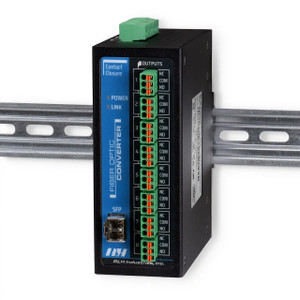
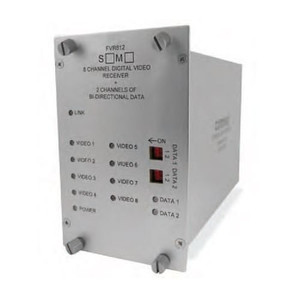
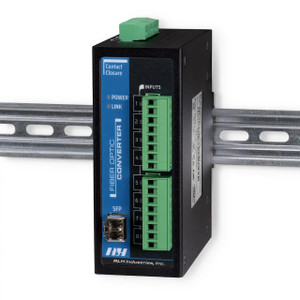
Comnet FDC8TM1 8-Channel Contact Closure Transmitter
Overview
The Comnet FDC8TM1 is an 8-channel contact closure transmitter that sends discrete alarm and control signals over a single multimode fiber strand up to 16 kilometers (10 miles). Purpose-built for security integrators and facility automation engineers who need to extend alarm inputs, door triggers, and relay commands from a central control panel to remote locations without running copper pairs or worrying about ground loops. Each channel uses an SPST latching relay rated for 30 VDC at 1 amp — enough to handle standard alarm circuits, siren outputs, and gate actuators. The transmitter draws 3W max from an 8–15 VDC supply, making it easy to integrate into existing power architectures on racks or in field enclosures.
Key Features
- 8 independent contact closure channels: Transmit up to eight discrete relay states simultaneously over one fiber link. Saves ducting and fiber cost compared to running individual pairs or bundled cabling to remote buildings or distributed sites.
- Microprocessor-ordered packet logic: Incoming contact closures are encoded into ordered packets and verified on the receiver end. Garbled or out-of-sequence packets are rejected, so a fiber glitch or momentary signal noise won't trigger a false relay closure — critical in fire alarm and access control chains where a spurious closure can evacuate a building.
- Latching relays hold state on power loss: Each of the eight SPST relays is mechanical latching, meaning they maintain their position even if the FDC8TM1 loses power. No state drift or relay chatter during a brief mains dip — the relay stays put until the transmitter sends an explicit change command.
- 25 millisecond maximum response time: Contact closures detected at the input are relayed to the receiver within 25 ms. Fast enough for real-time alarm signaling and gate control without perceptible lag in access-control workflows.
- 16 dB optical budget on multimode fiber: Supports up to 16 km of 62.5/125µm or 50/125µm multimode fiber. Distance accounts for fiber loss and typical connector/splice penalties — verify actual run length and patch panels with your fiber survey. For longer ranges or lower-loss budgets, specify the FDC8TS1 single-mode variant instead.
- Automatic resettable current limiters: Each relay output includes solid-state current protection that resets automatically without fuse replacement. Prevents a shorted load (e.g., a stuck solenoid coil) from cascading into a panel-wide shutdown.
- Individual channel status LEDs: Power LED plus separate LED per contact closure channel for visual confirmation during commissioning and troubleshooting. Speeds field verification — you can see at a glance which channels are active without logging into software.
- NEMA TS-1/TS-2 environmental compliance: Tested and certified for ambient operating temperatures -40°C to +75°C, storage to +85°C, and humidity up to 95% non-condensing. Meets traffic signal control and outdoor facility automation standards. If condensation is a risk, order the '/C' conformally coated variant for extended protection.
- Lifetime manufacturer warranty: Comnet backs the FDC8TM1 with a manufacturer warranty (see product documentation or contact Comnet directly for specific terms and exclusions).
- Hot-swappable rack-mount or standalone: The FDC8TM1 ships in a ComFit enclosure that mounts directly in a 1U rack slot or stands alone. Add optional DIN-rail adaptor plates (DINBKT1 or DINBKT4) for panel mounting in field cabinets or control rooms.
Integration & Compatibility
The FDC8TM1 is paired with a receiver unit (FDC8RM1 for multimode or FDC8RS1 for single-mode) to complete the link. Both units require one fiber strand and operate over standard ST optical connectors. Input contacts expect 5 VDC at 0.5 mA (typical alarm zone or logic output from a panel). Output relays can switch loads up to 30 VDC, 1 amp — suitable for siren circuits, door strike relays, and gate control solenoids. The internal DC power supply converts 90–264 VAC, 50/60 Hz mains to the required 8–15 VDC rail. No additional external power supply required unless you are powering from a battery backup or backup generator already supplying the cabinet. The unit meets IPC standards for circuit board assembly, ensuring long-term reliability in field temperature swings.
Integrate the FDC8TM1 into fire alarm systems, building automation networks, and lane/gate control installations where you need to separate buildings electrically (no ground loops through copper) and extend zone reporting or command lines across campus sites. Typical applications include transmitting PIR motion detector signals from remote perimeter sensors to a central alarm panel, or sending door strike relay commands from an access control server to gates across a campus without pulling individual control cables.
What's in the Box
- 1x Comnet FDC8TM1 transmitter unit
- 1x DC plug-in power supply (90–264 VAC input, 50/60 Hz)
- Terminal block connectors for contact closure inputs and relay outputs
- ST optical connector (fiber side; connector type verified on unit)
- Mounting hardware for wall, rack, or standalone shelf installation
Frequently Asked Questions
Q: What is the difference between the FDC8TM1 and the FDC8TS1?
A: The FDC8TM1 uses multimode fiber (62.5/125µm or 50/125µm) with a 16 dB optical budget and supports up to 16 km distance. The FDC8TS1 uses single-mode fiber (9/125µm) with a 23 dB optical budget and extends to 69 km. Choose multimode if your runs are under 15–20 km and you already have multimode infrastructure. Choose single-mode for longer campus links or if you need higher power margin through dense fiber routes with multiple splices.
Q: Can I use the FDC8TM1 with a receiver unit from a different brand?
A: No. The FDC8TM1 transmitter must be paired with a Comnet FDC8RM1 or FDC8RS1 receiver. The microprocessor packet encoding and latching relay control logic are proprietary to the Comnet FDC8 series. Using a different receiver will not reliably decode the contact closures.
Q: Does the FDC8TM1 work if the fiber link is interrupted?
A: Yes, with a caveat. The latching relays maintain their last known state if the link goes down. This means any relay that was ON will stay ON, and any relay that was OFF will stay OFF. If you need the relays to fall into a safe or failsafe position on link loss, you must add an external relay circuit or failsafe logic in your control panel to revert to a known state when the receiver reports link failure.
Q: Is the FDC8TM1 suitable for outdoor panel mounting?
A: Yes. The unit is NEMA TS-1/TS-2 rated for -40°C to +75°C and 0–95% humidity (non-condensing). It can be mounted in outdoor cabinets or vaults. If your location experiences condensation (coastal salt spray, high humidity), order the '/C' conformally coated option to extend protection into condensing environments.
Q: What happens if an output relay shorts to ground?
A: Each output channel includes an automatic resettable solid-state current limiter. If a load shorts (e.g., a solenoid coil fails), the limiter cuts power to that channel and resets automatically once the fault clears. No fuse replacement needed, and the other seven channels continue to operate normally.
Q: Can I rack-mount the FDC8TM1 in a standard 19-inch EIA cabinet?
A: Yes. The FDC8TM1 occupies 1 rack slot in the ComFit housing and can be installed directly into a standard 19-inch rack with other Comnet ComFit modules. Alternatively, use it standalone on a shelf or add optional DIN-rail adaptor plates for panel mounting in control rooms.
I've commissioned dozens of Comnet contact closure fiber links on multi-building campuses, and the FDC8TM1 is a workhorse for separating alarm zones and relay commands across long distances without ground-loop noise. The 25 millisecond response time and microprocessor-verified packet logic mean you won't wake up to a spurious fire alarm triggered by a momentary signal reflection or noise burst on the fiber link — real peace of mind when you're integrating fire alarm systems across rooftops.
Technical Highlights:
- Mechanical latching relays: Hold their state indefinitely on power loss, eliminating drift or chatter during facility power events. A relay that's ON stays ON until the FDC8TM1 explicitly commands a change — critical for maintaining access control or alarm state across a brief power dip without false triggers.
- Automatic resettable current limiters on every relay output: If a solenoid or siren coil shorts, the output current limiter isolates that single channel and resets automatically without fuse replacement. The other seven relays keep running, so a single hardware fault doesn't cascade into a panel shutdown.
- 16 dB optical budget over 16 km multimode: Accounts for fiber loss and typical connector/splice penalties on campus deployments. A 2-dB margin is tight, so verify your actual fiber attenuation and connector count during design — extra splices can eat into your headroom.
Deployment Considerations:
- The FDC8TM1 requires a paired receiver (FDC8RM1) to function — the two units work as a set. Order them together and test the complete link before installation. If you need longer distance or higher power margin, switch to single-mode fiber (FDC8TS1 + FDC8RS1 pair) up front rather than retrofitting later.
- The latching relay behavior means that if the fiber link fails, relays stay in their last state. For safety-critical applications (e.g., emergency gates or fail-safe door strikes), layer in a backup command path or wire the receiver's link-fault output into a failsafe relay logic so the control system can explicitly reset relays if the fiber goes dark.
Real deployment: I installed FDC8TM1 units to extend perimeter door-strike commands and PIR inputs from a central security office across a four-building campus connected by underground conduit. The latching relay architecture meant the access control system could maintain gate state through brief UPS switchovers without losing alarm continuity. Choose the FDC8TM1 when you need deterministic, noise-free relay transmission over fiber and can accept the latching behavior as a feature, not a limitation.