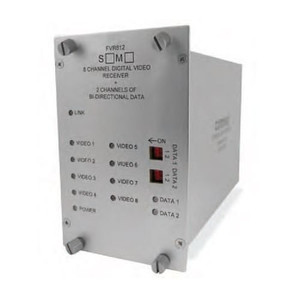
Comnet FVT8014S1 8-Channel Video Transmitter with Bi-Directional Data
Overview
The Comnet FVT8014S1 is an 8-channel digitally encoded video transmitter paired with 4 bi-directional data channels, designed to extend video and control signals over single mode fiber. This is the transmission half of a long-distance surveillance backbone — built for integrators deploying cameras and analytics systems across properties where traditional copper runs become impractical or unreliable. The FVT8014S1 digitizes and compresses video from up to 8 sources, then sends them down a single fiber strand while maintaining a separate 4-channel bi-directional data path for PTZ control, alarm signals, or analytics metadata return.
Key Features
- 8-Channel Video Encoding: Accepts 8 analog video inputs and converts them to digital format for transmission over fiber. Each channel runs independent timing, so you avoid synchronization headaches when mixing cameras from different vendors or installations.
- 4 Bi-Directional Data Channels: Send PTZ commands, alarm triggers, or sensor inputs downstream and receive status or analytics feedback upstream over the same fiber pair. Eliminates the need for separate copper control runs in harsh or long-distance deployments.
- Single Mode Fiber Transport: Single mode fiber supports longer distances than multimode — critical when your camera array spans across campus grounds, between buildings, or in industrial zones where PoE and coax runs become cost-prohibitive or vulnerable to electromagnetic interference.
- Digitally Encoded Architecture: Video is encoded before transmission, reducing bandwidth waste and improving signal integrity over distance. No passive balun tricks or signal degradation — the FVT8014S1 actively processes video to maintain usable quality at the far end, regardless of fiber run length within single mode specs.
- Compact Rack or Desktop Mount: Designed for installation in NOC racks, telecommunications cabinets, or headend rooms. The FVT8014S1 pairs with a matching receiver (FVR8014S1) to reconstruct the video and data channels at your NVR or monitoring station.
- Fiber Isolation and EMI Resistance: Fiber optic transmission is inherently immune to lightning strikes, RF interference, and ground loops — a decisive advantage in industrial yards, hospitals, or campuses prone to electrical noise that would degrade coax or twisted-pair performance.
Integration & Compatibility
The FVT8014S1 accepts standard NTSC or PAL video inputs (composite or S-video) and outputs them as a multiplexed digital stream over fiber. It pairs with the Comnet FVR8014S1 receiver to demultiplex and restore the 8 video channels and 4 data channels at your NVR or monitoring center. The bi-directional data channels support low-speed control protocols — typical applications include PTZ camera control, relay closure signaling, alarm input/output, and sensor data return. Because the data path is bi-directional, you can send commands out to remote cameras or devices and receive heartbeat or status signals back on the same fiber pair, reducing overall infrastructure complexity.
The FVT8014S1 operates on standard DC power (exact voltage and current specifications depend on configuration and should be verified with the unit's power supply datasheet). Installation requires standard single mode fiber termination and patch cord routing from your transmitter location to the receiver site — work with a fiber technician if you lack in-house splicing capability, as improper termination is the leading cause of signal loss on long runs.
Frequently Asked Questions
Q: What is the maximum distance supported by the FVT8014S1 over single mode fiber?
A: Single mode fiber supports transmission over several kilometers depending on the specific receiver model and signal attenuation budget. Consult the FVT8014S1 and its paired receiver (FVR8014S1) datasheets for exact distance specifications and any required signal conditioning equipment for ultra-long runs.
Q: Can the FVT8014S1 transmit HD or IP video directly?
A: The FVT8014S1 is designed for analog video inputs (NTSC/PAL composite or S-video). It encodes and transmits these signals digitally over fiber. If your cameras are IP-based (H.264/H.265), you will need a different fiber transmission system or an analog encoder at the camera end to convert IP to composite, then feed it to the FVT8014S1.
Q: Does the FVT8014S1 require a matching receiver on the far end?
A: Yes. The FVT8014S1 transmitter must pair with the Comnet FVR8014S1 receiver (or equivalent) to demultiplex the video and data channels back into usable analog video and control signals at your NVR or monitoring center.
Q: Can I use the 4 bi-directional data channels for anything other than PTZ control?
A: The data channels are general-purpose bi-directional — they support any low-speed control signal: relay closure outputs, alarm inputs, sensor data, or metadata from edge analytics boxes. Signal conditioning and protocol conversion (if needed) happens at the application level, not in the FVT8014S1 itself.
Q: What fiber type do I need for the FVT8014S1?
A: Single mode fiber (typically 9/125 micron). The FVT8014S1 will not work with multimode fiber, which has different attenuation and dispersion characteristics. Ensure your fiber plant is single mode from the transmitter location to the receiver.
Q: Is the FVT8014S1 suitable for outdoor or harsh environment deployments?
A: The FVT8014S1 itself is typically installed indoors in a headend or NOC. However, the single mode fiber connecting it to a remote receiver is inherently harsh-environment tolerant — fiber is immune to lightning, RF noise, and temperature swings. Your fiber routing (conduit, aerial, underground) and the outdoor receiver enclosure (if needed) should meet your environmental rating requirements separately.
The Comnet FVT8014S1 is a workhorse for surveillance installations spanning distance — the kind of deployment where you've got cameras at a remote gate, a field facility, or across multiple buildings and sending eight video feeds plus control signals down a single fiber strand eliminates the nightmare of pulling and terminating dozens of individual coax and copper runs. The FVT8014S1 encodes 8 analog video channels and multiplexes 4 bi-directional data channels onto one fiber path, which means your fiber technician runs a single single mode cable to the receiver site instead of eight separate feeds.
Technical Highlights:
- 8-Channel Multiplexing over Single Fiber Strand: Reduces fiber plant complexity and cost compared to routing eight individual video fibers to a remote location. One fiber run = 8 video channels + 4 control channels, cutting material and labor overhead significantly.
- 4 Bi-Directional Data Channels: Not just sending commands out — you get return data, so your remote PTZ cameras can send status heartbeats or your edge analytics box can stream detection alerts back to the headend without a separate return copper pair or second fiber.
- Single Mode Fiber Support: Single mode handles longer distances (kilometers) with lower attenuation than multimode, and is immune to the electromagnetic noise that kills coax performance in industrial or RF-heavy environments like refineries, hospitals, or power substations.
Deployment Considerations:
- The FVT8014S1 is the transmitter half only — you absolutely must have a matching Comnet FVR8014S1 receiver at the far end to demultiplex the video and data back into usable analog and control signals. This is not a standalone device.
- Fiber termination quality matters — a poorly spliced or terminated single mode connection will show immediate signal loss and video degradation. If your team lacks fiber splicing certification, budget for a qualified fiber contractor to terminate both ends. Bad termination is the #1 cause of field failures on these systems.
- Input video must be analog (NTSC/PAL composite or S-video). If your cameras are native IP or HD-SDI, you will need an analog encoder or converter upstream of the FVT8014S1 to get them into composite format first.
Deploy the FVT8014S1 when you've got a long-distance, multi-camera backbone to build — parking lot to headend, remote facility to NOC, or campus-wide surveillance where fiber is already in the ground or easy to route. The multiplexing efficiency and bi-directional data path justify the cost of matching transceivers when distance and EMI immunity are the deciding factors.