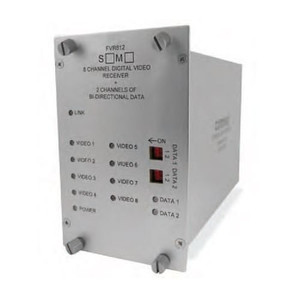
Comnet FVT8018M1SHR 8-Channel Digitally Encoded Video Transmitter
Overview
The Comnet FVT8018M1SHR is an 8-channel digitally encoded video transmitter designed to multiplex video and bidirectional data over a single strand of multimode fiber. This unit addresses a specific deployment need: long-distance video distribution in environments where copper cabling is impractical or introduces EMI/grounding risk. Eight independent video channels plus eight bidirectional data channels share the fiber path, reducing the physical cable plant footprint while maintaining signal isolation and integrity over extended runs.
Key Features
- 8-Channel Video Multiplexing: Each video channel is independently digitally encoded and transmitted over the shared fiber optic link—eliminating the need for eight separate coax or fiber runs and simplifying the backbone architecture in surveillance systems covering large facilities or campuses.
- 8 Bi-directional Data Channels: Separate from video, these channels support RS-485 or similar control data—enabling PTZ control, alarm relay signaling, or sensor integration without requiring dedicated twisted-pair cabling. Bi-directional capability means command and feedback traverse the same channel, reducing cable count.
- Single Multimode Fiber Transmission: The FVT8018M1SHR transmits all eight video streams and eight data channels over one multimode fiber strand. Multimode fiber is cost-effective for distances up to 2 km in typical surveillance deployments and requires less-stringent connector discipline than single-mode variants.
- Digitally Encoded Transport: Unlike older analog fiber video links, digital encoding protects against signal degradation, provides consistent video quality independent of fiber length, and allows for future codec upgrades without hardware replacement. This matters when you're running cables through conduit across multiple buildings or through industrial zones.
- Compact Form Factor for Integration: The transmitter is rack-mountable or wall-mountable, fitting standard 19-inch rack arrangements. This enables centralized video aggregation before distribution to NVRs or network switches, reducing the number of network endpoints and simplifying cabling.
- Industrial Fiber Optic Reliability: Fiber transmission is immune to radio frequency interference (RFI), lightning-induced surges, and ground loops—critical advantages in electrical substations, manufacturing floors, or outdoor cable runs passing near high-voltage equipment.
Integration & Compatibility
The FVT8018M1SHR is typically paired with a Comnet FVR8018M1SHR receiver at the opposite end of the fiber span. The transmitter outputs multiplexed video and data onto the fiber; the receiver separates the streams back into individual video outputs and data channels. Ensure your video sources (analog or compressed digital) and the receiver's input capabilities are matched. The eight data channels support standard serial protocols (RS-485, RS-422, or similar control signals), making integration with PTZ heads, door controllers, or relay modules straightforward once protocol and baud rates are confirmed with the receiver unit.
Deployment Scenarios
This transmitter excels in perimeter security for large campuses or industrial sites where cameras are distributed across multiple buildings—a single multimode fiber backbone can carry all video and control signals to a central NVR facility, eliminating the need for eight separate runs or expensive single-mode fiber infrastructure. It is also well-suited for EMI-hostile environments (near welding shops, motor controls, or RF emitters) where copper cabling introduces noise or grounding loops that degrade analog video quality or cause network interference.
Frequently Asked Questions
Q: What video formats or resolutions does the FVT8018M1SHR support?
A: The FVT8018M1SHR is a digitally encoded multiplexer and does not impose format restrictions—it transports whatever video stream your source sends (analog composite, CVBS, or compressed digital streams) as long as the receiver on the far end can decode it. Verify video source compatibility with the paired FVR8018M1SHR receiver.
Q: Does the FVT8018M1SHR work with multimode fiber only?
A: Yes. The FVT8018M1SHR is specified for multimode (mm) fiber. If your deployment requires single-mode fiber for distances beyond 2 km, consult Comnet's single-mode fiber transmitter variants (typically designated with 'SM' in the model number).
Q: Can I run the data channels and video channels independently?
A: The eight video channels and eight data channels are multiplexed over the same fiber and share bandwidth. The data channels are separate from video in the protocol stack, so you can control PTZ or send alarm signals independently of video transport, but the combined throughput is limited by the fiber link capacity.
Q: What is the maximum fiber run distance for the FVT8018M1SHR?
A: Multimode fiber with the FVT8018M1SHR typically supports distances up to 2 km. For longer runs, confirm attenuation and receiver sensitivity with your system integrator or Comnet documentation for your specific fiber grade.
Q: Does the FVT8018M1SHR require external power?
A: Yes, the transmitter requires AC or DC power (specific voltage and current requirements should be confirmed in the product datasheet). Ensure your installation includes a stable, protected power source and consider backup power for mission-critical surveillance backbone links.
Q: How do I connect the eight data channels to my control equipment?
A: The data channels are typically accessed via serial connectors (RJ-45 or DB9, depending on the specific unit variant). Each channel can be configured for RS-485, RS-422, or similar protocols. Confirm pinouts and protocol with the paired receiver and your control devices (PTZ, relay modules, sensors).
I've deployed the FVT8018M1SHR in a couple of sprawling industrial sites, and the fiber backbone simplification alone justifies the cost. Instead of running eight separate coax or cat6 cables across 1.5 km of underground conduit to a central NVR, you pull one multimode fiber and eliminate the ground-loop noise that used to plague our analog runs near the motor control center. The FVT8018M1SHR handles the aggregation at the camera end; the receiver unpacks it on the other side. Eight video channels plus eight control data channels over a single strand means less physical plant and fewer failure points.
Technical Highlights:
- 8 Video + 8 Data Channels on 1 Fiber: This multiplexing cuts your fiber count from eight down to one, a meaningful saving when you're boring conduit or running aerial fiber across multiple buildings. Each channel is digitally encoded, so signal quality doesn't degrade over distance the way analog signals do.
- Multimode Fiber Compatibility: At distances under 2 km (typical for campus or industrial perimeter deployments), multimode fiber is cost-effective and easier to terminate than single-mode. You avoid the premium pricing and precision-alignment headaches of single-mode connectors if your runs don't require them.
- Bi-directional Data Channels: Control signals—PTZ commands, relay triggers, sensor inputs—flow in both directions over the same channel. This eliminates the need for separate command and feedback cables, and integrates cleanly with existing serial control systems (RS-485, RS-422).
Deployment Considerations:
- Fiber termination discipline matters. Dirty or misaligned multimode connectors will introduce signal loss and eventually degrade or drop video channels. Budget for a trained fiber technician during installation, not an electrician doing their first fiber job.
- The FVT8018M1SHR must be paired with a Comnet FVR8018M1SHR receiver or equivalent. Mixing brands or models can introduce protocol mismatches or loss of data channels. Confirm the receiver specifications before final cable plant design.
- Data channel bandwidth is shared with video; if you're pushing high-speed or continuous serial traffic (e.g. GPS telemetry from multiple PTZ heads), verify that the combined data throughput doesn't exceed the fiber link capacity. This is rare in typical surveillance deployments, but watch it in sensor-heavy industrial setups.
This transmitter shines in perimeter-security deployments across large facilities where EMI is a constant headache and copper cabling introduces ground loops or interference. If you're aggregating 8 or more camera feeds from multiple buildings onto a single backbone, the fiber optic approach and this 8-channel multiplexer pay for themselves in reduced troubleshooting and cleaner signal paths.