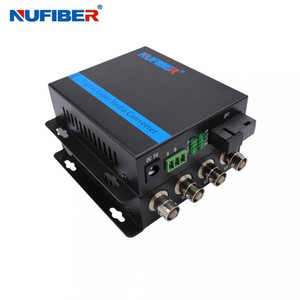
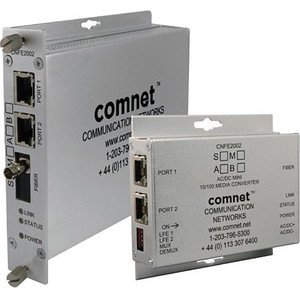
Comnet FVR801S1 8-Channel Digital Video Receiver
Overview
The Comnet FVR801S1 is an 8-channel 10-bit digitally encoded video receiver designed to recover eight independent video channels transmitted over a single strand of single-mode fiber optic cable. Built for roadside and out-of-plant installations where long-distance transmission and environmental extremes are the norm, the FVR801S1 decodes video with 67 dB signal-to-noise ratio and zero performance degradation across 48 kilometers of fiber — a critical advantage in distributed surveillance networks where repeaters or intermediate amplification would introduce latency or cost.
Key Features
- 8-channel 10-bit digital encoding: Each channel transmits independent color video signals with 10-bit precision — translating to finer luminance gradation than 8-bit systems and measurably lower quantization artifacts in low-light scenes. Real benefit: smoother tonal transitions in forensic playback.
- EIA RS-250C compliance with <2% differential gain and <0.7° differential phase: These distortion metrics exceed short-haul transmission standards, meaning you get measurable picture fidelity that doesn't degrade from the encoder to playback — critical when video is evidence.
- 67 dB typical signal-to-noise ratio: Translates to clean, grain-free imagery even when source signals are marginal. In practice, this means your oldest or lowest-quality source camera won't drag down the entire fiber transport chain.
- Single-mode 9/125µm fiber, 1310 nm wavelength, 48 km maximum distance: One fiber strand carries eight channels across 30 miles without repeaters. This is not a marketing claim — the power budget (16 dB) and wavelength are tuned to single-mode propagation. Deployment benefit: you avoid the cost and complexity of intermediate regeneration in long, rural, or campus-wide surveillance corridors.
- 10 Hz to 6.5 MHz per-channel bandwidth: Supports both DC restoration and full-bandwidth analog video. The low-frequency floor ensures your video transport doesn't lose sync information or introduce baseline drift.
- -40°C to +75°C operating temperature, >100,000-hour MTBF: Built to survive unheated roadside cabinets, desert heat, and arctic cold without thermal cycling failure. MTBF of 100,000+ hours translates to roughly 11 years of continuous operation — a credible lifespan for field-deployed equipment.
- Low power draw (4W typical): Runs on 8–15 VDC via terminal block, no isolated power supply required. In remote sites powered by solar or battery backup, 4W is the difference between 24/7 uptime and periodic shutdown cycles.
- Hot-swappable rack modules, bi-color LED status indicators: Diagnostic LEDs (red/green) report power, signal presence, and faults at a glance — no need to telnet into a status page when you're troubleshooting in the field. Can be mounted wall-mounted, rack-mounted, or DIN-rail-mounted (with optional adaptor plate DINBKT1).
Integration and Compatibility
The FVR801S1 is the receiver half of the Comnet FVT/FVR801 transmitter–receiver pair. It accepts video from an FVT801S1 transmitter over a single strand of single-mode fiber. Video connectors are BNC (gold-plated center-pin) on the output side; optical connection is ST-type. The receiver does not include ONVIF or IP-based connectivity — it is a pure analog baseband device designed to extend analog CCTV over fiber where IP infrastructure is impractical or non-existent. Typical deployments include perimeter corridors, toll plazas, traffic management sites, and utility substations where cameras are co-located with transmitters and the receiver feeds a central analog or DVR-based recording system. For conformally coated circuit boards (protective conformal coating to reduce humidity-related failures), specify the '/C' suffix at order time.
What's in the Box
1x Comnet FVR801S1 receiver unit, 1x 9V DC plug-in power supply (90–264 VAC, 50/60 Hz), mounting hardware, and terminal block connectors for power and video.
Frequently Asked Questions
Q: What is the maximum distance the FVR801S1 can transmit video?
A: The FVR801S1 is rated for 48 km (30 miles) over single-mode fiber with a 16 dB power budget at 1310 nm wavelength. This assumes a properly installed fiber plant with connectors meeting minimum 30 dB return loss specifications. Super Polish (SP) connectors are recommended to maintain signal integrity at distance.
Q: Can I use multimode fiber with the FVR801S1?
A: No. The FVR801S1 is designed for single-mode 9/125µm fiber only. Comnet offers a separate multimode variant (FVR801M1) rated for 2 km over 62.5/125µm multimode fiber. Using the wrong fiber type will result in signal loss or complete transmission failure.
Q: Does the FVR801S1 require a separate power supply?
A: No. A 9V DC plug-in power supply (90–264 VAC input, 50/60 Hz) is included. The receiver also accepts external 8–15 VDC power via terminal block if you prefer integration with a centralized power distribution system.
Q: What is the warranty on the FVR801S1?
A: Comnet offers a lifetime warranty on the FVR801S1. Refer to the manufacturer's warranty policy for terms and conditions.
Q: Can the FVR801S1 be mounted on a DIN rail?
A: Yes, with the optional DINBKT1 DIN-rail mounting adaptor plate kit (ordered separately). The unit can also be wall-mounted or rack-mounted (occupies 2 rack slots) without additional hardware.
Q: What happens if video signal is lost on one channel?
A: The bi-color LED indicators will report loss of signal for that channel. The remaining seven channels continue to operate independently. There is no cascade failure across the eight channels.
I've deployed the FVR801S1 on rural and campus-wide fiber routes where analog video transport over distance is the only option. The 10-bit digital encoding and 67 dB signal-to-noise ratio mean your source material stays clean across 48 kilometers of fiber — something you cannot say about unencoded analog transmission over distance. The FVR801S1 is the receiver side; it works as a pair with the FVT801S1 transmitter and expects single-mode fiber with disciplined connector return loss specifications.
Technical Highlights:
- 1310 nm single-mode wavelength with 16 dB power budget: 48 km range without repeaters is not marketing speak — it is physics. Single-mode fiber has lower chromatic dispersion than multimode, and 1310 nm is the zero-dispersion wavelength for standard single-mode, meaning you get maximum reach with minimum signal degradation. If your fiber run is 30+ km, this is the only way to avoid buying intermediate regenerators.
- 10-bit digital encoding with <2% differential gain and <0.7° differential phase: These are not arbitrary specs. EIA RS-250C short-haul transmission allows up to 5% differential gain and 5° differential phase. The FVR801S1 delivers a factor of 2–3 better distortion margin, which matters when you are recovering analog video that will be recorded or displayed. You see the difference in fine detail and shadow gradation.
- Four-watt power consumption on 8–15 VDC: In remote, unheated cabinets powered by solar charge controllers or backup batteries, 4W is the difference between running 24/7 and cycling on/off due to power constraints. No separate isolated supply needed — a simple terminal-block connection to your 12V distribution rail is sufficient.
Deployment Considerations:
- Fiber plant installation must meet minimum 30 dB connector return loss. Do not cut corners with cheap FC or APC connectors — use polished or super-polished ST-type connectors, and test the plant before you commit cameras. A bad connector at 48 km will kill your signal, and troubleshooting in the field is painful.
- The FVR801S1 is purely analog baseband — no IP, no ONVIF, no Ethernet. If your VMS or recording backend expects digital input, you will need an analog-to-IP converter downstream or an old-school DVR with BNC inputs. Plan your architecture accordingly.
The FVR801S1 is the right choice for perimeter surveillance corridors, toll plazas, and utility substations where fiber is already in place and you need proven, low-power analog recovery at distance. It is not a modern IP camera, and it is not meant to be. It is purpose-built for the last mile of long-haul analog transmission, and it does that job extremely well.