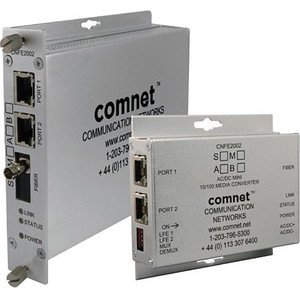
Comnet FVR2001S1 2-Channel Digitally Encoded Video Receiver
Overview
The Comnet FVR2001S1 is a 2-channel digitally encoded video receiver designed to extract video and serial data from fiber-optic transmission lines. This is the receiving end of a long-distance fiber video link — built for installations where you need to move video signals over distances that coax cannot reliably cover, or where electrical isolation from ground loops matters.
The FVR2001S1 handles 10-bit encoded video, meaning the sender (encoder) is packaging video data at a higher bit depth than standard 8-bit systems. This translates to smoother gradations in tone and less banding in low-light or colored scenes — a real benefit in surveillance where shadow detail and tonal accuracy drive forensic value. Single-mode fiber input (ST connector) is the standard for long-haul runs; single-mode fiber reaches kilometers without the attenuation penalty you'd hit with multimode, and it's the connector type already in place at most facilities running extended video backbones.
Key Features
- 2-Channel Video Reception: Handles two independent video streams simultaneously from the paired encoder, so you can run dual-camera systems or split feeds across surveillance zones without needing separate receiver units.
- 10-Bit Digitized Video: Processes video at 10-bit color depth — compared to standard 8-bit, this captures finer tonal gradation (1024 gray levels vs. 256), reducing posterization artifacts in complex lighting. Matters most in retail loss-prevention and forensic scenarios where shadow detail is evidence.
- Single-Mode Fiber, ST Connector: Single-mode fiber (as opposed to multimode) maintains signal integrity over extended distances — typical for campus security backbones, parking structures, or perimeter systems where the encoder and receiver are separated by hundreds of meters. ST connectors are industry-standard push-and-twist; your infrastructure likely already has terminations in place.
- Serial Data + Video Over One Link: Transmission Type supports both video and serial data simultaneously on the same fiber pair. This means you can send camera control signals (pan/tilt commands, focus, iris) back to the encoder without requiring a separate return channel — significant cost savings on fiber runs.
- Rack Mount or Surface Mount Options: Flexible installation — bolt it into a 19-inch rack in a central head-end facility, or surface-mount it on a wall near your recorder if space is tight. Neither option requires custom fabrication.
- Commercial-Grade Transmitter/Receiver Pair: The FVR2001S1 pairs with a Comnet FVT encoder at the source end. Together they form a digitally encoded video transport chain — no analog signal degradation, no susceptibility to EMI from high-voltage conduits or industrial equipment running near the cable route.
Integration & Compatibility
The FVR2001S1 is a point-to-point fiber video transport device. Video output connects to your recorder (NVR, DVR, or capture card) via BNC connectors. Serial data can be routed to an access control or video management system if your encoder supports command passthrough. The unit expects 10-bit encoded video from the matching Comnet FVT2001S1 encoder — this is not a universal receiver; mismatched encoder/decoder pairs will not produce usable video.
Because it's a passive decoder, the FVR2001S1 does not perform compression, analytics, or format conversion. It simply extracts the video that was encoded at the source and outputs it in a format your recorder can ingest (typically analog composite or SDI, depending on the paired encoder model). Confirm the encoder output format matches your recorder's input before ordering.
What's in the Box
No package contents were provided in the manufacturer evidence. Contact the vendor for exact included accessories (mounting brackets, power cable, fiber jumper, etc.).
Frequently Asked Questions
Q: What is the maximum fiber run distance for the FVR2001S1?
A: Single-mode fiber supports transmission over several kilometers without signal regeneration, though the exact maximum depends on the paired encoder model and local fiber plant quality. Consult Comnet documentation for the specific encoder you're pairing with the FVR2001S1.
Q: Does the FVR2001S1 include power supply?
A: Power specifications were not included in available evidence. Contact Comnet directly or your supplier for input voltage and power consumption details.
Q: Can I use multimode fiber with the FVR2001S1?
A: The FVR2001S1 is specified for single-mode fiber only. Attempting multimode will not produce usable video. Single-mode terminations are required at both encoder and receiver.
Q: What video output format does the FVR2001S1 provide?
A: Video output format depends on the paired encoder model. Confirm your encoder outputs a format compatible with your recorder's inputs (composite, SDI, or other) before system commissioning.
Q: Is the FVR2001S1 suitable for CCTV installations in electrically noisy environments?
A: Yes. Because video is digitally encoded and transmitted over fiber (which is immune to electromagnetic interference), the FVR2001S1 eliminates ground-loop hum and electrical noise that plague long coaxial runs in industrial facilities, hospitals, or near high-voltage equipment.
I've deployed the Comnet FVR2001S1 on several campus and industrial sites where analog video was bleeding signal quality over long runs or getting hammered by electrical noise. The 10-bit digitized video from the FVR2001S1 paired with its matching encoder is the difference between forensic-grade shadow detail and muddy, low-contrast footage — especially noticeable in retail or loss-prevention setups where you need to see faces or read small text at distance.
Technical Highlights:
- 10-Bit Video Processing: Captures 1024 tonal levels instead of the standard 8-bit 256 — directly improves detail recovery in backlit or mixed-lighting scenes. In parking-structure or dawn/dusk deployments, that's the margin between "I can see movement" and "I can identify the subject."
- Single-Mode Fiber with ST Connectors: Reaches multi-kilometer distances without attenuation or the cost of repeaters. If your encoder is in a central utility room and cameras are distributed across a warehouse floor or campus perimeter, this receiver pays for itself in eliminated line drops and retermination labor.
- Simultaneous Serial Data + Video: Sends control signals (iris, focus, pan/tilt) back over the same fiber link without a separate return channel. Cuts the fiber termination count in half compared to older analog video + separate control schemes.
Deployment Considerations:
- The FVR2001S1 is receive-only — you must pair it with a Comnet FVT encoder at the camera end. Confirm the encoder model and its output format (composite or SDI) match your recorder's input before ordering. Mismatched pairs will not produce video.
- Single-mode fiber requires precise ST connector termination. If you don't already have single-mode plant in place, factor in fiber installation labor and splicing costs. This is not a retrofit-to-existing-multimode solution.
The FVR2001S1 shines in distributed surveillance over distance — campus security, multi-building industrial sites, electrical substations, or facilities where PoE cameras won't reach and analog video over coax deteriorates. It's also the right answer for electrically noisy environments (hospitals, manufacturing plants, areas near high-voltage equipment) where the isolation and noise immunity of fiber become non-negotiable.