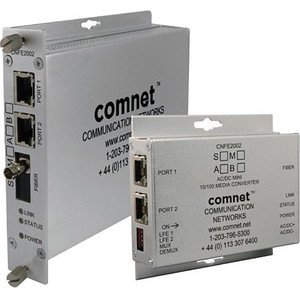
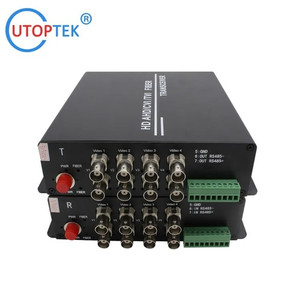
Comnet FVR401S1 4-Channel Digital Video Receiver
Overview
The Comnet FVR401S1 is a 4-channel digitally encoded video receiver designed to accept multiple NTSC, PAL, or SECAM CCTV signals transmitted over a single optical fiber. Built on 10-bit digital encoding technology, the FVR401S1 operates as the receiving end of a fiber optic video transmission system, paired with a corresponding Comnet fiber optic transmitter. This model supports single-mode fiber (9/125µm) at 1310nm wavelength, delivering a 23dB optical power budget that enables transmission distances up to 69 kilometers (43 miles) — far exceeding the 100-meter limit of direct coaxial runs. The unit is engineered for unconditioned roadside and out-of-plant installations where electrical interference, temperature extremes, or distance constraints make traditional baseband video routing impractical.
Key Features
- 10-bit digital video encoding: Converts four analog video channels into digitally encoded signals over a single fiber strand. This approach eliminates crosstalk between channels and preserves signal integrity across long distances — critical when routing video from remote traffic signals, highway interchanges, or rural camera sites back to a central monitoring station.
- 69 km maximum optical distance (23dB power budget): Single-mode fiber allows this receiver to work at distances impossible with coax or multimode fiber. A 43-mile range means you can place a remote camera site on a hilltop or at an industrial perimeter without intermediate repeaters, reducing infrastructure complexity and cost.
- Four simultaneous video channels on one fiber: Multiplexes four separate CCTV feeds onto a single optical strand, cutting fiber installation labor roughly in half compared to running one fiber per camera. For long-distance deployments (highways, utility corridors, water systems), this density advantage compounds the savings.
- EIA RS-250C short-haul compliance with exceptional video fidelity: Differential gain <2%, differential phase <0.7°, and tilt <1% mean the receiver outputs video distortion so minimal that standard CCTV monitors and DVRs see no perceptible quality loss. Signal-to-noise ratio of 67dB typical keeps image noise invisible in typical surveillance footage.
- Zero performance variation across the optical path loss range: Unlike analog fiber systems that degrade predictably with distance, this digital receiver maintains constant output quality whether the fiber run is 1 km or 69 km. You won't find yourself tweaking gain or chasing signal degradation problems.
- Automatic resettable solid-state current limiters: Protects all power and signal input/output lines from transient voltage spikes, power surges, and lightning strikes — essential in outdoor roadside cabinets where power quality is poor and lightning risk is high. No fuses to replace; the limiters self-reset automatically.
- NEMA TS-1/TS-2 and Caltrans certification: Third-party tested and validated for ambient operating temperature, mechanical shock, vibration, humidity with condensation, and transient voltage protection per traffic signal control standards. If your deployment is near roadways or in a certified traffic management system, this documentation proves compliance without additional validation work.
- Bi-color LED status indicators: Red/green LEDs on the front panel show critical operating parameters at a glance — no network login required to verify the fiber link is active and video is flowing. In a dark cabinet or remote enclosure, this tactile feedback is invaluable for field troubleshooting.
- Temperature hardened for unconditioned environments: Operating range -40°C to +75°C and storage range -40°C to +85°C mean the receiver survives desert heat, arctic cold, and unheated roadside cabinets without derating. Relative humidity tolerance to 95% non-condensing accommodates high-moisture environments (coastal areas, river valleys) without conformal coating — though optional '/C' conformal coating is available if you need condensation protection.
- ST optical connector and terminal block power input: ST connectors are field-rugged and widely used in outdoor fiber installations. Terminal block power accepts 8–15 VDC at only 3W draw, making it compatible with standard 12V cabinet power supplies and battery backup systems. No proprietary power supplies required.
- Lifetime warranty: Covers manufacturing defects indefinitely, a strong signal of build quality and long-term support.
Integration and Compatibility
The FVR401S1 pairs exclusively with the Comnet FVT401S1 (4-channel transmitter, single-mode fiber, 1310nm) or with multimode variants if your fiber infrastructure supports 1310nm but uses 62.5/125µm fiber instead. The receiver is universally compatible with any NTSC, PAL, or SECAM CCTV camera system — no adjustment to the optical module or video pathway is needed when swapping camera brands or changing video formats. The four BNC video outputs (gold-plated center pins for corrosion resistance) connect directly to any DVR, video matrix, or monitor input rated for 1V pk-pk baseband video. The system is completely transparent to the video signal path: no frame loss, no latency, no digital artifacts — the fiber link simply replaces a long coax run.
The receiver requires a fiber installation with a minimum optical power budget of 30dB. This specification ensures adequate optical signal margin at the maximum distance. Installation requires an ST fiber patch cable matching your fiber type (single-mode 9/125µm for the FVR401S1) and standard fiber termination practices.
What's in the Box
- 1x Comnet FVR401S1 receiver module
- 1x 9 Volt DC plug-in power supply (90–264 VAC input, 50/60 Hz)
Frequently Asked Questions
Q: What is the difference between the FVR401S1 (single-mode) and the FVR401M1 (multimode) receiver?
A: The FVR401S1 supports single-mode fiber (9/125µm) at 1310nm and achieves a 23dB optical power budget with a maximum distance of 69 kilometers. The FVR401M1 uses multimode fiber (62.5/125µm), also at 1310nm, but has a 16dB power budget limited to 2 kilometers. Choose the FVR401S1 for long-distance deployments (highway corridors, utility routes, remote sites). Choose the FVR401M1 for shorter runs (campus networks, industrial parks) where multimode fiber is already installed and cost is a factor.
Q: Can I extend the FVR401S1 beyond 69 kilometers?
A: No. The 69 km distance is set by the 23dB optical power budget and the 1310nm single-mode fiber specifications. To extend beyond 69 km, you would need an optical amplifier (EDFA) or a repeater node — neither is built into the FVR401S1. For distances beyond 69 km, consult Comnet for system design guidance.
Q: What power supply is included with the FVR401S1?
A: A 9 Volt DC plug-in power supply (90–264 VAC input, 50/60 Hz) is included. The receiver itself draws only 3W at 8–15 VDC, so the included supply is ample. If you prefer to integrate with a cabinet 12V power system, any regulated 8–15 VDC supply rated for at least 200mA will work.
Q: Is the FVR401S1 suitable for outdoor cabinet installation?
A: Yes. The FVR401S1 is rated NEMA TS-1/TS-2 and Caltrans certified for unconditioned roadside and out-of-plant environments. It operates reliably from -40°C to +75°C and tolerates up to 95% relative humidity (non-condensing). If you anticipate condensation inside your cabinet, specify the optional '/C' conformal coating variant (FVR401S1/C) for additional protection.
Q: Does the FVR401S1 require configuration or adjustment in the field?
A: No. The FVR401S1 is a plug-and-play receiver. Connect the ST fiber patch cable, apply power, and the four video channels appear on the BNC outputs. No electrical or optical adjustments are needed — the fiber link is transparent and requires no setup.
Q: What happens if the optical fiber signal is lost?
A: The bi-color LED indicators change state to red, signaling a fiber fault or transmitter failure. Video on the BNC outputs will drop (no signal). The receiver itself does not have a hold-last-frame function — it is a simple fiber-to-baseband video converter with no memory or regeneration logic. Restore the fiber link or check the transmitter to resume video flow.
I've deployed the FVR401S1 on highway corridor projects where running coax from a remote traffic camera site back to a central NOC was either impossible or prohibitively expensive. The 69-kilometer single-mode fiber reach is a game-changer for those scenarios — you can place a receiver in your central equipment room and pull one fiber from a hilltop camera array 40+ miles away. The FVR401S1 does exactly one job: it takes four CCTV video streams off a single-mode fiber and puts them on four BNC outputs without fuss, latency, or image degradation. The 10-bit digital encoding ensures EIA RS-250C compliance and zero video distortion across the entire optical path loss range.
Technical Highlights:
- 23dB optical power budget at 1310nm single-mode: Delivers 69 km maximum distance — about 40 times the reach of a standard 100-meter coax run. For utility companies, highway agencies, and rural surveillance networks, this eliminates repeater hops and the complexity that comes with them.
- Differential gain <2%, differential phase <0.7°, 67dB SNR: Video quality is indistinguishable from direct baseband output. Courts and law enforcement depend on this fidelity; the FVR401S1 preserves evidence-grade detail end-to-end without compression or regeneration artifacts.
- Four channels multiplexed onto one fiber: Installation crews run a single fiber strand instead of four, cutting labor costs and reducing conduit congestion — a real savings on long-distance outdoor routes where fiber is expensive to route and splice.
- NEMA TS-1/TS-2 and Caltrans certification: If you're integrating with traffic signal control systems or state DOT infrastructure, the third-party compliance stamp eliminates your validation burden and accelerates procurement.
- 8–15 VDC at 3W, resettable solid-state current limiters: Powers from any 12V cabinet supply; automatic current limiting survives transient voltage spikes from lightning, power surges, and poor grounding — common in outdoor roadside enclosures.
Deployment Considerations:
- The FVR401S1 is transparent and passive — it does not support any out-of-band monitoring or diagnostics beyond the LED status lights. If a fiber cut or transmitter failure occurs, you lose video with no automatic alert. Plan your network monitoring to periodically check video presence on each BNC output, or integrate with a VMS that monitors video loss.
- The included 9V power supply is adequate, but if your cabinet runs on 12V or 24V rails, you'll need to source a compatible 8–15 VDC supply — not a deal-breaker, but budget for it. The receiver draws only 3W, so any small 12V cabinet supply will handle it.
- Fiber installation quality matters: the system requires a minimum 30dB optical power budget. If your fiber runs dirty connectors, poor splices, or longer-than-planned routes, you may fall short. Always commission the link with an optical power meter before final installation.
The FVR401S1 is built for long-distance CCTV video transport in environments where distance, interference, or harsh temperature swings would kill coax — utility corridors, highway interchanges, remote industrial sites, and certification-driven traffic management systems. It is not a video encoder, not a DVR interface, and not a network device. It is a clean, reliable fiber-to-baseband translator for deployments where the alternative is four separate fiber runs or expensive repeater equipment.