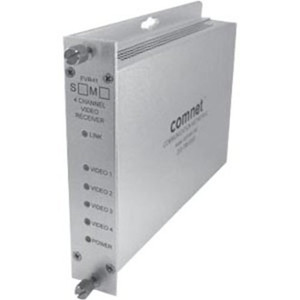
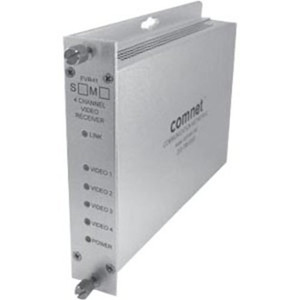
Comnet FVR414M1 4-Channel Digitally Encoded Video Receiver
Overview
The Comnet FVR414M1 is a 4-channel digitally encoded video receiver paired with 4 bi-directional data channels over a single fiber optic strand. This is a working solution for long-distance analog camera distribution where electrical isolation, EMI immunity, and distance (beyond copper limits) drive the decision. The FVR414M1 sits at the receiving end of a fiber run, taking 4 video streams plus serialized control and sensor data off the fiber and converting them back to baseband analog video (NTSC, PAL, or SECAM) and RS-232/422/485 data interfaces.
Key Features
- 4-Channel Video Reception over Fiber: Each channel carries a separate digitally encoded video signal, so you can run 4 independent camera feeds down one fiber pair. Eliminates the need for 4 separate copper video cables across long runs — a practical cost and infrastructure win in industrial or remote monitoring sites where trenching or conduit is expensive.
- 4 Bi-directional Data Channels: Beyond video, you get 4 independent serial data paths (RS-232, RS-422, RS-485). These handle PTZ commands, alarm inputs, sensor telemetry, or camera configuration traffic without sacrificing video bandwidth. Multi-mode fiber means shorter acceptable distances but lower cost than single-mode transceivers.
- Multi-Mode Fiber (ST Connectors): ST-terminated connections keep connector costs down and simplify field termination compared to single-mode LC or APC endpoints. Multi-mode is standard for campus-scale runs (up to ~2 km typical); if you need longer distances, upgrade to a single-mode variant in the Comnet fiber line.
- Dual Mounting Options (Rack or Surface): Flexibility to install in a central equipment rack at the receiving site or mount directly to a wall or pole-mounted enclosure. Rack mount saves space in crowded NOCs; surface mount works for remote shelters or cabinet-mounted setups.
- NTSC, PAL, SECAM Video Compatibility: Handles any standard analog video format, so retrofit into existing analog camera systems without worrying about format negotiation. This matters when integrating older surveillance cameras or regional standards outside North America.
- NEMA TS-1/TS-2 and Caltrans Compliance: Environmental/traffic certification signals durability in outdoor, road-side, or harsh-industrial duty. If this is destined for a transportation agency or outdoor utility deployment, these ratings are pre-qualified.
Integration & Compatibility
The FVR414M1 is the receiver half of a fiber-based video transport system. On the transmit side, you'll need a matching Comnet video transmitter (FVT414M1 or equivalent) to inject the 4 analog video signals and serial data into the fiber. The bi-directional data channels support standard industrial serial protocols — PTZ/dome controllers, relay outputs, and sensor inputs all speak RS-232/422/485, so integration with third-party access control, SCADA, or automation systems is straightforward.
Typical deployment: analog camera → transmitter (at site A) → single-mode or multi-mode fiber run → FVR414M1 receiver (at site B) → analog DVR, hybrid NVR, or network video recorder with analog input cards. The fiber span handles electrical isolation that would normally require opto-isolators or transformer coupling on copper lines, eliminating ground loop hum and lightning-strike vulnerability.
What's in the Box
Evidence of exact package contents was not found in the available documentation. Contact the manufacturer or your distributor for the specific kit contents (mounting hardware, power adapter, fiber patch cables, terminators, or other accessories may or may not be included).
Frequently Asked Questions
Q: What is the maximum fiber distance the FVR414M1 supports?
A: Multi-mode fiber (ST connectors) typically supports distances up to 2 km. Exact distance depends on the transmitter model and fiber grade. For longer runs, consider a single-mode variant in the Comnet product line.
Q: Does the FVR414M1 require external power?
A: Yes, the receiver requires DC power to operate. Specific voltage and current ratings are not detailed in the available evidence — consult the manufacturer's datasheet or technical support for power supply requirements.
Q: Can I use the FVR414M1 with modern IP cameras?
A: No. The FVR414M1 is designed for analog video (NTSC/PAL/SECAM). If you need to transport IP camera streams over fiber, you'll require a media converter or dedicated fiber gateway designed for Ethernet/network traffic.
Q: What serial protocols does the FVR414M1 data channel support?
A: The 4 bi-directional data channels support RS-232, RS-422, and RS-485. These cover most industrial control and PTZ command standards. Verify your specific device's serial pinout and protocol before integration.
Q: Is the FVR414M1 suitable for outdoor deployment?
A: The FVR414M1 is rated for NEMA TS-1/TS-2 and Caltrans compliance, indicating ruggedness in outdoor and traffic-adjacent environments. Ensure the mounting enclosure itself is weatherproof if installed exposed to rain or direct sun.
I've deployed fiber-based analog video receivers like the FVR414M1 in utility substations and remote highway camera arrays where copper cable runs would either exceed safe voltage-drop limits or present unacceptable lightning-strike exposure. The digitally encoded multi-mode fiber link on this unit means you get 4 camera feeds plus control data over a single fiber pair — that's a clean way to handle distributed analog surveillance without the bulk of 4 separate hardened cables and opto-isolator blocks.
Technical Highlights:
- 4 Independent Video Channels over Multi-Mode Fiber: Each channel carries a separate encoded video stream, so you're not time-multiplexing or sharing bandwidth between cameras. At a ~2 km fiber reach, this is solid for campus deployments or industrial sites with distributed camera arrays. The ST connector interface is easy to field-terminate if you need to splice or extend the run.
- 4 Bi-directional Data Channels (RS-232/422/485): The FVR414M1 doesn't just pass video — those 4 serial data ports let you send PTZ commands, alarm signals, or sensor telemetry back up the same fiber without eating into your video bandwidth. In a remote site with limited fiber entry points, this consolidation saves engineering complexity and termination costs.
- NEMA TS-1/TS-2 & Caltrans Certification: If you're installing this at a DOT camera station or an industrial facility with published environmental standards, the rating is already locked in. Saves the approval cycle.
Deployment Considerations:
- The FVR414M1 is analog-only — if any of your cameras migrate to IP-based models, you'll need a separate media converter or a purpose-built fiber gateway. Don't assume a fiber transceiver designed for Ethernet will work here.
- Multi-mode fiber maxes out around 2 km; if your camera site is further than that, budget for single-mode fiber and corresponding Comnet single-mode transceivers. The cost step is real, but necessary for longer backbone runs.
- You must have a matching transmitter on the far end — typically a Comnet FVT414M1. Verify the transmitter model supports the video format and data channels you actually need; don't assume all Comnet fiber video pairs are interchangeable.
This is the right tool for analog camera surveillance spanning long, electrically noisy distances — utility districts, airport perimeter arrays, and remote industrial monitoring. If your camera plan is purely IP-native or if fiber distance is under a few hundred meters, a managed network switch with media converters is often simpler and more cost-effective than dedicated video fiber transceivers.