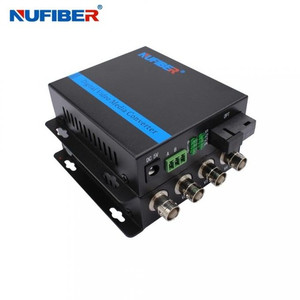
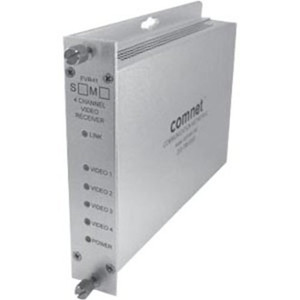
Comnet FVR40A4S 4-Channel Digitally Encoded Video Receiver + 4 Audio Channels SM 1 Fiber
Overview
The FVR40A4S is a 4-channel digitally encoded video receiver designed to extract real-time video and audio from a single multimode or single-mode optical fiber at distances up to 48 km. This is the receive end of a fiber-optic video/audio transmission system — paired with a compatible Comnet transmitter, it recovers four independent NTSC, PAL, or SECAM video channels plus four audio channels with no signal degradation across long outdoor or industrial runs where copper cabling would fail. Built for harsh environments (–40°C to +75°C), NEMA TS-2 rated, and factory-made in the USA with a lifetime manufacturer warranty, the FVR40A4S addresses the specific pain point of transmitting broadcast-quality CCTV and audio over fiber without introducing video noise, sync loss, or audio artifacts.
Key Features
- 10-bit digitally encoded video: Transmits EIA/TIA RS-250C short-haul quality video in digital form, meaning zero analog degradation. By the time the signal reaches the receiver, the video is reconstructed bit-perfect — no ghosting, no hum injection, no high-frequency rolloff. This matters in surveillance where you need forensic-grade playback across 48 km runs.
- 24-bit/96 kHz audio encoding: Professional studio-grade audio sampling at 96 kHz with 24-bit quantization delivers full bandwidth (20 Hz to 18 kHz) with 144 dB dynamic range. Compare this to typical analog CCTV audio (compressed, lossy, bandwidth-limited) — the difference is immediately audible on two-way intercom or facility communication links.
- Four independent audio and video channels per fiber: Each receiver extracts four separate video and four separate audio streams from one fiber pair, eliminating the cost and complexity of running four separate fiber strands or four separate copper pairs for analog video/audio multiplex.
- 48 km optical transmission range: Operates over multimode (typical 2 km) or single-mode fiber out to 48 km without repeaters or optical amplifiers. This distance is critical for highway surveillance, remote facility monitoring, or any perimeter application where copper distance limits (300–600 m) are not acceptable.
- No optical attenuators required: Wide dynamic range design means the receiver automatically adapts to different fiber loss levels (caused by splice counts, age, temperature) — no technician needs to manually insert variable optical attenuators or adjust gain. Plug, light it, and it works.
- NEMA TS-2 environmental rating and –40°C to +75°C operating range: Complies with traffic signal equipment environmental standards, meaning the unit survives salt-fog corrosion, UV exposure, thermal cycling, and humidity extremes without field failures. Roadside, parking lot, or unconditioned warehouse — the FVR40A4S does not require climate control.
- Hot-swappable rack modules and ComFit housing: The FVR40A4S fits into Comnet's ComFit modular rack system, allowing you to swap receiver cards without powering down the entire chassis. It also mounts standalone on a shelf or DIN rail (with optional DINBKT1 adapter plate) for flexible deployment in both rack rooms and field cabinets.
- Bi-color LED status indicators: Red/green LEDs confirm optical signal detection and operating mode at a glance — no need to SSH into a management interface or pull a multimeter to verify the link is live.
Integration & Compatibility
The FVR40A4S is completely transparent to any NTSC, PAL, or SECAM CCTV camera system. Because it operates on the analog video signal level (EIA/TIA RS-250C short-haul standard), it works with legacy analog security cameras, modern hybrid DVRs that accept analog baseband video input, and any facility already running analog CCTV infrastructure. No software drivers, no IP networking, no VMS integration required — the video emerges at the receiver as a standard analog composite signal ready to feed a monitor or DVR input.
Audio connections are line-level balanced (600 ohm impedance, +6 dBm maximum output), so the four audio channels from the FVR40A4S connect to any line-input audio mixer, intercom amplifier, or DVR audio input without preamplifier stages.
Voltage transient protection on all power and signal lines shields the receiver from surges caused by lightning strikes near fiber entry points, switching transients, or equipment disconnections — a critical safety feature in outdoor or remote installations.
What's in the Box
The FVR40A4S is supplied as a bare module. Rack mount brackets, power supplies, fiber connectors, and patch cords are sourced separately based on your specific installation geometry and fiber type (multimode or single-mode SC, ST, or LC connectors).
Frequently Asked Questions
Q: What is the difference between the FVR40A4S receiver and the FVT40A4S transmitter?
A: The FVT40A4S is the transmitter — it accepts four analog video and four analog audio inputs and encodes them onto a single optical fiber. The FVR40A4S is the receiver at the far end — it extracts those four video and four audio channels from the fiber and outputs them as analog baseband signals. You need both a transmitter and receiver pair to build a complete fiber video/audio link.
Q: Does the FVR40A4S require a separate power supply?
A: Yes. The FVR40A4S is a powered module and requires a DC power input (exact voltage depends on your power supply module; confirm with Comnet documentation for your configuration). Power is typically supplied via a Comnet power shelf or external PSU rated for the ComFit housing you are using.
Q: Can I use multimode fiber with the FVR40A4S, or do I need single-mode?
A: The FVR40A4S supports both multimode and single-mode fiber. Multimode fiber is simpler to install and less expensive but limits you to ~2 km per fiber run; single-mode fiber enables the full 48 km range. Choose based on your distance requirement. Your transmitter and receiver must use the same fiber type.
Q: Is the audio output from the FVR40A4S stereo or mono?
A: The FVR40A4S outputs four independent mono audio channels at line level (600 ohm balanced, +6 dBm max). You can pair them as two stereo pairs or keep them as four separate mono feeds depending on your audio routing needs.
Q: What warranty does the FVR40A4S carry?
A: The FVR40A4S carries a lifetime manufacturer warranty, reflecting the industrial-grade build and 40+ years of Comnet's fiber video transmission heritage.
Q: Is the FVR40A4S suitable for outdoor cabinet mounting?
A: Yes. NEMA TS-2 rating and the –40°C to +75°C operating range make it suitable for unconditioned outdoor cabinets, roadside shelters, and remote site installations. Ensure proper ventilation for airflow and protect the fiber entry point from direct water spray with strain relief boots.
The FVR40A4S hits a specific niche in fiber-optic CCTV: when you need four independent analog video and audio channels transmitted cleanly over distances that would saturate or lose signal on copper. I spec the FVR40A4S into deployments where the analog camera infrastructure already exists (legacy DVRs, established analog backbone) but the transmission distance or EMI environment rules out coax or twisted pair. The 10-bit digital encoding is the key — it means the video signal is converted to digital at the transmitter, rides the fiber immune to interference, and is reconstructed bit-perfect at the receiver. No hum, no ghosting, no sync jitter by kilometer 10 or 20.
Technical Highlights:
- 10-bit video encoding + EIA/TIA RS-250C compliance: Broadcast-grade video fidelity delivered unchanged across 48 km. Unlike analog video on long coax runs (which suffers high-frequency rolloff, reflections, and cross-talk), the FVR40A4S reconstructs the video signal with forensic clarity. Relevant if you're recording license plates or facial detail at a distance.
- 24-bit/96 kHz audio at 20 Hz–18 kHz: Professional audio bandwidth and dynamic range (144 dB). Means facility intercom, ambient audio recording, or two-way communication emerges clean and intelligible even over 48 km. Standard analog CCTV audio is compressed and bandwidth-limited — this is not.
- Four channels over one fiber pair: Reduces fiber strand count and splice cost. Instead of running four separate fiber pairs for four video/audio circuits, the FVR40A4S multiplexes all four onto one strand — a significant labor and material savings in long-distance or difficult-to-cable routes (river crossings, multi-building campuses).
- NEMA TS-2 / –40°C to +75°C: The unit is built to survive roadside or outdoor cabinet environments without climate control. Salt-fog and thermal cycling are non-issues.
Deployment Considerations:
- This is the receive end only — you must pair it with a Comnet FVT40A4S (or compatible) transmitter on the camera side. Mismatched or missing transmitter is the most common field gotcha.
- Fiber type (multimode vs. single-mode) must match between transmitter and receiver. Multimode gives you ~2 km; single-mode unlocks the full 48 km. If you plan to expand the run later, single-mode is the safer choice upfront, even if your first run is only 5 km.
- Optical connectors (SC, ST, LC) are not standardized in the box — you specify them at purchase. Confirm your site's fiber plant uses the same connector type before ordering patch cords.
- The receiver requires external DC power (no PoE). Plan for a UPS or backup power strategy if your DVR or recording system is also remote — fiber itself doesn't power anything.
Deploy the FVR40A4S when you're bridging a distance (highway corridor surveillance, campus perimeter, multi-site facility monitoring) where copper distance limits or EMI make analog CCTV impractical, but you don't want to rip out the existing analog camera plant and rebuild on IP. It's the bridge solution that lets you keep your DVRs and cameras running while extending the transmission distance cleanly.