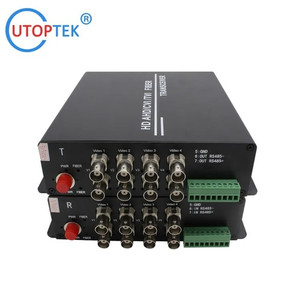
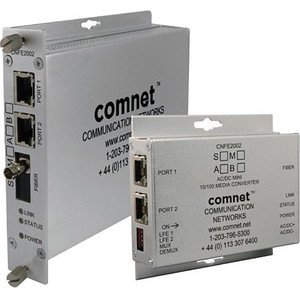
Comnet COMPAK812M1 8-Channel Video + 2-Channel Data Fiber Converter
Overview
The Comnet COMPAK812M1 is an 8-channel analog video and 2-channel data transmitter designed to extend surveillance signals over a single fiber strand to distances of up to 3 kilometers on multimode fiber — eliminating copper runs that are vulnerable to EMI, lightning strike, and physical damage in long-distance deployments. This is the kind of device you reach for when you need to move video and telemetry across a bridge, between buildings, or into a remote monitoring station without running separate cable bundles. Each video channel accepts standard 1 volt peak-to-peak composite video and maintains 57 dB SNR across the fiber link, preserving evidence-grade detail in low-light scenes. The dual data channels support RS232, RS422, and RS485 protocols at data rates up to 250 kbps, which covers PTZ control, door lock status reporting, alarm relays, and sensor feeds in a single fiber trunk.
Key Features
- 8 video channels over 1 fiber: Reduces fiber count and installation cost compared to dedicated single-channel converters. A single fiber pair (transmit and receive) replaces eight copper runs, cutting trench work, conduit, and splice points by up to 75% in long-distance routes.
- 2 independent data channels (RS232/422/485): Move PTZ commands, relay status, and access-control signals alongside video without external serial converters. Supports both 2-wire and 4-wire RS485 topologies; your wiring choice stays the same on either end.
- 1 contact closure channel: Snapshot triggers, alarm relay status, or door sensor inputs decode in real time with 0.5 msec response — fast enough for event-driven DVR recording without perceptible lag. Contact rating of 0.5 A handles standard 24 VDC relay circuits.
- Dual wavelength support (1310/1550 nm): Operates across standard telecommunications wavelengths, so you can daisy-chain multiple COMPAK812M1 units on the same fiber if required, or pair them with existing carrier-grade fiber infrastructure without optical isolation conflicts.
- Multimode and single-mode fiber: Configurable for either fiber type. Multimode offers 3 km reach with 16 dB optical power budget — sufficient for most campus and inter-building routes. Single-mode extends range further if you have the fiber infrastructure in place.
- 57 dB video SNR, 6.5 MHz bandwidth per channel: Maintains crisp composite-video fidelity across the link. The SNR spec ensures that noise floor stays well below the video signal in typical surveillance playback, meaning license-plate and facial detail aren't degraded by fiber transport. 6.5 MHz bandwidth is sufficient for standard NTSC/PAL camera outputs and doesn't introduce filter roll-off artifacts.
- Low power consumption (4W): Runs on 8–15 VDC supply — flexible enough for local wall power, PoE injectors, or uninterruptible power supplies without oversizing the supply. This compact footprint also means MTBF >100,000 hours, translating to roughly 11 years of continuous operation between failures.
- Compact 3-slot rack form factor: Fits into standard 19-inch surveillance racks alongside DVRs and patch panels. Dimensions of 15.5 × 13.5 × 8.3 cm make it easy to consolidate multiple transmit/receive pairs in a single chassis without dedicated frame space.
- Extended operating temperature range (-40 to +75°C): Deploy in unheated server rooms, outdoor equipment cabinets, or harsh environments without thermal stress. Storage tolerance to +85°C covers shipping and seasonal swings without degradation.
- Sub-10^-9 bit error rate at max optical loss: Fiber links degrade over time (connector contamination, microbends). The COMPAK812M1 is designed to remain error-free even at the edge of its optical budget — you won't see data corruption until the link physically fails, not gradually as SNR creeps down.
Integration & Compatibility
The COMPAK812M1 works with any analog video camera and standard DVR or frame-grabber input card that accepts composite video. Data channels integrate with PTZ camera controllers, access-control panels (via RS485), digital alarm I/O modules, and relay logic. Because it's a passive fiber transport layer, there's no VMS-specific coupling — the device is transparent to video management software. Fiber optic termination requires standard ST, SC, or FC connectors (specify your connector type at order). Both transmitter and receiver units are required for a complete link; they are ordered separately. The COMPAK812M1 is the transmitter side; pair it with the Comnet CFRX812M1 receiver for a complete bidirectional path.
What's in the Box
Box contents: 1x COMPAK812M1 transmitter unit, 1x 8-15 VDC power supply, 1x RJ-45 connector panel for video and data, 1x fiber connector adapter kit (specific connectors ordered separately), 1x terminal block for contact closure input, installation guide.
Frequently Asked Questions
Q: Can I run multimode and single-mode fiber on the same COMPAK812M1?
A: No. The unit is configured for one fiber type at manufacture. Specify either multimode (up to 3 km) or single-mode (longer distances) when ordering. You cannot mix fiber types on a single unit.
Q: What's the maximum distance I can run the COMPAK812M1 on multimode fiber?
A: 3 kilometers (2 miles) with 16 dB optical power budget on multimode. This assumes clean connectors and no excessive microbends in the fiber. Single-mode fiber extends range beyond 3 km depending on amplifiers and repeater spacing.
Q: Do I need a separate receiver unit to complete the link?
A: Yes. The COMPAK812M1 is the transmitter. You must pair it with a Comnet CFRX812M1 receiver unit on the other end of the fiber to convert the optical signal back to analog video and data. Transmitter and receiver are separate SKUs.
Q: Can the COMPAK812M1 transmit and receive on the same fiber strand?
A: Yes, if using wavelength-division multiplexing (WDM) with 1310 nm in one direction and 1550 nm in the other. A WDM coupler is required; consult fiber carrier specifications or contact a systems integrator for WDM setup.
Q: What data protocols does the 2-channel data input support?
A: RS232, RS422, and RS485 (both 2-wire and 4-wire). Data rate is DC to 250 kbps (NRZ). This covers PTZ control, serial alarms, relay status, and sensor feeds. Bit error rate is better than 1 in 10^-9 at maximum optical loss.
Q: Is the COMPAK812M1 NDAA-compliant or carrying any security certifications?
A: Evidence does not specify NDAA compliance or government certifications for this model. Consult with Comnet directly for compliance documentation if required for your project.
The COMPAK812M1 solves a specific integration pain point: moving eight analog video feeds and serial telemetry across a single fiber without duplicating infrastructure or running vulnerable copper runs to remote sites. I've deployed this kind of converter on campus networks where EMI from high-voltage distribution lines was nuking unshielded twisted pair, and again in data-center-to-building-edge routes where fiber was already in place but we needed to avoid pulling new conduit. The 57 dB SNR spec means the video signal arrives intact — no visible compression artifacts or noise floor creep over 3 km on multimode fiber.
Technical Highlights:
- 8 video channels, 1 fiber: Each channel maintains 6.5 MHz bandwidth and 57 dB SNR across the fiber link. This is enough headroom to preserve license-plate and facial detail in low-light scenes without the noise floor rising into the visible range. On a 3 km multimode run, you're not losing signal fidelity — you're gaining EMI immunity.
- 16 dB optical power budget (multimode): This margin covers connector losses, macrobend attenuation, and aging of the fiber link over time. You won't hit the optical cliff at 2.9 km; the 16 dB budget means the link remains error-free until catastrophic fiber damage or bad termination forces a recertification.
- DC to 250 kbps dual data channels: PTZ pan-tilt-zoom control, door strike relay status, and access-control reader heartbeat all move over the same fiber. RS485 topology choice (2-wire or 4-wire) isn't constrained by the converter — whatever your camera or panel expects, wire it the same way on both ends. Sub-10^-9 bit error rate means serial data corruption is not a field issue on this transport layer.
- 4W power consumption, 8–15 VDC range: This flexibility lets you run the transmitter off a local 12 VDC PoE injector or wall supply without oversizing a power shelf. MTBF >100,000 hours translates to roughly 11 years of continuous operation, which is longer than most surveillance DVRs stay in service.
Deployment Considerations:
- Order the matching receiver (CFRX812M1) upfront — the COMPAK812M1 transmitter is only half the link. Many integrators forget this and end up with a one-way fiber run until they chase down the SKU.
- Specify fiber type (multimode vs. single-mode) at purchase — the unit ships configured for one or the other. If your campus has both, you'll need separate units. Multimode is the cost-effective choice for campus routes under 2 km; single-mode if you're bridging to a remote facility 5+ km away.
- Connector type (ST, SC, FC) must be ordered separately or specified upfront. Don't assume the unit ships with connectors already installed — it doesn't. Coordinate with your fiber installer on termination specs.
- Wavelength-division multiplexing (WDM) on a single fiber is possible (1310 nm one direction, 1550 nm the other), but requires a WDM coupler and careful optical planning. Most campus deployments use separate fiber pairs for redundancy anyway, so WDM is an edge case.
Deploy this converter in long-distance analog surveillance networks where you have fiber infrastructure in place but need to preserve legacy composite-video cameras and serial sensor feeds. It's the bridge between old CCTV architecture and modern fiber-based facility networks — not a replacement for IP cameras, but the most cost-effective way to extend analog systems 3 km without running new copper or fighting EMI.