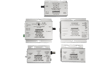
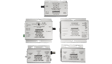
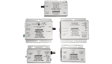
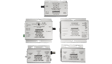
Comnet CNFE2005M2 2-Channel 10/100Mbps Ethernet-to-Fiber Media Converter
Overview
The CNFE2005M2 is a two-channel media converter that bridges 10/100 Mbps copper Ethernet to a single 100 Mbps optical fiber link. Deploy this when you need to extend surveillance camera or network connectivity beyond 100 meters of copper cabling—fiber runs let you reach multimode distances up to 3 km (2 mi) or singlemode distances up to 20 km (12 mi) without repeaters. The unit accepts two independent 10/100 BASE-T electrical inputs and consolidates them onto one optical port with Comnet's Mux/Demux feature (selectable via DIP switch), isolating traffic and preventing multicast flooding on the fiber uplink. Optional PoE+ capability (30W or 60W models available) lets you power remote devices directly from the converter, eliminating the need for a separate power supply at the camera location.
Compatibility
The CNFE2005M2 works with any IP camera or network device requiring 10/100 Mbps Ethernet. It is compatible with standard surveillance NVRs, managed Ethernet switches, and enterprise VMS platforms that recognize ONVIF-compliant devices. The ST connector variant (referenced in this model) integrates with existing fiber backbone infrastructure using ST-terminated patch cable assemblies. The converter supports IEEE 802.3, 802.3u, and 802.3at standards, so it integrates seamlessly into networks already running standard Ethernet and PoE infrastructure.
Installation Notes
Operate this converter in ambient temperatures from −40°C to +75°C and storage temperatures to −85°C, covering outdoor and non-conditioned warehouse environments. The unit draws only 3W without PoE load, keeping thermal dissipation minimal. Mount using the compact footprint (standard 6.1 × 5.3 × 1.1 inches or mini 4.1 × 3.7 × 1.1 inches) in cabinets, wall boxes, or DIN rail setups. If you are deploying the PoE models (CNFE2005M2POE or CNFE2005M2POEHO), they require a separately sourced 48–56V DC power supply. The Link Fault Pass-Through feature automatically detects electrical port failure and signals the head-end by switching the optical port state—useful for network monitoring. Auto-negotiation and MDI/MDI-X crossover eliminate manual media configuration.