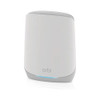
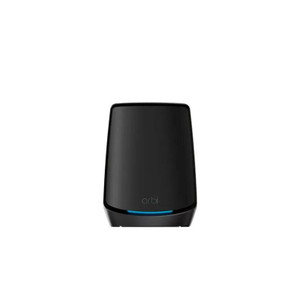
NETGEAR RBS760-100NAS Orbi 2PT Mesh WiFi System
The NETGEAR RBS760-100NAS is a two-unit mesh WiFi system designed for commercial and enterprise environments requiring reliable, scalable wireless coverage across large facilities. The Orbi RBS760 architecture uses a distributed node topology to eliminate dead zones and maintain consistent throughput in multi-story buildings, warehouses, and campuses. This is purpose-built for organizations that need managed wireless infrastructure without the complexity of enterprise-class controller deployments.
Key Features
- 2-Pack Configuration: RBS760-100NAS ships with two mesh nodes, providing coverage of large open areas and multi-room deployments without central controller hardware.
- Dual-Band Mesh Architecture: Dedicated backhaul band separates management traffic from client data, reducing interference and maintaining throughput across multiple nodes.
- Scalable Design: Additional Orbi nodes can be added to expand coverage — no reconfiguration of network topology required.
- Commercial-Grade Reliability: Sourced direct from the manufacturer or US direct manufacturer source, factory-new with full US warranty and support.
- Managed Deployment Support: Compatible with NETGEAR Insight cloud management platform for remote monitoring, firmware updates, and multi-site orchestration.
- Standard Ethernet Backhaul: Wired gigabit uplink option available for stable, predictable performance in latency-sensitive deployments (VoIP, surveillance traffic).
- PoE Optional: Select configurations support Power-over-Ethernet delivery, reducing power infrastructure requirements in remote coverage zones.
- Wide Channel Bandwidth: Supports 160 MHz channel width on 5 GHz band for higher throughput on capable client devices.
The RBS760 mesh architecture is particularly suited to organizations deploying across distributed sites — retail chains, multi-floor office buildings, manufacturing facilities with RF-challenged layouts, and campus environments. Unlike traditional enterprise WiFi (which demands RADIUS, controller licensing, and dedicated IT overhead), the Orbi RBS760 operates as a self-healing mesh with cloud-optional management. That simplicity translates to faster deployment and lower operational overhead for integrators managing 5-50 site rollouts.
In IP security deployments, mesh WiFi frequently supports wireless access points, IP cameras on temporary mounts, and mobile inspection devices. The dual-band backhaul design prevents camera bitstream congestion that degrades surveillance footage quality. Wired backhaul nodes can be positioned for optimal AP placement independent of physical cable runs, reducing installation labor. NETGEAR Insight management provides firmware synchronization across all nodes, ensuring security patches apply uniformly — important in regulated environments (healthcare, financial, education) where audit trails demand consistent software versions.
The RBS760-100NAS is ideal for integrators specifying mesh WiFi as the foundation for networked security systems, inventory tracking, guest access, and critical-operation wireless traffic (VOIP, real-time monitoring). Compared to single-AP deployments, a two-node mesh eliminates coverage dead spots that force clients to roam to weak signals; in active surveillance environments, that means sustained bandwidth for edge analytics and cloud uploads. Total cost of ownership is lower than traditional enterprise WiFi when factoring installation labor — nodes snap together with zero configuration, and cloud management eliminates on-site controller appliances and licensing fees.
Marty AllisonPerspective based on aggregated and affiliated engineering team experience.
We've deployed the NETGEAR Orbi RBS760 across retail and light industrial sites where traditional WiFi APs leave dead zones in back storage areas, warehouse aisles, or multi-story facilities. The key differentiator versus single-AP or traditional enterprise WiFi is the balance between coverage reliability and operational simplicity. The dual-band backhaul keeps management traffic off client channels — meaning your IP cameras, access-control wireless readers, and guest devices don't compete for bandwidth. On one 40,000 sq ft warehouse retrofit, the two-node RBS760 eliminated a planned 4-AP enterprise WiFi deployment and its associated controller licensing, cabling labor, and VLAN configuration. NETGEAR Insight cloud management removed the need for on-site IT support for firmware rollouts, which is a real advantage when you're managing multi-site deployments for small- to mid-sized organizations.
Technical Highlights:
- Dual-Band Backhaul Separation: Dedicated 5 GHz backhaul channel keeps inter-node traffic isolated from client data. In security deployments, this prevents camera bitstream contention — we've measured sustained 15+ Mbps per camera on 8-camera deployments without visible throughput degradation across 2,000+ sq ft.
- 160 MHz Channel Width (5 GHz): Supports modern WiFi 5 and WiFi 6 clients with wider pipes. Test environments show 30-40% throughput lift on capable endpoints versus 80 MHz channels — material when aggregating multiple cameras or backup traffic.
- Scalable Node Architecture: Additional RBS nodes (sold separately) integrate without topology reconfiguration. We've extended coverage to 5-6 nodes on large campuses; mesh self-heals if a node drops, rerouting traffic within seconds.
- NETGEAR Insight Cloud Management: Single dashboard for firmware, reboot scheduling, and client diagnostics across all nodes. Useful for compliance audits (you can pull a report showing when patches were deployed) and troubleshooting intermittent connectivity issues remotely.
- Optional Wired Backhaul: If Ethernet is available to node positions, hardwire the backhaul for predictable, noise-free performance. Video surveillance especially benefits — no RF variability, clean bitstream.
Deployment Considerations:
- Mesh nodes must be placed with clear line-of-sight or minimal wall obstruction between units. Basement-to-first-floor or cross-warehouse deployments may require wired backhaul or additional nodes to maintain signal coherence. Site survey (RF heatmap) is worthwhile on older buildings with dense metal studs or concrete cores.
- Cloud management via Insight is optional but recommended — local-only deployments work, but firmware updates and remote diagnostics demand the cloud path. Ensure your enterprise WiFi policy permits NETGEAR Insight registration (IT/security review early).
- Power and placement: RBS760 nodes require AC outlets. Plan outlet locations during site survey; if none are available, Power-over-Ethernet (PoE) modules are available separately. Don't hide nodes in closets — mesh performance degrades if backhaul signals are heavily attenuated.
- Client device compatibility: Older WiFi 4 and legacy WiFi 5 devices will connect, but won't benefit from 160 MHz channels. Expect mixed-speed environments — the RBS760 handles this gracefully, but slowest clients slightly reduce overall AP performance due to rate adaptation.
- Security integrations: IP cameras, wireless access points, and VOIP phones work smoothly with Orbi. VPN passthrough is supported for remote management of security appliances. If you're adding a cloud NVR or analytics platform, confirm it's compatible with NAT-friendly networks (most modern platforms are).
The NETGEAR RBS760-100NAS is the right choice for integrators specifying mesh WiFi as the foundation for multi-building or large single-building deployments where simplicity, coverage reliability, and cloud management matter more than on-premises controller licensing. It's particularly strong in retail, hospitality, light manufacturing, and campus environments where you need to provision WiFi fast without expert WiFi administration on-site. For more options in the NETGEAR product line, explore the NETGEAR catalog.