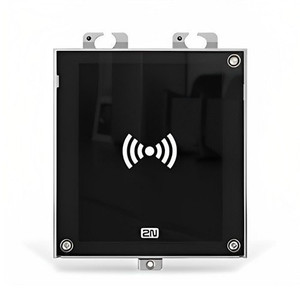
2N 02772-001 Multi-Protocol Access Reader
The 2N 02772-001 is a network-connected credential reader built to eliminate the complexity of managing heterogeneous access control environments. Rather than deploy separate hardware for legacy cards, mobile credentials, and smart cards, the 02772-001 handles four distinct protocols—BLE, 125kHz RFID, 13.56MHz, and NFC—through a single device. This consolidation cuts installation complexity, reduces network switch port consumption, and lowers total cost of ownership when retrofitting mixed-credential deployments or managing multi-tenant facilities where standardization across all users is impractical.
Integrators routinely encounter sites where legacy 125kHz card infrastructure coexists with modern credential requirements: smartphone-based access, contactless payment integration, or multi-factor authentication workflows. The 02772-001 bridges that gap by treating protocol diversity as a deployment asset rather than a liability. That flexibility scales from small office retrofits to large campuses where credential migration happens incrementally over months or years rather than in a single cutover event.
Key Features
- BLE (Bluetooth Low Energy) credential support — enables smartphone-based access without requiring a dedicated mobile credential platform. Users present their phone and authenticate directly; BLE's minimal power draw means longer practical range than traditional Bluetooth, and no drain on the reader's battery reserves. Useful for BYOD (bring your own device) scenarios where standardization on a single credential issuer is unrealistic.
- 125kHz RFID backward compatibility — maintains support for existing legacy card libraries. This is the single largest barrier to retirement of older access control systems; the 02772-001 removes the pressure to decommission working card stock immediately, allowing phased migration to newer credential types over time.
- 13.56MHz protocol handling — supports modern ISO/IEC 14443 Type A/B smart cards and NFC-enabled credentials. Critical for organizations adopting contactless payment systems, government-issued ID integration, or higher-security multi-factor authentication schemes.
- Native NFC support — allows consumer smartphones running standard NFC applications to function as credentials. Reduces friction in access workflows compared to proprietary mobile apps, particularly valuable in environments with high staff turnover or visitor access requirements.
- Single network connection — all four protocols funnel through one IP endpoint, simplifying integration with access control panels, cloud identity platforms, or VMS systems. Reduces network switch port consumption compared to four separate readers and lowers infrastructure cost proportionally.
- IP/Ethernet connectivity with REST API — communicates via standard open protocols to backend access management systems. No proprietary drivers, no vendor-specific VMS modules required—the 02772-001 integrates with existing identity management stacks (SAML, OAuth, webhook-based systems) without modification to access control logic.
- Retrofit-ready form factor — mounting compatibility aligns with existing door hardware, minimizing physical site modifications during technology rollouts. Particularly valuable in environments where construction or downtime approval is difficult to obtain.
Integration and Deployment Context
From an access control architecture perspective, the 02772-001 serves as a credential input normalizer. Its role is to accept any of four credential types and present authenticated identity to a backend access controller or identity management system. This isolation of the reader from the access decision logic means existing systems integrate without modification, whether they run on-premises, in the cloud, or across hybrid environments.
The device draws minimal power via PoE or a separate power supply, and communicates via REST API or webhook to your existing stack. No special VMS infrastructure or proprietary integration modules required—the 02772-001 speaks standards-based protocols.
Common deployment scenarios include:
- Enterprise office access during credential migration: legacy 125kHz cards coexist with BLE mobile credential pilots, allowing gradual staff onboarding without forcing immediate card replacement.
- Multi-tenant buildings: different tenants maintain different credential policies, and the 02772-001 supports all types within a single physical reader, reducing per-door hardware count.
- Warehouse and logistics facilities: seasonal staffing benefits from quick mobile credential provisioning alongside permanent employee card-based access.
- High-security environments: physical card + smartphone approval for multi-factor authentication on sensitive doors.
Why Multi-Protocol Consolidation Matters
Single-protocol readers force a binary choice: either standardize all credentials on one technology (costly cutover, disruption to existing infrastructure) or deploy multiple readers per door (installation complexity, switch port exhaustion, higher maintenance footprint). The 02772-001 removes that false choice. By handling all four protocols in one footprint, it reduces hardware, cabling, and operational complexity—particularly valuable in retrofit scenarios where budget or access constraints make wholesale system replacement impractical.
What's in the Box
No package content details available in the evidence. Contact the manufacturer or your integrator for inclusion items and mounting templates.
Frequently Asked Questions
Q: Does the 2N 02772-001 support smartphone credentials without a dedicated mobile credentialing platform?
A: Yes. BLE and NFC protocols allow standard consumer smartphones to authenticate directly. You do not need to purchase a separate mobile credential issuer or app licensing platform—the reader presents the credential to your existing access control backend, which handles the authentication decision.
Q: Can I keep existing 125kHz card readers in service while adding the 02772-001?
A: Yes. The 02772-001 is designed for retrofit scenarios. Existing legacy card readers can remain in service during a phased migration. The 02772-001 supports the same 125kHz credentials, allowing you to retire older readers on your schedule.
Q: What access control systems does the 02772-001 integrate with?
A: The device communicates via REST API and webhook standards to backend access control panels, cloud identity platforms, and VMS systems. It does not require proprietary drivers or vendor-specific modules. Confirm your specific access control system's REST/webhook capabilities with its vendor before purchase.
Q: Does the 02772-001 support multi-factor authentication?
A: Yes. A user can present a physical card (125kHz or 13.56MHz) and then approve access on their smartphone via BLE, or vice versa. The reader supplies both credentials to the backend, where the access control system decides whether both factors are required for that door.
Q: What is the power consumption of the 02772-001?
A: No specific wattage figures are available in the evidence. Confirm power requirements with the manufacturer datasheet before sizing PoE infrastructure or dedicated power supplies.
Q: Can the 02772-001 handle outdoor deployments?
A: No environmental rating (IP/IK) is specified in the evidence. This reader appears intended for indoor door-entry scenarios. For outdoor mounted access points, confirm environmental specifications with the manufacturer.
Jerry TildsenPerspective based on aggregated IPSD and affiliated engineering team experience.
The 2N 02772-001 solves a real pain point: the retrofit scenario where you have 125kHz cards that work, staff expecting smartphone-based access, and budget constraints that make a wholesale technology migration unrealistic. Rather than install three separate readers per door, the 02772-001 handles all four protocols in one footprint. That's a material reduction in hardware, cabling, and integration overhead—especially valuable in campus deployments where credential types vary by department or tenant.
Technical Highlights:
- Four-protocol consolidation (BLE, 125kHz, 13.56MHz, NFC): Eliminates the need for separate hardware per credential type. One reader, one IP connection, four credential pathways to your backend. Reduces network switch port consumption and simplifies cabling.
- REST API + webhook integration: The 02772-001 speaks open standards, not proprietary protocols. Any access control panel or cloud identity system that understands REST can consume credentials from this reader. No vendor lock-in, no special VMS modules required.
- BLE for smartphone access: Mobile credentials authenticate directly via Bluetooth Low Energy without requiring a dedicated mobile credential platform. Particularly valuable in BYOD environments where you cannot standardize on a single issuer or app.
Deployment Considerations:
- Power requirements (PoE wattage or supply voltage) are not specified in available documentation. Confirm power budgeting before finalizing infrastructure design, especially in PoE-dependent deployments with tight switch capacity.
- Environmental rating (IP/IK) is not provided—this reader is oriented toward indoor door-entry installations. If you need outdoor weatherproof access, confirm suitability with 2N before proceeding.
- The device requires a backend access control system capable of REST/webhook integration. Standalone door controllers or older proprietary systems may not support this reader's output format. Validate compatibility before committing to hardware.
The 02772-001 is well-matched to enterprise office retrofits, multi-tenant buildings, and warehouse environments where you have a mix of legacy cards and modern access expectations. It is less suitable for greenfield deployments where you can standardize on a single credential type from the outset, or for environments requiring outdoor-hardened readers with environmental certifications.