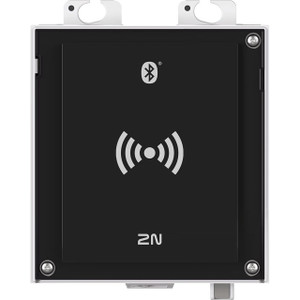
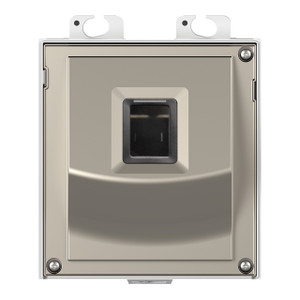
2N 02782-001 IP Verso Multi-Credential Access Control Reader
The 2N 02782-001 is a single-device networked access control reader that consolidates four distinct credential types—RFID proximity cards, NFC smart cards, Bluetooth Low Energy (BLE) mobile devices, and PIN keyboard entry—into one IP-addressable endpoint. For integrators managing facilities with mixed credential ecosystems or transitioning from legacy proximity card infrastructure to modern mobile authentication, this consolidation eliminates the need to deploy and maintain parallel reader hardware at each access point, reducing both installation labor and long-term hardware management overhead.
Key Features
- 125kHz RFID proximity card support: Reads legacy access control card formats already deployed across most corporate and institutional campuses. Backward compatibility means you don't discard existing credential investments during modernization cycles—the 02782-001 coexists with older card stock without requiring replacement.
- 13.56MHz NFC/smart card reader with ISO/IEC 14443 Type A and Type B compliance: Enables support for enterprise-grade smart cards, NFC badges, and standards-compliant mobile credential platforms. This standards adherence is critical—you're not locked into proprietary formats and can source credentials from multiple vendors, avoiding vendor lock-in on credential supplies.
- Bluetooth Low Energy (BLE) mobile authentication: Allows access via smartphone and wearable devices without requiring NFC-capable hardware. BLE credential loss or theft no longer requires physical card replacement—you can disable access remotely from your management system within seconds, reducing administrative overhead and response time during credential compromise.
- Integrated numeric PIN keyboard: Supports manual credential entry and PIN codes as a fallback or supplementary authentication method. Keyboard-based fallback eliminates single points of failure when mobile or card credentials are unavailable, ensuring staff can still access facilities during credential-reading outages or forgotten devices.
- IP network integration with H.264 compression support: The reader connects via standard Ethernet (PoE or hardwired), centralizing credential validation and decision-making on your access control system rather than storing policy locally on the device. This architecture simplifies policy updates across multi-building deployments—change access rights once in your management system, and all readers enforce it immediately.
- Hybrid authentication workflows: The device supports credential combination strategies (e.g., card + PIN, BLE + PIN, NFC + PIN) to meet higher security requirements in sensitive areas. This flexibility is essential for healthcare facilities, data centers, and high-security environments where multifactor authentication is mandatory.
Integration & Compatibility
The 02782-001 integrates with any networked access control system that accepts IP-based reader endpoints and supports standard credential protocols. ISO/IEC 14443 Type A/B compliance ensures interoperability with commercial-off-the-shelf smart cards and mobile credential platforms; integrators must verify that their access control management software supports BLE credential parsing and PIN validation logic before deployment. Network bandwidth requirements are minimal—credential handshake traffic is typically under 100 KB per transaction—so integration into existing IP infrastructure rarely requires switch upgrades or VLAN reconfiguration. PoE support reduces installation complexity by eliminating dedicated power runs to each reader location.
When to Choose a Different Model
If your deployment requires wireless reader-to-controller communication (e.g., temporary access points in areas where running Ethernet is impractical), evaluate the broader 2N access control reader family for models with integrated LoRaWAN or cellular connectivity. If credential support must extend to obscure legacy formats (magnetic stripe, Wiegand over distance), consult with 2N technical resources to confirm compatibility before procurement. Single-credential deployments (e.g., RFID only, no hybrid authentication) may benefit from purpose-built single-protocol readers if cost is the primary driver—the 02782-001 adds flexibility at the cost of higher upfront expense.
Frequently Asked Questions
Q: Does the 2N 02782-001 support my existing 125kHz proximity cards?
A: Yes. The 02782-001 reads legacy 125kHz RFID proximity card formats. You can integrate it alongside existing cards without requiring credential replacement.
Q: Can I use the 02782-001 with smartphone credentials?
A: Yes, via Bluetooth Low Energy (BLE). Smartphones and compatible wearables can authenticate directly to the reader. Your access control system must support BLE credential parsing to validate mobile tokens.
Q: What happens if a credential reader fails?
A: The integrated PIN keyboard serves as a fallback. Users can enter a PIN code to gain access, ensuring the facility remains accessible during reader outages or credential failures.
Q: Is the 02782-001 compatible with ISO/IEC 14443 smart cards?
A: Yes. The 13.56MHz NFC reader supports both ISO/IEC 14443 Type A and Type B smart cards, making it compatible with enterprise-grade smart card systems and standards-compliant mobile credential platforms.
Q: Does the 02782-001 support multifactor authentication?
A: Yes. The device supports hybrid authentication workflows such as card + PIN, BLE + PIN, and NFC + PIN combinations, meeting higher security requirements for sensitive environments.
Q: Can I use the 02782-001 for remote credential disabling?
A: Yes. Because the 02782-001 is networked via IP, your access control management system can revoke credentials remotely. Stolen or lost devices can be disabled immediately without physical reader intervention.
Jerry TildsenPerspective based on aggregated IPSD and affiliated engineering team experience.
The 2N 02782-001 solves a real problem: credential sprawl. In facilities where you've inherited legacy 125kHz card systems, and stakeholders are now demanding mobile credential capability, deploying separate readers at each access point balloons both capex and operational complexity. The 02782-001 consolidates four credential types into one networked device, which cuts installation time and simplifies policy management at scale.
Technical Highlights:
- Four credential types in one reader: 125kHz RFID, 13.56MHz NFC (ISO/IEC 14443 A/B), BLE, and PIN keyboard. You eliminate parallel reader deployments and reduce the number of integration points your access control system must manage.
- Hybrid authentication: Card + PIN, BLE + PIN, NFC + PIN combinations. Essential for facilities with varying security zones—use single-factor at the lobby, multifactor at the server room or pharmacy.
- Centralized policy via IP: All credential decisions are made on your networked access control system, not locally on the reader. Change a user's access rights once in your management system, and it's enforced at all 02782-001 endpoints immediately.
Deployment Considerations:
- Your access control management software must support BLE credential parsing. If your system only handles RFID and PIN, you won't be able to validate mobile credentials—confirm this before purchase.
- NFC credential sources must comply with ISO/IEC 14443 Type A or B standards. Proprietary or non-compliant smart card formats will not work, so audit your smart card ecosystem before deployment.
- The 02782-001 relies on centralized IP connectivity to validate credentials. In network-disconnected scenarios (e.g., temporary access in a facility with no Ethernet run), this reader requires fallback to PIN-only or a different architecture.
The 02782-001 is your choice for modernizing multi-credential access control in campuses or large facilities where you're managing card stock alongside emerging mobile credential demands. If you're building greenfield access control from scratch and can standardize on a single credential type, a purpose-built single-protocol reader may lower cost. But for retrofit and multi-protocol integration, the 02782-001 (often searched as 02782 001) pays for itself in installation time alone.