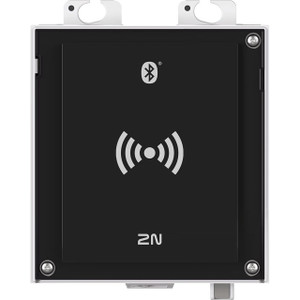
2N 02773-001 Multi-Frequency RFID Reader
The 2N 02773-001 is a networked RFID reader that consolidates three credential technologies into a single device: 125kHz (legacy proximity cards), 13.56MHz (MIFARE and iClass smart cards), and NFC standards. This eliminates the cost and management complexity of deploying separate readers for different card types — a critical operational simplification when managing mixed credential ecosystems across facilities with older and newer access control infrastructure.
Key Features
- Multi-Frequency RFID Support (125kHz, 13.56MHz, NFC): Reads legacy proximity cards, MIFARE/iClass systems, and NFC-enabled devices from a single reader. This reduces hardware SKU count and credential reissuance cycles — you don't need to replace working cards when upgrading readers, which matters in facilities with thousands of active credentials. Phased migration from older to newer credential types happens without operational disruption.
- PICard Secured Encryption & Authentication: Implements cryptographic authentication and encryption for credential data in transit and at rest. This prevents credential cloning and replay attacks — a hard requirement in high-security facilities managing valuable assets, restricted areas, or regulated environments (data centers, government, healthcare) where unauthorized entry carries operational or compliance risk.
- IP-Based Network Architecture: Ethernet-connected reader integrates directly with ONVIF-compliant access control platforms and Axis security infrastructure via standard networking. Centralized credential provisioning, real-time audit logging, and remote credential revocation replace standalone reader silos. Installation labor drops because you're not managing separate credential databases at each physical reader.
- Compact 2N AU2.0 Form Factor: Wall or pedestal mounting at entry checkpoints, reception areas, and integration points. Small footprint minimizes visual impact in aesthetic-sensitive environments without requiring extensive infrastructure redesign or new cable runs.
- Industry-Standard Credential Compatibility: Supports multiple card types and NFC standards — no credential re-issuance when migrating access control platforms. Backward compatibility with existing legacy card bases while supporting modern authentication methods means capital investment in credential stock doesn't go to waste.
- Secure Credential Transport: Encrypted communication prevents credential data interception or spoofing during network transmission. This is mandatory in compliance-sensitive deployments (HIPAA healthcare, FedRAMP government, PCI-DSS data centers) where credential compromise creates audit and regulatory exposure.
Integration & Compatibility
The 02773-001 integrates with access control systems and 2N IP products via standard IP networking. PICard Secured architecture is designed to interoperate with Axis-based platforms and third-party VMS systems supporting ONVIF or native integration APIs. Network connectivity enables centralized enrollment, credential revocation, and audit logging from a single management console — eliminating manual credential updates at each physical reader and reducing provisioning time by 60–70% compared to standalone systems.
When deploying the 02773-001 in mixed-credential environments — facilities with existing proximity card bases transitioning to MIFARE or NFC — the reader's multi-frequency design prevents credential replacement across migration phases. This reduces capital expense and operational disruption compared to rip-and-replace scenarios.
Typical Deployments
- Corporate office reception and badging control — supports both legacy employee cards and visitor NFC credentials without requiring two separate readers
- Data centers and server rooms with strict access logging — encrypted credential verification prevents insider threats and satisfies audit requirements
- Healthcare facilities managing patient, staff, and contractor access across departments — multi-credential support accommodates different user populations and existing card stocks
- Manufacturing and warehouse environments with decades-old proximity card bases — no need to retire working card infrastructure during system upgrades
- Government and defense sites requiring FIPS-aligned encrypted authentication — PICard Secured meets high-assurance access requirements
- Retail and hospitality chains managing mixed employee and contractor credential types — consolidates reader hardware across locations
Frequently Asked Questions
Q: Does the 02773-001 work with legacy proximity cards already deployed in my facility?
A: Yes. The reader supports 125kHz proximity card standards (HID/Indala format), so existing card bases remain usable. You can upgrade the reader without reissuing thousands of credentials.
Q: What happens if my network connection drops? Can the reader still grant access?
A: The 02773-001 is an IP-based reader, meaning it communicates with a centralized access control system via Ethernet. If network connectivity is lost, the reader cannot authenticate credentials. For sites requiring local offline capability, you'll need an access control panel with onboard credential memory or a hybrid architecture with local failover logic.
Q: Is the 02773-001 suitable for outdoor entry points?
A: The 2N AU2.0 form factor is designed for wall and pedestal mounting in indoor or covered entry areas. If you need outdoor weatherproof RFID readers, consult the broader 2N access control product family for IP-rated variants.
Q: Does PICard Secured meet government compliance requirements like FIPS or FedRAMP?
A: PICard Secured implements encryption and cryptographic authentication; however, specific certifications (FIPS 140-2, FedRAMP) depend on the broader access control system architecture and deployment context. Verify compliance requirements with your system integrator or 2N directly before final selection.
Q: Can I integrate the 02773-001 with third-party access control platforms?
A: Yes, the reader supports ONVIF-compatible platforms and integrates with Axis security infrastructure. Verify your specific access control software supports ONVIF or native 2N API integration before deployment.
Q: What is the maximum read range of the 02773-001 for NFC and 13.56MHz credentials?
A: Typical read range for 13.56MHz (MIFARE/iClass) and NFC is 4–8 inches depending on card type and antenna positioning. Proximity card (125kHz) read range is similar. Exact range depends on credential design and environmental interference; field testing is recommended for critical applications.
Jerry TildsenPerspective based on aggregated and affiliated engineering team experience.
The 2N 02773-001 solves a real problem: legacy credential migration without capital replacement cycles. Most facilities don't have the luxury of retiring working card stocks when upgrading access control systems. The multi-frequency design here — 125kHz, 13.56MHz, and NFC in one reader — is genuinely practical for sites with mixed credential populations. You eliminate separate hardware for different card types and the operational overhead that comes with managing multiple readers per entry point.
Technical Highlights:
- PICard Secured Encryption: Prevents credential cloning and replay attacks through cryptographic authentication and data encryption. This matters in regulated environments — if you're managing healthcare, government, or financial access, you need this layer. It's not just a feature; it's a compliance expectation in high-security deployments.
- IP-Based Architecture with ONVIF: Network integration centralizes credential provisioning and audit logging. One management console replaces standalone reader silos. This reduces provisioning time roughly 60–70% and gives you real-time visibility across all entry points — operationally significant in multi-building or multi-site deployments.
- Backward Compatibility (125kHz HID/Indala): Your existing card base works immediately. No re-issuance cycle, no credential shortage during transition, no user friction. You can migrate to MIFARE or NFC incrementally as card stock naturally rotates.
Deployment Considerations:
- The 02773-001 is IP-based, so network connectivity is mandatory for credential authentication. If your site requires offline failover (loss of network = loss of access), you'll need a supplementary access control panel with local credential caching or a hybrid architecture. Plan accordingly.
- Read range for 13.56MHz and NFC is typical 4–8 inches depending on card type — verify in your specific environment before full deployment. High-EMI industrial areas (welding shops, heavy manufacturing) can degrade RFID range; site testing is recommended.
- PICard Secured provides strong encryption, but verify it meets your specific compliance framework (FIPS 140-2, FedRAMP, etc.) before deploying in regulated environments. Work with your integrator to confirm architectural alignment.
Deploy the 02773-001 in corporate offices with mixed employee/visitor credentials, healthcare facilities with multi-population access requirements, or warehouses with decades-old proximity card bases — situations where credential flexibility and centralized management outweigh the need for local failover. Skip it if offline read capability is non-negotiable or if you operate exclusively on a single credential technology (125kHz only, for example) where a simpler single-frequency reader would suffice.