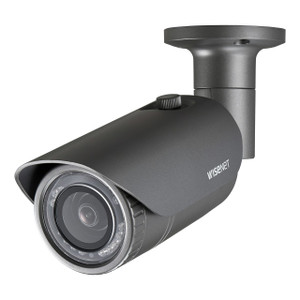
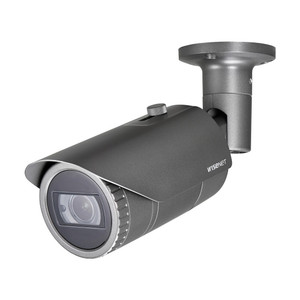
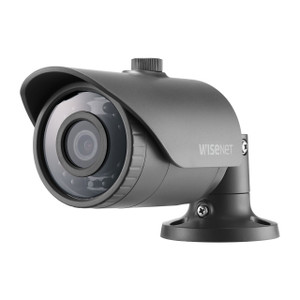
Hanwha HCO-7030RA 4MP IR Bullet Camera
The Hanwha HCO-7030RA is a 4MP fixed-lens bullet camera purpose-built for outdoor perimeter surveillance where weather resistance, infrared night vision, and integration with existing analog or hybrid systems matter more than converting to full IP. This is not an IP camera—it's an AHD and CVBS analog model that delivers 2560 × 1440 resolution at 30 fps, meaning you preserve coaxial infrastructure investments while gaining forensic-grade detail without the bandwidth or NVR complexity of an IP transition.
Key Features
- 4MP QHD Resolution (2560 × 1440) at 30 fps — sufficient detail for facial identification and license plate capture at typical perimeter distances, without forcing a network video recorder upgrade. Runs over standard coax.
- 30-Meter IR LED Range with 0 Lux B/W Night Vision — covers parking lots, loading docks, and fence lines without auxiliary lighting. Full color mode requires 0.27 lux minimum, so dusk/dawn still delivers color footage if ambient light is present.
- 6.0mm Fixed Lens, F2.0 Aperture, 49° Horizontal FOV — optimized for broad coverage of vehicle approach routes and entry points. Not varifocal, so no motorized adjustment needed; aim once and done.
- Digital Wide Dynamic Range (DWDR) — balances bright sunlit areas against deep shadows in the same frame, critical when a camera faces a loading dock with bright exterior and dark interior simultaneously.
- 4-Zone Motion Detection & 2-Zone Privacy Masking — configure motion alerts for high-traffic areas while blanking sensitive zones (e.g., neighboring properties, office windows). Reduces false alarms and privacy complaints.
- IP66 & IK10 Rating — dust-proof and vandal-resistant. IP66 handles rain, salt spray, and high-pressure wash-downs; IK10 withstands impacts from thrown objects. Skip this camera if you need full submersion (IP67+) or extreme cold below −30°C.
- Extended Operating Temperature −30°C to +55°C — runs year-round in continental and tropical climates without seasonal shutdown or heater modules.
- 12VDC Power, Max 5W Consumption — negligible load on a power supply. Deploy six cameras on a single 60W supply. No PoE dependency means simpler wiring in installations where coax runs are already installed.
Integration & Compatibility
The HCO-7030RA outputs AHD and CVBS (composite video) signal, making it compatible with Hanwha hybrid DVR systems and any third-party AHD recorder. If you operate a mixed-camera environment—some IP, some analog—this model slides into the analog chain without extra converters. Pair it with Hanwha power supplies in the SLA series (2M2400P, 2M2800P, 2M3600P, 2M6000P) for centralized 12V distribution across multiple cameras, or use the SPM-4210 wall-mounted supply for smaller deployments. For buyers evaluating outdoor surveillance cameras with existing coax infrastructure, the HCO-7030RA eliminates the need for IP-to-analog converters or wholesale recorder replacement.
When to Choose a Different Model
If you are building a new surveillance system or migrating existing infrastructure to IP, do not choose the HCO-7030RA. Consider a higher-resolution analog camera variant in the Hanwha lineup, or move to an IP bullet model that supports PoE, edge analytics, and integration with modern VMS platforms. The HCO-7030RA is a legacy-system lifeline, not a forward-looking purchase. It makes sense only if you already own AHD recorders or are refreshing analog cameras while keeping the recorder and cabling in place. Consult a camera selection guide to determine whether analog or IP aligns with your infrastructure roadmap.
Deployment Scenarios
Typical use cases include parking lot perimeter coverage, warehouse loading dock surveillance, building entrance hardening, industrial facility fence-line monitoring, and retrofit upgrades on properties with functional coax runs but aging analog cameras. The compact bullet form factor mounts flush to walls, poles, or eaves without a separate junction box, and the IP66/IK10 rating eliminates the need for separate environmental enclosures in rain, snow, or salt-spray environments. The 30m IR range ensures full-darkness capture on unlit properties, while DWDR prevents backlight washout when the lens faces bright loading dock doors or vehicle headlights.
Frequently Asked Questions
Q: What is the difference between AHD and CVBS output on the HCO-7030RA?
A: AHD (Analog High Definition) carries the 4MP signal over standard coax, delivering full 2560 × 1440 resolution to AHD-capable recorders. CVBS is composite video, a fallback analog format that downgrades to 960 × 480 resolution. Use AHD for new deployments to maximize quality; CVBS is a legacy fallback if an older recorder doesn't support AHD.
Q: Can the HCO-7030RA be used with IP network video recorders?
A: No. The HCO-7030RA outputs analog signal only (AHD/CVBS). To integrate with IP-based NVRs, you would need a separate analog-to-IP converter, which adds cost and complexity. For new IP-centric installations, choose an IP camera instead.
Q: What is the minimum light level required for the HCO-7030RA to capture color video?
A: 0.27 lux (approximately dusk-level light). Below that threshold, the camera switches to monochrome and activates the 30m IR illuminator. In total darkness, you get black-and-white IR video; in twilight conditions, color video with IR-assisted clarity.
Q: Does the HCO-7030RA support motion detection and privacy zones?
A: Yes. The camera provides 4-zone motion detection (configurable sensitivity per zone) and 2-zone privacy masking. Motion zones trigger alerts; privacy zones blank out sensitive areas in the recorded stream, reducing false alarms and addressing privacy concerns on neighboring properties or office windows.
Q: What power supply should I use with multiple HCO-7030RA cameras?
A: Each camera draws a maximum of 5W at 12VDC. A single 60W centralized power supply can feed up to 12 cameras. Hanwha's SLA series (2M2400P, 2M2800P, 2M3600P, 2M6000P) are designed for this purpose; smaller deployments can use the SPM-4210 wall-mounted 12V supply.
Q: Is the HCO-7030RA suitable for outdoor installations in cold climates?
A: Yes, within limits. The operating temperature range is −30°C to +55°C, which covers most continental winters and tropical summers. However, extreme arctic deployments (below −30°C) or equipment-heating requirements are not supported; in those cases, specify a heater-equipped enclosure or select a camera rated for lower temperatures.
James EverettPerspective based on aggregated IP Security Depot and affiliated engineering team experience.
The HCO-7030RA is a solid choice if you're stuck maintaining or upgrading an analog surveillance ecosystem—and I mean that as a compliment, not a put-down. Too many integrators force IP migration where it doesn't make sense. If you have working coax runs and a functioning AHD recorder, this 4MP bullet gives you a clean, no-fuss camera that doesn't require you to rip out infrastructure or add IP encoders. At 5W draw, it's efficient enough that six cameras won't stress a 60W supply.
Technical Highlights:
- 2560 × 1440 @ 30 fps over coax: Full AHD resolution without coercing you into an IP transition. That's meaningful forensic detail for parking lots and loading docks where you need to read plates or identify faces at distance.
- 30m IR + 0.27 lux color floor: The IR range is generous for an analog camera. You get night vision in total darkness and still retain color in low-light perimeter conditions—rare in budget analog.
- IP66/IK10 + −30°C to +55°C: Industrial durability. Rain, salt spray, thrown rocks, temperature swings—this camera won't break. The only deal-breaker is if you need IP67 (submersion) or sub-Arctic operation.
Deployment Considerations:
- Analog output only—no ONVIF, no PoE, no cloud integration. You're locked into coax and an AHD recorder. If your organization is trending IP, this camera doesn't future-proof you.
- Fixed 6mm lens. You get 49° horizontal field of view—good for entry points and parking lot sweeps, but no zoom. If you need adjustable focal length, look elsewhere.
Deploy the HCO-7030RA on warehouse perimeters, loading docks, and parking lot retrofits where analog infrastructure is already paid for and the recorder is solid. It's not a forward-investment camera, but it's reliable infrastructure maintenance.