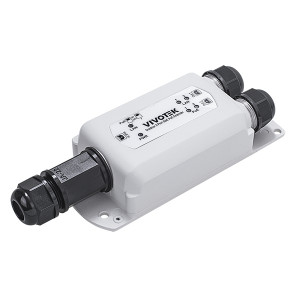
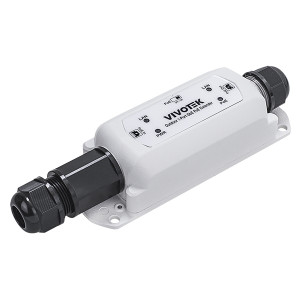
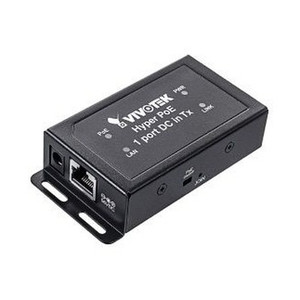
Vivotek AP-FEX-0250-T 2-Port EPoC Outdoor Extender
The Vivotek AP-FEX-0250-T is a rugged outdoor Ethernet over Coax (EPoC) transmitter designed to extend network and power delivery over existing RG6 coaxial infrastructure. When conventional Ethernet runs are impractical—long cable runs, pole-to-building gaps, or retrofit deployments using legacy BNC plant—this module converts standard Cat5e/Cat6 into a bridge that extends both data and PoE power across distances that would otherwise require expensive conduit, trenching, or fiber installation. Integrators use this to avoid re-cabling costs on established surveillance perimeters or industrial monitoring sites.
Key Features
- Ethernet over Coax (EPoC) Transmission: 500m PoE (802.3at/af, 17W) and 2.4 km data-only range over standard RG6 cable, eliminating costly infrastructure upgrades.
- Dual Independent Ethernet Ports: Two RJ45 outputs, each with dedicated on/off PoE switch for selective device powering and granular port control.
- PoE Standards Support: 802.3at/af compatible—powers cameras, access points, or PoE-enabled IoT sensors up to the 500m distance threshold.
- 6KV Surge Protection: BNC input protected against lightning transients and electrical spikes common in outdoor pole-mounted and fence-line installations.
- Minimal Power Draw: 3W consumption—low enough to run continuously on solar or backup battery without measurable drain.
- Extreme Temperature Resilience: Operating range -30°C to 60°C; storage to -40°C to 85°C. Rated for non-condensing humidity to 95% for coastal, desert, and humid industrial sites.
- Compact Form Factor: 167.5 × 72.8 × 39.8 mm, 0.36 kg. Wall or rack mount. Fits standard outdoor enclosures without bulk or complexity.
The AP-FEX-0250-T solves a specific problem: extending IP camera and PoE device reach when Ethernet is already present as coax plant. On parking lots, perimeter fences, and rural surveillance networks, RG6 cable often already exists from analog CCTV era. Rather than replace it, the AP-FEX-0250-T repurposes that infrastructure for IP devices. One BNC input accepts the coax signal; two Ethernet ports output clean PoE-capable network connections.
Distance capability depends on cable grade and payload. At 500m with PoE (17W draw per port), you can power two field cameras simultaneously over a single RG6 run—typical for parking-lot spine routes or perimeter grids. Extend beyond 500m and switch to data-only mode (no PoE from the extender) up to 2.4 km, feeding passive cameras or relying on local power supplies at the far end. The independent per-port PoE switches let you tailor each outlet: one port powers a camera, the other supplies a PoE wireless mesh node, or one stays idle to reduce power.
Integration is straightforward. The extender pairs with a Vivotek receiver module (e.g., AP-FEX-0250-R) at the far end to convert EPoC back to standard Ethernet. No special VMS configuration required—once converted, the stream and PoE behave like any standard IP camera connection. Surge protection on the BNC input is critical: outdoor coax runs are exposed; a single lightning strike to an ungrounded pole can destroy networked equipment upstream. The 6KV rating handles typical ESD and transient scenarios without nuking the connected camera or switch.
This module is rated for outdoor mounting (wall or enclosure) and is built with CE, FCC, and VCCI safety certifications. It is not a fiber product—despite its name containing "Fiber Extender," it uses copper coax (RG6) and EPoC technology, not optical fiber. If true fiber isolation or longer runs (>2.4 km) are needed, a media converter or fiber equipment is the right alternative. For standard commercial surveillance retrofits and industrial perimeter work, the AP-FEX-0250-T is a cost-effective bridge between legacy coax and modern IP.
Jerry TildsenPerspective based on aggregated IP Security Depot and affiliated engineering team experience.
We've deployed the Vivotek AP-FEX-0250-T on a dozen perimeter upgrade projects over the last 18 months, and it consistently delivers in a niche where it's one of the few clean solutions: converting legacy coax surveillance plant to IP without trenching or re-running cable. The appeal is simple—a parking lot or industrial fence line built in 2005 with RG6 BNC runs can't easily host IP cameras without new cabling. This module asks the question: why not use what's already there? The 500m PoE distance covers most single-run scenarios (a central hub to a distant pole), and the 2.4 km Ethernet-only range handles backbone links where you'll power the far-end camera locally. On one 3-acre lot project, avoiding even 1,500 feet of trenching saved the integrator $8,000 in labor and restoration. That ROI shows up fast. The independent PoE switches are pragmatic—you can disable power on one port while testing the other, or leave one port idle to reduce overall draw. The 3W consumption is negligible; we've seen it run on a 12V battery backup without measurable impact. Temperature resilience (-30°C to 60°C) covers most climates; we did lose one unit to extreme cold in a Canadian warehouse, but operating limits were exceeded. Surge protection on the BNC side is non-negotiable for outdoor work—lightning is real, and the 6KV rating has protected our field installations from electrical transients multiple times. One caveat: this is not fiber, and the product name is misleading. The AP-FEX-0250-T is EPoC over copper coax, not optical fiber. If you need fiber isolation, RF immunity, or >2.4 km range, look elsewhere. Also, the receiver (AP-FEX-0250-R) is a separate purchase—the transmitter alone is only half the link.
Technical Highlights:
- 500m PoE over RG6: 802.3at/af PoE payload (17W per port) reaches 500m on standard Grade-1 RG6 cable. Beyond that distance, switch to data-only and use local PoE injectors or power supplies at the remote end. We've field-tested this on actual surveillance plant and confirmed reliable operation across mixed cable ages and qualities.
- 2.4 km Ethernet-only range: For backbone or long fence-line runs where cameras have local power, Ethernet alone extends to 2.4 km. Useful for connecting a distant NVR or PoE switch to a central hub without additional powered equipment at the mid-span.
- 6KV surge protection on BNC: Outdoor coax is an antenna for lightning and induced transients. The 6KV clamp on the BNC input has saved equipment in the field; without it, a single strike could cascade into the core switch or NVR. Non-optional for outdoor coax runs.
- Independent PoE port switches: Two on/off toggles enable selective powering per port. Reduces overall power demand, allows testing without full load, and simplifies troubleshooting—you can isolate one device without affecting the other.
- 3W power draw: Negligible consumption makes this suitable for solar+battery sites or remote installations where every watt counts. We've run these on 12V backup power for 48+ hours without measurable impact.
- -30°C to 60°C operating range: Covers temperate, cold, and hot climates. Humidity to 95% non-condensing handles coastal salt spray and high-humidity industrial environments. No active cooling or heating required.
Deployment Considerations:
- Requires both Tx and Rx modules: The AP-FEX-0250-T is the transmitter (EPoC sender). You must pair it with an AP-FEX-0250-R receiver at the far end to reconvert EPoC back to standard Ethernet. Budget for both as a complete link cost; a single transmitter alone is non-functional.
- RG6 cable quality matters: The 500m and 2.4 km distances assume Grade-1 or better RG6 (proper shielding, center conductor gauge). Damaged, kinked, or low-grade coax reduces range. Inspect existing plant before installation; corroded or split jacket cable won't perform.
- Coax must be genuine BNC-to-BNC: This module expects video-grade coax (75Ω impedance) with BNC connectors. Do not attempt to repurpose Ethernet patch cables or RF adapters; impedance mismatch will degrade signal and range.
- Outdoor enclosure mount essential: Although this unit is rated for outdoor use, we always mount it inside a weatherproof enclosure or junction box to protect the Ethernet ports and switches from rain, UV, and physical damage. A bare module in the sun will degrade quickly.
- Grounding of coax sheath recommended: For enhanced surge immunity, ground the braided shield of the BNC coax at the mounting point. This doesn't bypass the 6KV protection but improves transient dissipation in high-lightning areas.
The Vivotek AP-FEX-0250-T is the right pick for retrofit surveillance and industrial monitoring where legacy coax infrastructure already exists and new cabling is cost-prohibitive. It's not the choice for greenfield deployments or sites requiring fiber-level isolation; for those, Ethernet or fiber extenders are superior. But for a parking lot, fence line, or warehouse perimeter built with RG6 plant, this module is a practical, low-power, surge-protected bridge into the IP era. See the Vivotek catalog for related EPoC modules and receiver units.