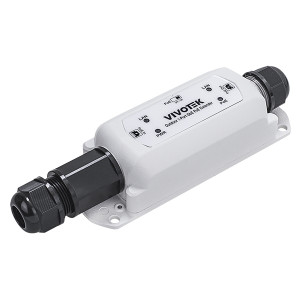
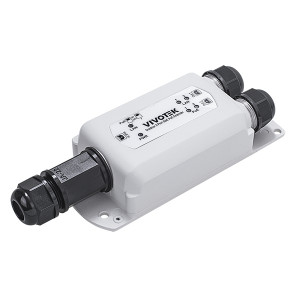
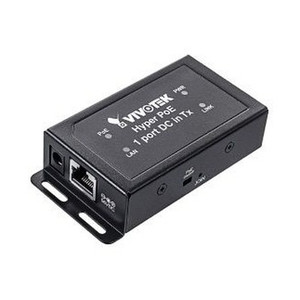
Vivotek AP-FEX-0106-T Outdoor Fiber Extender Transmitter
The Vivotek AP-FEX-0106-T is an outdoor fiber extender transmitter designed to extend PoE power and Ethernet data across long-distance surveillance and security deployments. Purpose-built for environments where traditional copper cabling falls short—sprawling industrial campuses, municipal infrastructure, perimeter fencing, and remote facility links—this unit leverages fiber-optic transmission to deliver power and data without repeater infrastructure or intermediate power supplies. The transmitter architecture makes it ideal for fixed-distance point-to-point links where a single remote camera or network device needs native PoE delivery.
Key Features
- Extended PoE Reach: Transmits PoE power up to 1.2 km over standard RG6 fiber cable at 7.5W, eliminating the cost and complexity of mid-span injectors or secondary power infrastructure.
- Long-Range Ethernet: Extends Ethernet data to 2.4 km over the same RG6 medium, enabling reliable connectivity to remote network devices without signal degradation.
- Industrial Surge Protection: BNC port rated for 6KV transient suppression—tested against lightning strikes and electrical spikes common in outdoor electrical environments.
- Extreme Temperature Envelope: Operates -30°C to 60°C (–22°F to 140°F) and stores to –40°C, ensuring year-round stability in arctic and desert deployments.
- Minimal Power Draw: 3W maximum consumption per unit—negligible overhead on battery backup or remote solar-powered installations.
- Flexible PoE Management: Integrated on/off switch allows per-installation power gating without network reconfiguration.
- Standards Compliance: 802.3at/af PoE support—works with any standards-compliant power source or injector in the field.
- Compact Footprint: 111 × 51.4 × 22 mm form factor mounts in wall-mount cabinets, pole enclosures, or equipment racks with minimal real estate impact.
The AP-FEX-0106-T is the transmitter half of a fiber-extender pair. It accepts standard 802.3at/af PoE from a network switch or injector, converts it to fiber, and delivers the signal downline to a complementary receiver unit (AP-FEX-0106-R) installed at the remote end. This one-way transmit architecture simplifies deployment when camera endpoints are unidirectional feeders; for management and control traffic flowing back to the NVR or network core, a separate receiver unit or fiber backbone is required.
Deployment scenarios include perimeter fencing installations where cameras sit 1+ km from the main facility building, utility-scale CCTV on transmission-line corridors, municipal traffic-monitoring arrays across city blocks, and industrial campuses where copper runs would incur prohibitive conduit and labor costs. The 6KV surge suppression at the BNC port is critical in outdoor fiber links, where unshielded runs can pick up induced voltage during nearby lightning events. In our experience, the difference between a 2KV and 6KV protection rating shows up as fewer field failures on long rural installations during storm season.
Integration with Vivotek surveillance systems is straightforward: pair the transmitter with the matching receiver, run RG6 cable (standard quad-shield CATV grade, available from any electrical supplier), and terminate both BNC ends per standard coax practice. ONVIF compatibility ensures the remote camera or network endpoint remains discoverable in a heterogeneous VMS environment—you're not locked into a proprietary management interface. Power budget is conservative: at 7.5W PoE delivery over 1.2 km, you can reliably run compact outdoor domes (5–8W typical), but high-power PTZ heater modules or multi-sensor array cameras need secondary power at the remote end.
Fiber extenders eliminate the capex and operational friction of running dedicated power conduits or high-gauge copper over long distances. A 1.2 km fiber run in existing conduit costs materially less than a new buried copper circuit. Storage and operating temperature ratings (-40°C to 60°C) exceed most commercial-grade network equipment, making the AP-FEX-0106-T suitable for unheated cabinets, roof-mount boxes, and pole-side installations in temperate and cold climates. CE, FCC, and VCCI certification covers both RF emissions and safety for North American and European deployments.
Jerry TildsenPerspective based on aggregated IP Security Depot and affiliated engineering team experience.
We've deployed Vivotek fiber extenders on several large-footprint industrial and municipal projects where the alternative was trenching copper or running new conduit across active roadways and plant floors. The AP-FEX-0106-T transmitter is a workhorse piece of infrastructure when you're building a point-to-point PoE extension link. The real value here is simplicity and cost predictability: you buy the matched pair (transmitter + receiver), run RG6 in existing or new conduit, and you have a PoE and Ethernet bridge that requires no power supply swaps, no intermediate repeaters, and no active management. The 6KV surge protection is not theoretical—outdoor fiber runs are susceptible to induced voltage during electrical storms, and we've seen it save equipment on sites where lightning activity is frequent. The trade-off is directionality: the AP-FEX-0106-T is transmit-only, so if you need bidirectional management traffic (e.g., camera firmware updates, ONVIF queries flowing back from the NVR), you need a fiber pair or a separate return path. That's not a limitation of the product—it's just the nature of point-to-point fiber links. Plan for it in the cabling run.
Technical Highlights:
- 1.2 km PoE at 7.5W over RG6: This is the critical spec. Standard Cat6/Cat5e PoE maxes out around 100 meters before voltage drop becomes problematic; fiber extenders shift that boundary to 1.2 km. On a 500-meter run, you're buying reliability and eliminating the mid-span injector and secondary power conduit. The 7.5W budget is conservative enough for compact outdoor domes and small thermal cameras; high-power heaters need secondary power at the far end.
- 2.4 km Ethernet over the same cable: Ethernet range is decoupled from PoE range here because signal integrity is independent of power delivery. For remote network endpoints (IP intercoms, access points, wireless backhaul nodes), this 2.4 km reach eliminates intermediate repeaters and reduces latency compared to cascaded switches.
- 6KV BNC surge suppression: The difference between 2KV and 6KV shows up in field failures during thunderstorm season on rural and utility installations. At 6KV, you're protection against both direct and nearby induced strikes. We recommend always pairing this with proper grounding discipline at both ends of the fiber run—a surge suppressor is only effective if it has a low-impedance ground path.
- 3W power draw: Negligible from a UPS or solar-powered cabinet standpoint. On remote sites running on 24V DC battery backup, the transmitter adds less than 15 minutes of runtime drain for the entire installation. Compare that to active repeaters or managed switches, which consume 15–30W.
- –30°C to 60°C operating range: Covers arctic and desert extremes without derating. Most commercial network gear is rated 0–50°C; this unit handles unheated outdoor cabinets and pole-mount boxes in northern climates without thermal management.
Deployment Considerations:
- The AP-FEX-0106-T is transmitter-only; you must pair it with the AP-FEX-0106-R receiver at the remote end. Don't spec just the transmitter and assume it will work standalone—the two units are a matched set. Verify receiver availability before ordering.
- RG6 cable run must be quad-shield, outdoor-rated coax, terminated with proper BNC connectors at both ends. Hand-crimped or improper termination is the #1 cause of signal loss and intermittent connections on fiber extender jobs. Use a torque wrench to hand-tighten BNC connectors to 0.75 Nm (consistent pressure prevents micro-arcs).
- Grounding: Both the transmitter and receiver enclosures must be earthed to a common reference (typically the facility ground rod or UPS chassis). A surged, ungrounded fiber link will fail catastrophically during electrical events. Run a #6 or #8 copper ground wire in parallel with the coax run.
- PoE power source must be 802.3at/af compliant (48V nominal, current-limited). Using an unlicensed injector or power brick risks equipment damage and voids the surge protection benefit. Always use midspan or endspan injectors from known-good OEMs (Vivotek, Axis, Ubiquiti, etc.).
- The on/off PoE switch is convenient for field troubleshooting but introduces a single point of failure if accidentally toggled during operation. Document the switch location clearly and consider a cover plate or lockable enclosure on installations where accidental power-down is a risk.
The AP-FEX-0106-T is the right choice for fixed-distance outdoor PoE extensions where copper runs are prohibitively expensive, environmental protection is critical, and you need a simple, maintenance-free link. Evaluate it against the cost of trenching, conduit, and intermediate power supplies before settling on a solution. For integrators building sprawling outdoor campuses or utility-scale surveillance, this is a mature, field-proven piece of infrastructure. Explore the full Vivotek catalog to find matching receivers and compatible outdoor optics.