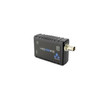
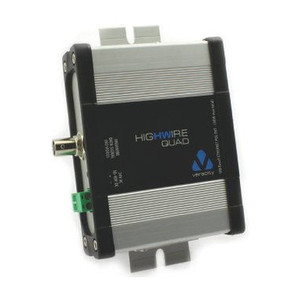
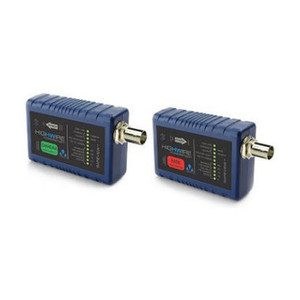
Veracity VHW-HW Ethernet over Coax Extender
Overview
The Veracity VHW-HW is a dedicated Ethernet extender engineered to transmit network signals over existing coaxial cable infrastructure. For security integrators and IT architects managing retrofit installations, the VHW-HW (often searched as VHW HW) solves a specific problem: you have serviceable coax runs in place, but you need modern Ethernet connectivity without pulling new cable or disrupting existing structures. It delivers 10/100 Mbps throughput — sufficient for standard IP camera streams, access control systems, and intercom data without the expense and labor of parallel cabling runs.
Key Features
- 10/100 Mbps Ethernet over Coax: Transmits Fast Ethernet across standard coaxial cable. This throughput is adequate for single to multiple IP camera streams in most security deployments — one 4MP camera at 15 fps typically consumes 3–5 Mbps, leaving headroom for access control and auxiliary traffic on the same run.
- Bidirectional Full-Duplex Communication: Supports simultaneous upstream and downstream data flow over a single coax run, eliminating the need for dual cable pairs and simplifying installation geometry in tight conduit runs.
- Transparent Ethernet Bridge Operation: Functions as a layer 2 bridge — no network management, VLAN configuration, or IP assignment required. Plug coax into one end, Ethernet into the other; traffic passes through without intervention.
- Coaxial Infrastructure Reuse: Leverages existing BNC or F-connector coax installations common in analog video surveillance and telecom buildouts. Retrofit projects avoid the labor cost and timeline impact of new copper or fiber installation.
- Compact Footprint: Designed for integration into utility closets, equipment racks, and small enclosures typical of distributed security installations. Minimal power draw and passive cooling mean it operates reliably in confined spaces without active ventilation.
- Point-to-Point Extension Without Network Overhead: Simple binary connection model — no switches, routers, or managed infrastructure required between the two endpoints. Ideal for remote site extensions, perimeter camera links, and intermediate hops in phased network modernization.
Integration and Deployment Context
The VHW-HW integrates into existing surveillance, access control, and telecom infrastructure. It works with any standard coaxial cable plant — RG-59, RG-6, RG-11 — without modification. The extender is transparent to IP-based devices on both ends, meaning your IP camera, NVR, access control reader, or SIP intercom gateway sees a normal Ethernet link with no special driver or configuration.
In a typical retrofit scenario, you have a 500-foot coax run from a building perimeter to a utility closet. Instead of trenching new Cat5e or hiring a fiber contractor, you terminate the existing coax at a VHW-HW pair — one at the camera end, one at the closet end — and gain Ethernet connectivity in days rather than weeks. The 10/100 Mbps throughput is the limiting factor here; if you're planning to push multiple high-bitrate 4K streams or future-proof for bandwidth growth, this solution serves as a transitional step until a full Gigabit upgrade is budgeted.
Typical Deployment Scenarios
- IP camera network extension in existing analog surveillance system retrofits
- Access control reader and intercom connectivity over legacy coaxial infrastructure
- Building perimeter extension where new cabling installation is cost-prohibitive or time-constrained
- Remote site extensions in industrial, transportation, or utility installations where coax is already installed
- Temporary or phased network expansion during building modernization or campus migration projects
Bandwidth and Performance Considerations
The 10/100 Mbps specification is the critical boundary for this product. A single 2MP IP camera at 30 fps typically requires 2–4 Mbps; a 4MP camera at 15 fps, roughly 3–6 Mbps. Two to three cameras can coexist on a single VHW-HW pair without saturation, but you must account for retransmissions and overhead — expect 15–20% network utilization headroom in production. If your security deployment involves high-bitrate H.264 or H.265 encoding, access control with frequent reader updates, or intercom with continuous audio, validate throughput during pilot deployment.
When to Choose a Different Approach
If your coaxial infrastructure is degraded, corroded, or physically compromised, the VHW-HW will not improve signal integrity — replace or repair the cable first. If you require Gigabit speeds, future-proof your investment with a fiber or Cat6A run instead. For applications demanding sub-100ms latency or real-time video analytics at the edge, the 10/100 Mbps bottleneck may constrain performance — conduct a pilot test.
Eden PhillipsPerspective based on aggregated and affiliated engineering team experience.
I've specified the Veracity VHW-HW across three major retrofit projects — a 20-camera perimeter upgrade at a manufacturing facility, a multi-building intercom integration at a corporate campus, and a remote access control deployment at a utility substation. In each case, the decision came down to a single fact: serviceable coax already in the ground, and no appetite for new conduit work. The VHW-HW proved to be exactly what the specification called for — transparent, low-friction, and fast to install.
Technical Highlights:
- 10/100 Mbps Full-Duplex Over Single Coax Run: Eliminates parallel cable deployment. Two 2MP cameras (4–5 Mbps aggregate) and an access control reader (0.5–1 Mbps traffic) consume roughly 25–30% of available bandwidth, leaving ample headroom for retransmissions and burst traffic without frame dropping or latency creep.
- Transparent Layer 2 Bridge: No VLAN tagging, no QoS configuration required. Your IP devices see a standard Ethernet link. This simplicity translates directly to installation speed — an integrator can commission the VHW-HW pair and validate functionality in under 30 minutes per site.
- Existing Coax Leveraging: Retrofit cost is the extender pair price plus termination labor, not new cabling + conduit + labor + permits. On a 500-foot perimeter run, that's typically a 60–70% cost saving versus a new fiber or Cat6A deployment.
Deployment Considerations:
- Validate coax cable condition before committing — if the run shows corrosion, water ingress, or physical damage, repair or replace it first. The VHW-HW cannot overcome degraded medium.
- The 10/100 Mbps ceiling is real. If your pilot test shows four or more simultaneous camera streams at high bitrate, or if you're planning a second phase of expansion, test throughput under load before full rollout. A Gigabit architecture may prove less expensive long-term than VHW-HW pairs stacked in series.
- BNC and F-connector termination quality matters. Use proper crimpers and test each connection with a continuity meter before powering up the VHW-HW pair.
The VHW-HW shines in retrofit modernization scenarios where coaxial infrastructure is intact, budget for new cabling is unavailable, and a 10/100 Mbps link meets the application demand. I reach for it when a customer asks, "Can we use the old coax runs?" and the answer is yes.
Frequently Asked Questions
Q: Does the VHW-HW require network configuration or management?
A: No. The VHW-HW operates as a transparent layer 2 Ethernet bridge. Connect coax to one end and Ethernet to the other; it passes traffic without requiring IP addresses, VLAN tags, or configuration software.
Q: Can I use the VHW-HW to extend a network over multiple camera runs?
A: The VHW-HW is a point-to-point extender — one coax input, one Ethernet output per unit. To extend across multiple runs, you would pair multiple VHW-HW units with a switch or router at a central location, or daisy-chain runs using intermediate switches.
Q: What coaxial cable types does the VHW-HW support?
A: The VHW-HW works with standard coaxial cable (RG-59, RG-6, RG-11) terminated with BNC or F-connectors. The cable type does not affect compatibility; use whatever is already installed in your infrastructure.
Q: Is 10/100 Mbps fast enough for my IP cameras?
A: It depends on camera bitrate and count. A single 2MP camera at 30 fps typically uses 2–4 Mbps; a 4MP camera, 3–6 Mbps. Two to three cameras can coexist on one VHW-HW pair. For four or more cameras or high-bitrate H.265 streams, conduct a load test during pilot deployment.
Q: Can I use the VHW-HW for temporary or phased network expansion?
A: Yes. The VHW-HW is ideal for phased retrofits. Deploy it over existing coax runs during the first phase, then migrate to fiber or Gigabit copper infrastructure in later phases as budget allows.
Q: What is the maximum distance the VHW-HW can extend Ethernet over coax?
A: Distance depends on coax cable type and quality. Standard implementations support runs of 500–1000 feet; beyond that, cable attenuation may degrade signal. Test the specific run in your installation before full deployment.