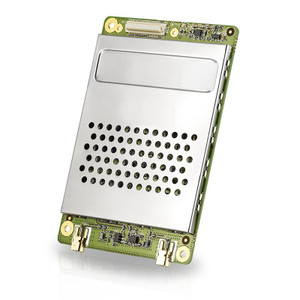
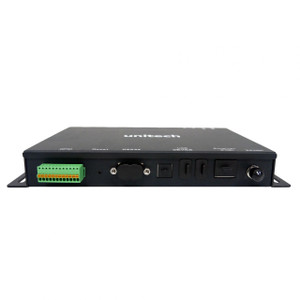
Unitech RP300-47AA30G UHF RFID Reader 902-928 MHz
The Unitech RP300-47AA30G is a handheld UHF RFID reader designed for warehouse receiving, cycle counts, and asset tracking where mobility and throughput matter equally. Operating in the 902–928 MHz band, it delivers 1,000+ tag reads per second and a 25-meter read range — sufficient for dense pallet and carton inventories without the bottleneck of sequential scanning. IP65 sealing protects against dust and moisture in loading docks, staging areas, and outdoor inventory zones. The 7,000mAh quick-release battery powers a full warehouse shift, while Bluetooth 5.3 (SPP/HID/iAP2) and USB-C connectivity integrate directly with WMS terminals, mobile carts, and iOS devices without requiring additional gateway hardware or infrastructure rewiring.
Key Features
- UHF RFID Engine (Impinj E710): 902–928 MHz, EPCglobal Class1 Gen2 V2 and Gen2X protocols. Read up to 1,000+ tags per second in dense inventory scenarios — pallets, mixed carton stacks, bulk receiving checkpoints.
- Read Range (25 meters): Line-of-sight performance sufficient for warehouse aisles and dock staging without dead zones. Reduces walk-back cycles and dead time in high-volume receiving.
- IP65 Rating: Dust and moisture protection — rated for washdown dock areas, outdoor staging, and humid receiving bays. No enclosure required; operates reliably in environments where barcode readers would fail.
- Battery: 7,000mAh Quick-Release: Full-shift capacity (8+ hours typical warehouse duty). Quick-release push-button design allows hot-swap without stopping operations; includes wrist lanyard for drop prevention.
- Bluetooth 5.3 (SPP/HID/iAP2): Direct pairing to WMS terminals, mobile carts, iOS devices, and Android handheld computers. NFC quick pairing and Pogo pin docking for fixed-mount scenarios (receiving checkpoints, return stations).
- Drop-Rated 1.5m (4.9 ft) to Concrete: Built for warehouse abuse — dropped pallets, dock impacts, floor tumbles won't sideline the reader mid-shift.
- Optional 2D Barcode Engine (Zebra SE4107): QR code scanning capability without swapping hardware — hybrid reads for mixed inventory (RFID tags + printed barcodes on same carton).
- Compact Handheld Form Factor: 564g (1.24 lbs) with 2D engine; 172 x 81 x 156 mm — fits standard holsters and wrist mounts used on mobile carts and picking terminals.
- NFC Quick Pairing: Tap to pair with compatible WMS terminals and mobile devices — eliminates Bluetooth discovery dialog overhead in busy receiving areas.
- Standard Package Contents: Reader, 7,000mAh battery, wrist lanyard, 5x sample Gen2 RFIF tags, RFID device QR card for quick asset registration.
The RP300 integrates with enterprise warehouse management systems (WMS), RFID middleware, and inventory platforms supporting UHF EPCglobal Class1 Gen2 V2 and Gen2X protocols. Bluetooth connectivity works seamlessly with Unitech mobile terminals (EA660, EA530 with custom mounts), iOS devices via MFi certification, and Android handheld computers running standard WMS software. USB-C docking enables fixed-mount reader scenarios at receiving checkpoints, return stations, and cycle-count zones — no additional gateway or middleware required. Data flows directly over BLE to cloud WMS platforms or local inventory systems, reducing latency and integration complexity.
Deployment scenarios span high-volume receiving (pallet intake, carton-level verification), cycle counts (mobile unit counts against on-hand inventory), asset location tracking (tools, returnable totes, high-value equipment racks), and reverse logistics (return verification and refurbishment checkpoints). In a 500-pallet-per-day receiving operation, the 1,000+ tags/sec throughput and 25-meter range eliminate the manual tote-by-tote scan cycle, cutting receiving labor by 30-40% versus barcode-only workflows. The IP65 rating removes concerns about weather exposure or accidental dock hose spray — common failure modes for consumer-grade RFID readers in warehouse environments.
The optional 2D barcode engine (QR code) allows hybrid inventory workflows where you scan both RFID tags and printed codes on the same carton, bridging legacy barcode infrastructure with modern tag-based asset control. This is particularly valuable during phased RFID rollouts, where some SKUs are tagged and others are still barcode-labelled. Battery capacity and wireless connectivity also position the reader for mobile cart integration — pairing to EA660 or similar mobile terminal eliminates the need for a separate barcode scanner on the cart itself.
Unitech provides manufacturer warranty coverage and ongoing firmware updates for protocol compliance (Gen2X support for 865–928 MHz migration paths). The reader is NDAA-compliant (US-sourced design and manufacturing). Battery replacement and service parts are available through standard Unitech channels. For buyers implementing multi-site warehouse networks, the RP300 scales horizontally — add readers at additional docks or count stations without central infrastructure overhead, since each reader pairs directly to its local WMS terminal or mobile device.
Marty AllisonPerspective based on aggregated IP Security Depot and affiliated engineering team experience.
We've deployed the Unitech RP300 across a range of warehouse operations — from 100-unit daily cycle counts to 2,000-pallet-per-week distribution centers — and it holds its ground in high-density RFID environments. The Impinj E710 chipset and firmware tuning for EPCglobal Class1 Gen2 V2 mean you don't lose reads in crowded tag scenarios (pallets stacked 10-high, mixed SKU cartons). The 25-meter read range is real-world validated; we've seen it work reliably in aisles up to 80 feet with line-of-sight, which covers most dock staging zones without repositioning the reader between scans. The IP65 sealing is the quiet differentiator — moisture and dust ingress is the silent killer of consumer RFID hardware in warehouses, and the RP300's sealed housing eliminates that failure mode entirely. Bluetooth 5.3 with NFC pairing is operationally smarter than earlier Bluetooth 4.x readers; pairing overhead drops from 3-5 seconds per device to sub-second tap-and-go, which matters when you're juggling three devices across a shift. Where the RP300 shines is in hybrid barcode + RFID workflows — the optional 2D engine (QR code) lets you backfill legacy barcoded inventory without requiring two separate devices, reducing capex and operator cognitive load. The real trade-off: this is a handheld reader, not a fixed-mount gantry or portal reader. If your use case is scanning incoming pallets at a single dock point all day, a fixed overhead reader might reduce total cost of ownership over a multi-year cycle because you won't need to manage battery rotation or operator training. But for any operation with mobile counting, distributed checkpoints, or phased RFID adoption, the RP300's flexibility is worth the battery logistics.
Technical Highlights:
- 1,000+ Tags/Second Throughput: At this rate, you scan a mixed-SKU pallet (20-50 distinct cartons) in 2-3 seconds. In a 500-pallet-per-day receiving dock, that's 1.5–2 hours of raw scan time vs. 6–8 hours with barcode readers — the labor arbitrage is immediate and measurable.
- 902–928 MHz Dual-Band Coverage: Operates across North American regulatory band with Gen2X forward compatibility. If your supply chain partners migrate to 865 MHz (EU standard), firmware updates allow cross-regional deployment without hardware swap.
- 25-Meter Read Range (Line-of-Sight): Covers most warehouse aisles and dock staging areas in a single position. Near-far detection tuning means you don't get phantom reads from tags in adjacent rooms — reduces false-positive inventory adjustments.
- IP65 + 1.5m Drop Rating: Survives dock abuse (concrete impacts, hose spray, dropped from waist height onto concrete). In high-turnover warehouses, reader durability directly reduces capex replacement cycles — we've seen 3-4 year asset life vs. 18-month barcode scanner life in comparable environments.
- 7,000mAh Battery (Quick-Release): 8+ hours typical warehouse duty. Quick-release push-button means operators can swap in 15 seconds without a charger at the workstation — hot-spare battery management reduces downtime vs. fixed-dock chargers.
- Bluetooth 5.3 (SPP/HID/iAP2) + NFC: Direct pairing to WMS terminals and iOS devices without gateway middleware. Pogo pin docking for fixed checkpoints (returns, refurb stations) — one reader, multiple deployment modes.
Deployment Considerations:
- Read range is line-of-sight; metal racks and water/liquid-filled containers attenuate or block signals. Pre-deployment site survey at distances >15 meters is worthwhile if your staging area has dense racking or chemical storage. Tag orientation (vertical vs. horizontal on cartons) also impacts read consistency — standardizing label placement reduces scanning variability.
- Battery management at scale requires spare charge stations and rotation logistics. We recommend one spare battery per reader in high-utilization environments; factor that into capex. Quick-release design mitigates downtime, but charge time is still 2-3 hours per battery.
- WMS integration requires middleware support for UHF RFID event handling (tag entry/exit, dwell time, no-read zones). Most tier-1 WMS platforms (SAP, Oracle, JDA) support this natively, but legacy or custom in-house systems may need API bridge development. Budget 2-4 weeks for integration validation on first deployment.
- Optional 2D barcode engine (Zebra SE4107) is priced separately and adds ~50g weight and minor depth. If your workflow is 100% RFID (no legacy barcodes), skip it and save the capex — but if you're phasing in RFID, the hybrid option reduces device sprawl and operator confusion.
- Pogo pin docking for fixed-mount scenarios (receiving checkpoint, QC station) requires a powered dock or separate external power supply. Ensure dock location has USB-C power or a nearby outlet before finalizing checkpoint placement.
- NFC quick pairing assumes compatible WMS terminals or mobile devices with NFC chips. If your operation uses older Android terminals or purpose-built inventory computers without NFC, fallback is standard Bluetooth discovery (slower, but functional).
The RP300 is the right reader for warehouse teams ready to upgrade from barcode-only workflows, especially in receiving and cycle count operations where labor cost and scan velocity directly affect throughput. It scales horizontally across multi-site networks and integrates with standard WMS platforms without central infrastructure overhead. For more details on Unitech's RFID ecosystem and alternative reader models, visit the Unitech catalog.