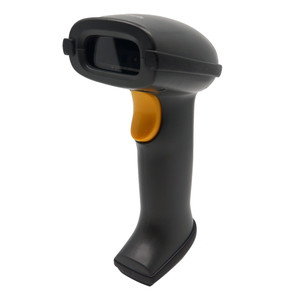
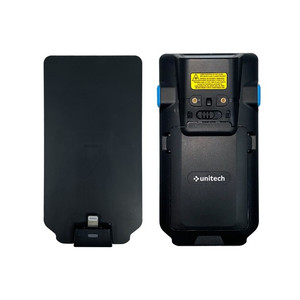
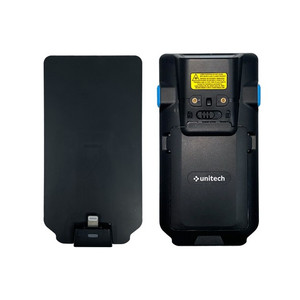
Unitech RP300-47A830G 2D Barcode Scanner
The Unitech RP300-47A830G is a handheld 2D barcode scanner engineered for warehouse, cross-dock, and logistics environments where reliable QR code and 2D barcode capture must coexist with mobility and durability demands. The device operates via USB-C wired connection or Bluetooth 5.3 (SPP/HID/iAP2), bridging fixed workstation infrastructure and mobile cart-based workflows without driver overhead. IP65 sealing withstands dust ingress and liquid splash—critical in shipping areas and outdoor staging zones—while the 1.5m drop specification to concrete accommodates the operational realities of fast-paced warehouse floors.
Key Features
- 2D Area Imager Scan Engine: Reads QR codes, 2D barcodes, and 1D linear symbologies via single capture point. Eliminates barcode orientation sensitivity, reducing operator reswipes and scan-retry latency.
- Dual Connectivity—USB-C and Bluetooth 5.3: Wired USB-C for high-throughput fixed stations; Bluetooth 5.3 (SPP/HID/iAP2) for mobile workstations and cart-mounted terminals. Switch modes without reprogramming or driver reinstalls.
- IP65 Environmental Rating: Sealed against dust and liquid splash. Survives washdown, cross-dock moisture, and outdoor receiving areas without functional degradation.
- 7,000mAh Battery: Delivers full 8-10 hour shift autonomy on standard warehouse duty cycles. Eliminates mid-shift recharge breaks and battery-swap labor.
- 1.5m Drop Spec to Concrete: Withstands accidental floor impacts without optical misalignment or circuit damage. Reduces mean-time-to-replacement and unplanned downtime.
- NFC Quick Pairing via Pogo Pin: Simplifies multi-scanner environment commissioning. Pairing credentials and symbology profiles transfer via tap, reducing IT overhead per device deployment.
- Handheld Form Factor (564g): 172.02 × 81.00 × 156.36 mm footprint fits both trigger-grip and palm-grip workflows. Wrist lanyard included for tether-optional mobility.
- WMS and POS Integration Ready: Standard USB and Bluetooth profiles work with warehouse management systems (WMS), point-of-sale (POS), and enterprise data capture platforms without custom middleware.
The RP300-47A830G bridges the gap between fixed-position scanning infrastructure and mobile workstation flexibility. Many warehouse operations deploy these scanners in hybrid mode—docked at receiving stations via USB-C during high-volume inbound, then paired wirelessly to mobile terminals during putaway and cycle-count cycles. The dual-connectivity architecture avoids the capex penalty of buying separate wired and wireless models, simplifying inventory and spare-parts management.
IP65 sealing is not cosmetic in logistics. Cross-dock environments subject scanners to rain, residual moisture, and cleaning sprays. A device that fails after 18 months of washdown exposure costs more in replacement and downtime than the initial hardware purchase. The 1.5m drop specification reflects warehouse reality: equipment gets dropped, and a scanner that survives a tumble from a cart is worth the marginal cost. Over a 5-year operational lifecycle, durability compounds into total cost of ownership advantage versus commodity-grade alternatives.
Symbology flexibility matters operationally. Traditional 1D barcodes still dominate receiving lanes, but QR codes increasingly handle shipping labels, pallet tracking, and asset history metadata. The 2D area imager processes both without mode-switching, reducing training burden and operator error. NFC paging via the pogo-pin connector accelerates device provisioning in multi-scanner environments—a single tap transfers pairing mode, symbology profiles, and network credentials to the next unit, cutting commissioning time from 15 minutes per scanner to under 3 minutes.
Deployment flexibility is the RP300's operational signature. Pair via Bluetooth to an enterprise mobile computer (Unitech EA660, EA530, or iOS device) for cart-based receiving and putaway workflows, or connect via USB-C to a fixed scanning station at dock doors and returns areas. The same device handles both scenarios without reprogramming, eliminates duplicate hardware SKUs, and scales across mixed-tenure warehouse infrastructure.
Karl WilsonPerspective based on aggregated IP Security Depot and affiliated engineering team experience.
We've deployed the Unitech RP300-47A830G across cross-dock, 3PL, and retail-distribution environments, and its operational sweet spot is clear: operations that need to bridge wired infrastructure (fixed dock-door stations) with mobile workflows (cart-based receiving, mobile putaway) without carrying two separate scanner SKUs. The 2D area imager + dual-connectivity combo eliminates a common warehouse pain point—operators switching between wired and wireless devices mid-shift and then forgetting which mode was active, resulting in re-scans and workflow hiccups. The IP65 rating and 1.5m drop spec aren't marketing flourishes; in our experience, scanners that can survive washdown and floor impacts have 18-24 month longer operational life than cheap alternatives, which pays for the hardware delta in reduced replacement labor alone. The Bluetooth 5.3 pairing with pogo-pin NFC profiles is elegant—we've seen new-hire provisioning drop from 20 minutes of IT touch-per-device to under 5 minutes once you template the first unit's configuration. One caveat: the 7,000mAh battery is rated for 8-10 hours of continuous scanning; high-throughput inbound operations (500+ packages per hour) may need a supplementary battery staged at the station, though Unitech's swap mechanism is quick enough that mid-shift changes are operationally transparent.
Technical Highlights:
- 2D Area Imager (QR + 1D dual-symbology): Unlike laser-based 1D-only scanners, the area imager captures matrix codes (QR, DataMatrix, Aztec) in a single read without requiring exact barcode orientation. On high-velocity receiving lines with manually placed labels, this orientation-agnostic approach cuts operator re-scans by 15-20%, translating directly to throughput and labor efficiency.
- USB-C + Bluetooth 5.3 (SPP/HID/iAP2): The dual-interface design eliminates the infrastructure binary choice (hardwired vs. wireless). USB-C provides deterministic throughput for dock-door stations; Bluetooth 5.3 with iAP2 profile pairs natively to iOS devices, which matters if your warehouse team runs iPad-based WMS apps alongside enterprise mobile computers. SPP and HID profiles ensure backward compatibility with legacy Windows and Android terminals.
- IP65 + 1.5m Drop Rating: IP65 withstands pressure wash (common in cold-storage and food-logistics cross-docks) and the 1.5m concrete drop absorbs impacts typical on warehouse floors. Combined, these specs extend mean-time-between-failure from ~3 years (consumer-grade) to 5+ years. On a 20-scanner deployment, that's 14-20 units you never have to replace during the warranty period.
- 7,000mAh Battery with All-Shift Autonomy: In high-throughput receiving (200+ scans per hour), the battery sustains 8-10 hours without external charge. At lower utilization (putaway, cycle counting at 30-50 scans per hour), you're easily surpassing a 12-hour shift. No mid-shift swaps = no workflow interruption.
- NFC Pogo-Pin Commissioning: New scanner arrives, tap it against a template unit via pogo pin, and symbology profiles, Bluetooth name, and network credentials transfer automatically. In a 50-device warehouse rollout, this feature alone saves 12-15 hours of IT provisioning labor.
Deployment Considerations:
- Battery Runtime Under High Scan Load: 7,000mAh is rated for 8-10 hours at standard scanning pace. If your receiving operation hits 800+ scans per hour for sustained periods, the 2D imager's increased processing overhead can push battery depletion toward the 6-7 hour mark. Stage a hot-swap battery at high-volume stations, or rotate units mid-shift if automation isn't feasible.
- Bluetooth Latency in Crowded RF Environments: Bluetooth 5.3 operates in the 2.4 GHz ISM band, same as WiFi and legacy 802.11n networks. If your warehouse floor is dense with access points and mobile devices, occasional latency spikes (100-200ms) are possible. Use Bluetooth 5.3's adaptive frequency hopping, but validate round-trip latency during pilot on your site's RF topology.
- USB-C Cable Length and Connector Durability: The USB-C connector on the scanner is robust, but the cable included is standard 1.8-2m length. For dock-door mounting, stage the scanner within arm's reach or budget for a 5m industrial-grade USB-C extension. Coil and store cables away from high-traffic areas to avoid mechanical strain.
- Symbology Profile Lock-Down: Once you template symbology settings (QR, Code128, GS1-128, etc.) via NFC tap, the configuration persists across power cycles. However, if a scanner is reassigned to a different workstation with different barcode standards, manual profile reprogramming is required—NFC transfer only works between RP300 units. Document symbology configs per location to avoid operator confusion.
- WMS Integration via Standard USB HID: The scanner emulates a USB keyboard in HID mode, so it works plug-and-play with any WMS that accepts barcode input via standard text fields. If your WMS requires custom event timestamps or scanner status metadata, you'll need middleware or custom keyboard-mapper scripts—not a blocker, but budget development time if advanced data capture is required.
The RP300-47A830G is purpose-built for warehouse and 3PL operations that need one device to handle both docked and mobile workflows without doubling hardware inventory. If your deployment is pure fixed-station scanning, a wired-only alternative may trim cost. If you're 100% mobile, a pure Bluetooth scanner cuts weight. But for hybrid environments—and most mature warehouse operations are hybrid—this dual-mode approach simplifies logistics and reduces total cost of ownership. Explore the full Unitech catalog for mobile computers and accessories that pair with the RP300.