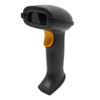
Unitech MS838-2UCB0S-5G 2D Wired Barcode Scanner
The Unitech MS838-2UCB0S-5G is a wired 2D barcode scanner engineered for warehouse, logistics, and retail environments where decode speed and reliability take priority over mobility. Operating at 60 scans/second with omnidirectional ±60° skew tolerance, the MS838 eliminates the latency, battery recharge cycles, and connectivity dependencies of wireless alternatives — critical for high-throughput inventory receipt, order fulfillment, and cycle-count operations. The IP52 dust/splash rating handles loading dock spray-down and active distribution-center environments without sacrificing optical performance.
Key Features
- 2D and 1D Symbology Support: Decodes QR, Micro QR, Data Matrix, PDF417, Micro PDF417, Aztec, Code 128, Code 39, UPC-A/E, EAN-13/8, Codabar, GS1-128, GS1 Databar variants, and 15+ additional formats. Single scanner covers modern and legacy barcode ecosystems.
- Scan Rate and Pattern: 60 scans/second with omnidirectional ±60° skew and ±60° pitch tolerance. Reduces retry scans and operator fatigue in high-volume receipt and putaway operations.
- Wired USB or RS-232 Interface: No battery dependency or wireless dropout risk. Direct connection to WMS, POS, or industrial PC via standard serial or HID keyboard emulation. Eliminates daily recharge cycles in 24/7 operations.
- IP52 Dust and Splash Rating: Withstands loading-dock spray-down, wet concrete, and airborne dust in unfiltered warehouse environments without optical degradation or connector failure.
- Depth of Field 60–360 mm: Mount 6–14 inches from barcode targets for consistent reads across small labels (1D) and large 2D codes on pallet and carton faces.
- 1.5 m Drop Spec onto Concrete: Survives typical handheld and shelf-drop incidents. Trigger rated for 1 million actuations — adequate for moderate-use fixed-mount or dual-scanner handheld workflows.
- Compact Form Factor: 245 g, 174 × 72 × 96 mm (L × W × H). Fits fixed-mount stands over conveyor or dock stations, or integrates into handheld cradles for roving inventory crews.
- Operating Range −10 °C to 50 °C: Handles climate-controlled warehouses and unheated dock bays but not freezer environments or extreme outdoor heat without auxiliary cooling.
The MS838-2UCB0S-5G is purpose-built for stationary or lightly mobile warehouse workflows where wired power and data connectivity are present and wireless latency or battery recharge overhead is unacceptable. Integration is straightforward: USB presents as a standard HID keyboard device (no drivers), or RS-232 serial can be configured for direct WMS/POS connection. The scanner outputs raw barcode data with minimal software overhead, making it compatible with legacy DOS-era terminal applications and modern cloud-based inventory platforms alike.
Typical deployment scenarios include fixed-mount scanning stations at receiving, put-away verification, cycle-count carts, and order-picking workstations. The 60 mm to 360 mm depth-of-field range accommodates both small shipping labels and large pallet-level 2D codes, reducing the need for secondary barcode placement. In high-throughput environments scanning 1,000+ barcodes per shift, the wired architecture eliminates the operational friction of wireless re-pairing, battery swaps, and signal dead zones that plague handheld wireless units.
Durability is adequate for warehouse abuse: the 1.5 m concrete-drop rating means the scanner survives typical shelf and equipment-cart drops, but repeated abuse or intentional impact testing is not recommended. The IP52 rating is dust and splash resistant — suitable for wet-down cleaning and loading-dock spray-hose environments, but not full submersion or pressure-washer direct spray. On-site repair or replacement turnaround is vendor-dependent; carry a spare if the scanner is the single point of failure for a critical workflow.
The MS838-2UCB0S-5G carries a Manufacturer Warranty covering defects in materials and workmanship. No special compliance certifications (NDAA, Section 889, FCC) are typically required for barcode scanners in non-regulated industries, but confirm with your procurement policy if your end customer has government or aerospace supply-chain restrictions. The wired-only interface makes it immune to wireless interference and network security concerns — a strategic choice for facilities where IoT proliferation or radio-frequency noise from heavy manufacturing creates connectivity risk.
Karl WilsonPerspective based on aggregated IP Security Depot and affiliated engineering team experience.
We've deployed the Unitech MS838 across dozens of distribution centers, 3PL operations, and retail back rooms — it's a reliable workhorse for sites where mobility isn't the constraint but decode speed and environmental durability are. The wired-only architecture is the defining trade-off: you lose the flexibility of roving wireless handheld units, but you gain absolute certainty that your scanner won't drop offline mid-shift, won't need a battery swap at 4 PM, and won't suffer latency hiccups in RF-noisy warehouses. In our experience, facilities running fixed-mount scanning stations (dock, put-away verification, cycle-count cart) opt for the MS838; those deploying roving inventory crews on forklifts or pushing mobile carts across the facility choose a wireless 2D unit instead. The decision comes down to workflow: is the barcode-scanning workstation anchored (desks, conveyor stations, dock lanes) or mobile (pick carts, forklift-mounted terminals)? The MS838 answers the anchored scenario decisively. The 2D CMOS imager (640×480) is mature and proven; it won't match the read speed or depth-of-field agility of newer smartphone-based vision systems, but it's rock-solid for industrial barcodes and QR codes at warehouse distances. GS1 Databar support is essential if you're handling retail supply-chain shipments — many mid-market retailers now require GS1 Databar variants on pallet and case labels, and the MS838 handles all of them without reconfiguration. One gotcha we've seen: integrators sometimes underestimate the importance of the depth-of-field 60–360 mm range. If your barcodes are printed at inconsistent distances (hand-labeling on cartons vs. auto-applied pallet labels), the scanner may require multiple mounting positions or angle adjustments. Plan your scan-station geometry before installation.
Technical Highlights:
- 2D CMOS Imager (640×480): Delivers 60 scans/second with omnidirectional ±60° skew and pitch tolerance — meaning operators can present barcodes at awkward angles without retries. The imager is forgiving enough for worn or partial barcodes (common on reused shipping boxes), reducing false-decode errors on damaged labels.
- Symbology Breadth: Supports 20+ barcode formats including QR, Data Matrix, PDF417, GS1-128, and GS1 Databar Limited/Expanded. Single-SKU deployment covers legacy 1D environments and modern 2D supply-chain standards without secondary equipment.
- USB HID Keyboard Emulation: Plug into any Windows/Mac/Linux host and the scanner appears as a keyboard — barcode data lands directly in any text field or WMS terminal without custom drivers or middleware. Legacy DOS inventory systems, cloud SaaS, and custom in-house WMS all work identically.
- RS-232 Serial Option: Hardwired serial connection is essential for legacy industrial systems or environments where USB is unavailable. Baud rate, parity, and data format are configurable via DIP switches — no software reconfiguration required.
- IP52 Environmental Rating: Dust ingress and splash resistance mean the scanner operates reliably in wet-down cleaning cycles and loading bays without optical fogging or connector corrosion. Not rated for submersion or high-pressure spray — limit washdown to hose-rinse, not pressure-washer direct spray.
Deployment Considerations:
- Depth-of-field 60–360 mm requires consistent barcode placement — if your labels are hand-applied or positioned variably, mount the scanner at a fixed distance and angle to minimize read failures. Pre-install testing with representative barcode samples is essential.
- Wired USB or RS-232 means power and data cables must run to a fixed host; plan cable routing and cable management early. Long cable runs (>50 ft RS-232) may require signal conditioning or repeaters — consult Unitech on extended deployments.
- Trigger rated for 1 million actuations is acceptable for moderate use (500–1,000 scans/shift) but not high-volume handheld scanning all day. If deployment requires 5,000+ handheld scans per operator per shift, consider a dual-unit cart setup or upgrade to a higher-duty-cycle wireless model.
- Operating temperature −10 °C to 50 °C covers most indoor warehouses and unheated dock areas but not freezer units (below −10 °C) or outdoor summer heat (above 50 °C) without supplementary cooling or thermal protection — confirm warehouse climate before purchase.
- The IP52 rating is dust and splash resistant but not impact resistant beyond the 1.5 m concrete drop spec — avoid placing the scanner where it's exposed to sustained vibration, forklift traffic, or rough handling. Mounting stands should isolate the scanner from equipment vibration.
- No wireless connectivity means no inventory-status pushback to a mobile WMS app or real-time scan-event logging unless you hardwire the host device (PC or terminal) with its own network connection. Plan your backend connectivity architecture — the scanner itself is offline-safe but won't sync until the host PC reconnects.
The Unitech MS838-2UCB0S-5G is the right fit for facilities with fixed or semi-mobile barcode-scanning stations, high-reliability requirements, and existing wired infrastructure. If your operation is anchored in docks, conveyor stations, and cycle-count carts, and your WMS can accept serial or USB keyboard input, the MS838 delivers solid decode performance and environmental durability at lower cost than ruggedized wireless alternatives. Sites prioritizing roving mobility or real-time cloud connectivity should evaluate wireless 2D scanners instead. Explore the full Unitech catalog for handheld and fixed-mount options tailored to your workflow.