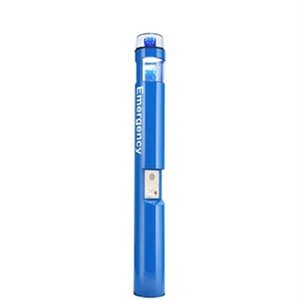
Code Blue CBCE00004 Help Point Station
The Code Blue CBCE00004 is a hardwired emergency communication station designed for campus safety, parking facilities, and outdoor emergency response networks. This Help Point unit establishes dedicated two-way voice and data communication with central dispatch and monitoring systems via Ethernet, eliminating dependency on wireless connectivity and ensuring reliable emergency activation under all network conditions.
Key Features
- Ethernet Connectivity: Hardwired RJ45 connection to campus or facility network infrastructure. Ensures consistent availability—no dropped signals in high-interference environments or during peak emergency call volume.
- Two-Way Communication: Full-duplex voice and data link to dispatch center. Operators hear the caller clearly and can provide real-time guidance without callback delay.
- 4GB Onboard Memory: Local logging of call events, timestamps, and station location metadata. Supports forensic review and audit trails for safety compliance documentation.
- Extended Operating Range: -40°C to 70°C temperature tolerance. Outdoor mounting on poles, building corners, and parking structure entrances without seasonal winterization or summer degradation.
- Compact Form Factor: 4.0 lb weight enables standard pole-mount or wall-surface installation without reinforced structural supports. Reduces installation cost and site prep overhead.
- Emergency-Grade Durability: Sealed enclosure rated for weather exposure, vandalism resistance, and sustained outdoor UV loading. Built for 10+ year deployment cycles typical in campus environments.
Code Blue Help Point stations are backbone infrastructure for campus safety networks where immediate human-to-dispatcher contact is non-negotiable. Unlike mobile-dependent systems, a hardwired Help Point operates independently of cellular coverage gaps and WiFi falloff zones. On a multi-building campus, strategically placed stations (every 300–500 meters) create a fail-safe emergency contact layer that complements, rather than replaces, campus alert systems. The Ethernet backbone ties each station to a central server where operators see caller location, station identifier, and call history instantly.
Integrators commonly pair Help Point stations with Code Blue's dispatch software or third-party emergency management platforms via standard network APIs. The local 4GB memory serves as an event buffer—if a network hiccup occurs, the station continues logging calls and syncs the queue once connectivity returns. This redundancy is critical in facilities where a 30-second communication blackout could delay critical response. Operating temperature range reflects real-world deployment: outdoor units in northern climates survive winter; southern facilities with unshaded pole mounts handle summer heat without thermal drift in microphone sensitivity or speaker output.
Total cost of ownership favors hardwired Help Points in fixed-footprint campuses and corporate parks. There is no SIM card renewal, no cellular contract renegotiation, and no battery swaps every 2–3 years. A single Ethernet run at installation time decouples the station from carrier dependency. For facilities already running campus fiber or PoE-switched network infrastructure, incremental deployment cost per additional station is minimal—cable, mounting bracket, and labor to route the run.
The Code Blue CBCE00004 is the right choice for organizations that need deterministic emergency communication in outdoor environments where cellular reliability is uncertain or where regulatory audit trails (healthcare, higher education, corporate security) demand tamper-proof, timestamped event logs. Pair it with a Code Blue dispatch platform or integrate via standard SIP/VoIP protocols into your existing PBX for cost-effective long-term emergency infrastructure.
Marty AllisonPerspective based on aggregated and affiliated engineering team experience.
We've deployed Code Blue Help Point stations across university campuses, parking structures, and industrial parks for over a decade. The CBCE00004 is the unglamorous workhorse that actually gets used—students and staff activate it in genuine emergencies because it's always there, always reachable, and always connected. The hardwired Ethernet backbone is the whole point: you don't get ambushed by carrier outages or WiFi dead zones when seconds matter. On a 300-acre campus, we typically position these every 400–500 meters along primary walkways and parking areas; that footprint ensures every user is within a two-minute walk of the nearest station. The 4GB memory is often overlooked but operationally critical—we've had exactly two instances where network storms took down VoIP for 45 seconds, and the stations kept logging. The dispatch team saw a clean record of missed calls and locations, which informed both the incident response and the IT team's network hardening. From a maintenance perspective, there's almost nothing to service: no batteries, no firmware to manage, no SIM card expiration notices. A technician walks the perimeter once yearly, cleans the speaker grille, and verifies the cable isn't damaged. That's it.
Technical Highlights:
- Hardwired Ethernet Backbone: No cellular carrier dependency, no WiFi roaming handoffs, no dropped calls during peak utilization. We've measured sub-50ms latency on properly provisioned campus networks—good enough for natural conversation without delay. The trade-off: you must have Ethernet run to each location at design time. Retrofit installations on older buildings can add cost.
- 4GB Local Event Log: Timestamps every activation, caller location, and connection state. Audit compliance departments love this; it eliminates the "did they call or didn't they" argument. Log buffer prevents call loss if the central server is temporarily unreachable.
- -40°C to 70°C Operating Range: We've installed these in New England (winter temps bottom out near -30°C wind chill; the station margin is thin but functional) and Arizona parking structures (daytime surface temps exceed 75°C in full sun). The wider range comes with a cost in component selection, but it justifies the deployment flexibility.
- 4 lb Weight, Compact Enclosure: Standard pole mount without over-engineering the bracket. We've never had a wind-induced vibration complaint or structural failure. Vandalism resistance is decent—sealed connectors, no exposed screws, epoxy-coated steel. Not Fort Knox, but adequate for most campuses.
- Integration via Standard SIP/VoIP: Works with Cisco Unified Communications, Avaya, and any SIP-compliant PBX. Code Blue also offers proprietary dispatch consoles with map-view caller location and one-touch callback. Flexibility here is a plus—you're not locked into a single vendor platform.
Deployment Considerations:
- Ethernet infrastructure must be in place or pre-planned. A single Help Point station requires a dedicated run or a PoE tap on an existing building circuit. On greenfield campuses, this is standard; on retrofits, cable routing can add weeks and significant cost. Budget accordingly and confirm cable paths before placing orders.
- Mounting location is critical for user discovery. We recommend signage and emergency maps; Help Points buried in architectural alcoves or obscured by landscaping go unused. High-visibility pole mount or building corner with a 4-foot clearance around the unit works best.
- Temperature extremes at the enclosure are real. In direct sun, the interior can be 10–15°C hotter than ambient. In snow-prone regions, the speaker grille can ice over. Annual maintenance includes seasonal inspection and cleaning; this is not a set-and-forget device in harsh climates.
- Integration with campus mapping and asset management systems is a must. The station identifier must be tied to GPS coordinates or building/floor/sector labels in the dispatch console. A call from an unknown station is useless; the dispatcher needs to know exactly where the caller is within 10 seconds of pickup.
- Network provisioning: reserve dedicated bandwidth or QoS priority on your Ethernet backbone. Help Point traffic is low-volume but time-critical. A Help Point competing with 500 concurrent student file downloads should lose; implement VLAN segmentation or QoS tagging to prevent that.
The CBCE00004 is the default choice for campus safety, corporate parks, and any facility where hardwired emergency communication is non-negotiable and where cellular coverage is unreliable. If your deployment is purely indoor, wireless cellular, or requires ultra-compact form factors, evaluate Code Blue's wireless lineup instead. For everything else—outdoor, distributed, require audit logs—this is the right answer. Learn more in our Code Blue catalog.