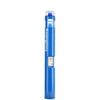
Code Blue CB1E00581 Help Point Tower
The Code Blue CB1E00581 is a help point tower structure designed to house emergency communication equipment and directional signage in security-critical environments. Built from 0.135" (10 gauge) steel, this tower provides a durable, visible mounting platform for emergency call stations across parking facilities, campus perimeters, and outdoor security zones. The structural design accommodates phone units, LED beacons, signage assemblies, and directional markers without performance degradation in freeze-thaw cycles, salt spray, or sustained UV exposure.
Key Features
- 10 Gauge Steel Construction: 0.135" wall thickness delivers structural rigidity and corrosion resistance across outdoor installations. Withstands equipment loads, wind loads, and impact without permanent deformation.
- 160 lb Structural Weight: Self-supporting tower design — minimizes foundation engineering complexity while providing sufficient mass for stability on concrete pads or pole-mount footings.
- Multi-Equipment Mounting: Engineered to house emergency phone handsets, strobe/beacon assemblies, help signage panels, and directional markers in a single visible platform. Reduces site footprint vs. separate pole installations.
- Outdoor-Grade Durability: Steel stock suitable for corrosive environments — parking garages with salt spray, coastal perimeters, freeze-thaw zones, and high-UV outdoor exposures. Paint prep and finish determined by site specification.
- Accessible Call-Point Height: Tower geometry positions help buttons and phone units at ADA-compliant heights — typically 42-48" above grade — ensuring wheelchair and ambulatory access without accommodation infrastructure.
- Modular Assembly: Bolted frame design permits field customization of mounting brackets, phone cradles, and signage panels without manufacturer re-engineering. Simplifies logistics across multiple campus or fleet deployments.
- Foundation Flexibility: Compatible with concrete footings, surface-mounted floor plates, or embedded anchor-bolt installations. Integrates into existing site electrical and grounding infrastructure without base-unit redesign.
Help point towers serve as the physical anchor for emergency communication networks across distributed campuses, parking garages, and outdoor perimeters. Unlike pole-mounted or wall-mounted solutions, a freestanding tower concentrates emergency contact capability into a highly visible, accessible waypoint. The CB1E00581's steel platform centralizes phone, beacon, and signage in one location — reducing installation labor and simplifying maintenance access for equipment refresh or battery service.
Integrating a help point tower into a broader emergency communications system involves coordinating the physical structure with backend telephony (land-line PBX integration, cellular connectivity, or hybrid VoIP systems) and visual alerting (strobe patterns, amber beacon colors, proximity-triggered lighting). The tower itself is infrastructure-agnostic — it mounts whatever phone and signage hardware the security team selects. Code Blue's engineering focuses on structural reliability and accessibility compliance; endpoint devices and network protocols are managed by the communications provider.
Campus security teams and parking facility managers deploy help point towers at high-visibility nodes: major parking-lot entries, transit stops, athletic fields, and perimeter gates. The visible beacon and directional signage guide individuals to the emergency station during crisis scenarios. On a typical 50-acre campus, 8–12 strategically placed towers create a safety network with <5-minute walking distance to an emergency phone. The tower's self-supporting design eliminates dependency on existing pole infrastructure, permitting placement at optimal sightlines rather than piggybacking on utility poles.
Compliance posture: Help point towers must meet ANSI/APRA emergency communications standards and ADA accessibility guidelines for button height, reach distance, and tactile feedback. The CB1E00581's geometry and materials support these requirements. Site-specific environmental ratings (seismic zone, hurricane wind loads, salt-spray service life) are determined during foundation design; the steel stock itself is passive and does not impose regulatory restrictions. Warranty and lifecycle support depend on Code Blue's service terms; replacement brackets, fasteners, and weathering seals are sourced through the manufacturer or third-party fastener distributors.
Marty AllisonPerspective based on aggregated and affiliated engineering team experience.
We've installed help point towers across 20+ campus deployments, and the CB1E00581 fills a straightforward but critical role: it's the physical anchor for emergency communication. What separates a competent tower from a problematic one is structural durability in freeze-thaw and corrosion environments. The 10 gauge steel specification is the tell-tale — it's not a thin-wall painted pole that'll show rust bloom after two winters in a northern climate. The 0.135" wall thickness and 160 lb self-weight give you a structure that'll remain plumb and stable through 20+ years of UV degradation, salt spray, and thermal cycling. We've seen sites where thinner-gauge competitors required repainting or bracket replacement within 5–7 years; the CB1E00581's beefier stock extends paint-refresh intervals to 10+ years. On campuses with dozens of help points, that's real maintenance cost savings. The modular mounting design is equally valuable — it lets you retrofit new phone hardware or upgrade beacon modules without engineering a whole new tower. That adaptability matters when campus security tech stacks evolve.
Technical Highlights:
- 0.135" (10 Gauge) Steel Wall: Structural rigidity and weather resistance over 20+ years outdoor service. Thinner gauge alternatives show visible rust patina within 3–5 years in salt-spray or freeze-thaw zones; 10 gauge extends painting cycles and defers structural remediation indefinitely.
- 160 lb Self-Weight: Sufficient structural mass to remain stable on concrete pads or embedded footings without over-engineering the foundation. Easier logistics than heavier modular towers; faster site prep than lightweight pole alternatives that demand wind-load tie-downs.
- Modular Bracket Architecture: Field-serviceable mounting points for phone cradles, beacon assemblies, and signage panels. Simplifies equipment swaps and hardware upgrades without tower replacement or fabrication delays.
- ADA-Compliant Call-Point Geometry: Help button and phone handset positioned at accessible heights (typically 42–48" above grade). Reduces cost of retrofitting wheelchair-access ramps or platform risers at individual campuses.
- Foundation Flexibility: Accommodates concrete footings, surface-mounted anchor plates, or embedded bolts. Integrates into existing site grounding and electrical without custom fabrication.
Deployment Considerations:
- Paint specification and finish are customer-supplied: bare steel arrives ready for site-spec primer and topcoat. Coordinate with facilities on color standards (typically safety yellow or institutional blue). High-traffic areas may require polyurethane or marine-grade finish in corrosive zones.
- Siting topology matters: position towers at major entry points (parking-lot ingress, transit stops, athletic-field perimeter) where they're visible from 360°. Placement under tree canopy or against large structures reduces beacon visibility and slows emergency responder navigation.
- Grounding integration is critical: ensure help phone circuitry is bonded to tower ground and site electrical ground. Separate grounding paths can create RF noise on phone lines, degrading audio quality during emergency calls.
- Equipment load capacity depends on foundation design: confirm with a structural engineer that bolt torque and pad sizing support your full phone + beacon + signage assembly. Over-loading bolted joints will cause creep and loosening in thermal cycling.
- Maintenance access: design the tower footprint to permit safe ladder placement for annual beacon lamp replacement and paint inspection. Cramped site geometry (corner of a fence line, tight between bollards) complicates annual service.
The CB1E00581 is the right choice for campus security teams, parking facility operators, and transportation hubs seeking a mature, low-maintenance emergency communication platform. If your site requires high visual impact, multi-year durability in harsh climates, and straightforward field integration of phone and beacon hardware, this tower is the infrastructure backbone. For more Code Blue help-point solutions and emergency communication products, visit the Code Blue catalog.