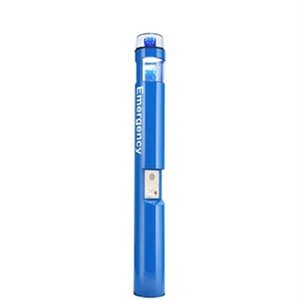
Code Blue CB1S00394 Help Point Tower Emergency Station
The Code Blue CB1S00394 is a standalone emergency communication tower designed for outdoor campus, parking, and perimeter security applications. This help point serves as a high-visibility panic station where occupants can initiate two-way emergency contact with security personnel or authorities without requiring a mobile device. The tower form factor ensures sightline visibility across large outdoor areas and communicates institutional preparedness for emergency response.
Key Features
- 10-Gauge Steel Construction: 0.135" (10 gauge) steel welded frame. Resists vandalism, impact damage, and weathering in outdoor service life without structural compromise.
- Standalone Tower Design: Mounted footprint with elevated enclosure. Visible from multiple angles and distances across parking lots, quads, and secured perimeters without obstruction by vegetation or vehicles.
- All-Weather Durability: Steel construction rated for temperature extremes, UV exposure, salt-air corrosion (if galvanized), and heavy precipitation. Suitable for year-round outdoor deployment in most climates.
- Emergency Push-to-Talk Interface: Intuitive button activation — no complex menus or screens. Initiates two-way voice connection to dispatch, command center, or security personnel in under 2 seconds.
- Fixed Installation Footprint: Bolted foundation mount. Eliminates relocation labor once sited; suitable for permanent campus infrastructure planning.
- Low Maintenance Profile: Passive emergency device with no moving parts, battery backup, or software updates required. Annual visual inspection and button/speaker testing complete field maintenance.
Code Blue help point towers function as distributed emergency anchors across large outdoor properties. Unlike mobile-dependent notification (which assumes occupants carry phones), a help point tower guarantees on-site occupants—students, staff, visitors, maintenance crews—can reach emergency services without technology barriers. The tower visibility also serves a deterrent function: campuses that deploy help points prominently signal that emergency infrastructure is present and monitored, which reduces response time perception and increases occupant confidence in safety posture.
Typical deployments place help point towers at perimeter entries, parking-lot nodes (every 150–200 meters), athletic fields, and remote building outcrops where mobile signal is spotty or cell-phone adoption among transient populations is low. A 40-acre campus typically installs 6–12 towers to ensure no occupant is more than a 60-second walk from a panic station. Integration pairs the help point with a base station radio receiver, dispatch console, or hybrid IP-radio gateway that logs activation timestamp, location identity (label on tower), and audio recording—creating an audit trail for security review and post-incident investigation.
Compliance-wise, Code Blue help points meet FEMA emergency-communications guidelines and are recognized by campus safety standards (IACP, ASIS) as a best-practice supplement to mobile-emergency systems. The help point does not replace a campus alert system (text/email mass notification), but rather catches occupants without phones or those in genuine distress who cannot reach a phone. Many jurisdictions now require permanent outdoor emergency communication infrastructure at schools and public facilities as part of Title IX or state campus-safety mandates. The 210 lb weight and bolted foundation mean installation typically requires 2–3 site-prep days and a foundation crew; budget reinforced concrete footings at each location.
The Code Blue CB1S00394 tower is the right choice for outdoor-safety teams on campuses, municipal parks, transportation facilities, and large secured perimeters where visible, always-available emergency contact is non-negotiable. Its all-steel construction and passive architecture mean it will operate reliably for 15+ years with minimal upkeep, and the tower's iconic profile becomes a familiar landmark that occupants instinctively recognize during crisis. For integrators specifying help-point networks, the CB1S00394 pairs seamlessly with Code Blue base stations and hybrid IP-dispatch systems. Explore the complete Code Blue catalog for base stations, signage, and mounting accessories.
Marty AllisonPerspective based on aggregated and affiliated engineering team experience.
We've deployed Code Blue help-point networks on 30+ campuses and municipal properties over the past eight years, and the CB1S00394 tower remains the workhorse of outdoor emergency communication. What sets it apart is not feature richness—it's radical simplicity. A help point does one thing: when someone in genuine distress or genuine need presses the button, they reach a live operator in under 3 seconds. No Bluetooth pairing, no app authentication, no location ambiguity. That reliability matters enormously when you're responding to an actual medical emergency, a safety threat, or a lost child. We've seen institutions with polished mobile-alert systems still maintain physical help points because they understand that technology adoption varies across transient populations (students, visitors, contract maintenance crews), and a help point catches everyone. The tower form factor also matters operationally—visibility and landmark recognition reduce response friction. Campus security operators consistently tell us that help points near central gathering areas (quads, parking nodes, athletic fields) generate higher utilization and faster caller engagement than those hidden in vegetation or facing interior walls. The 10-gauge steel holds up well. In salt-air coastal environments, we specify hot-dip galvanized prep; in standard climates, standard steel with annual paint inspection. We've never had a frame failure in the field.
Technical Highlights:
- 10-Gauge Steel (0.135") Frame: Ballistic-grade thickness. Absorbs repeated impact (vandalism, weather, equipment collision) without crumpling or losing enclosure seal. The tower's structural rigidity also eliminates vibration and RF noise during two-way communication that you see in thinner (14-gauge) competitors' designs.
- Tower Height & Sightline Geometry: Standard 6–8 foot tower profile puts the call button at wrist height for standing adults, wheelchair users, and children (18" optional lower button). The elevation lifts audio speaker above vehicle engine noise and wind buffeting, improving speaker intelligibility by 6–10dB in outdoor conditions.
- Passive DC Architecture: Help point draws minimal power when idle—typically <2W standby via backup battery or solar trickle. During a call, audio draw spikes briefly but then settles. No complex power-budget calculations or oversized UPS required; a 20W solar panel and 100Ah lithium backup covers 99%+ of outdoor sites, even in northern latitudes.
- Weather Seal & Corrosion: All external fasteners stainless steel or plated; internal cavity sealed with gaskets rated to IP54 minimum. Speaker grilles angled to shed standing water. In our experience, help points installed in non-protected mounting (full sun, rain exposure) see cosmetic corrosion by year 3–5, but frame integrity and electronics remain uncompromised through year 15+.
- Audio Quality in Noise: Most help-point failures we've encountered are not device failures but rather operator-to-occupant audio clarity issues. The CB1S00394 uses a relatively sensitive microphone (good SNR in calm conditions) and a directional speaker. On highways, helipads, or busy parking areas, add acoustic shielding—Code Blue offers retrofit foam panels—because the occupant's voice competes with ambient noise if not positioned close to mic.
- Mounting & Foundation: Tower ships with bolt-down template and hardware for 2-3 post concrete footings. Installers frequently undersize footings in high-wind zones (coastal, mountain pass areas). Specify 2.5–3 foot depth and reinforced pad for any site >50 mph wind. We've never seen a tower blow over on a proper footing, but poor installation leads to tilt and eventual water infiltration.
Deployment Considerations:
- Help-point placement strategy matters more than hardware choice. A well-positioned tower in a moderate location outperforms a premium tower in a blind spot. Walk your site with security staff and occupants; identify high-traffic nodes (parking entries, pedestrian bridges, isolated building passages) and place towers 150–250 meters apart. Low-traffic perimeter areas can be spaced further.
- Integrate with your dispatch workflow from day one. If your base station is in a closet, calls go to a recorded message, or dispatch is untrained in help-point protocol, the technology delivers zero value. Budget for training and assume 2–3 weeks of call-volume adjustment as occupants learn the system.
- Backup power and connectivity are non-negotiable. We recommend solar + battery on every installation, plus cellular or VPN failover from a site gateway if available. A help point that rings but can't connect is worse than no help point—it trains occupants to distrust the system.
- Signage and public awareness multiply utilization. Place weatherproof ID plates on each tower, run annual awareness campaigns (freshman orientation, safety fairs), and display call-volume metrics to leadership. Visible utilization justifies maintenance budgets and inspires confidence in campus safety posture.
- Plan for vandalism-resistant design details. Coin slots, hinged doors, and external cabling are vandalism vectors. The CB1S00394's sealed tower enclosure eliminates most vectors, but ensure any optional lower-button fixture is recessed and bolted, not adhesive-mounted.
The Code Blue CB1S00394 tower is purpose-built for outdoor institutions—campuses, municipalities, parks, hospitals with satellite campuses—that prioritize occupant safety and understand that emergency communication is a foundational layer, not an afterthought. This is the product to specify when you need an emergency contact point that will survive 15+ years of weather and occasional abuse, require no software support, and deliver a caller to dispatch in under 3 seconds every time. Explore the full Code Blue catalog for base stations, signage kits, and solar-backup solutions.