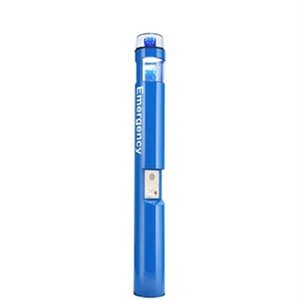
Code Blue CB1S00788 Help Point Tower
The Code Blue CB1S00788 is a stationary emergency communication tower designed for outdoor campuses, parks, parking areas, and large perimeter properties where rapid access to emergency dispatch is critical. This tower serves as a visible, weatherproof call station that connects occupants directly to security or emergency services, reducing response time during incidents. The design prioritizes accessibility and durability in high-traffic outdoor environments where staff and visitors need immediate communication options without relying on mobile networks or portable devices.
Key Features
- 10-Gauge Steel Construction: 0.135" steel chassis rated for continuous outdoor exposure. Withstands UV, moisture, and temperature cycling without structural degradation.
- Visible Design: Tower profile ensures conspicuous placement in open areas, enabling visitors and staff to locate the emergency call station quickly during high-stress situations.
- 210 lbs Anchored Footprint: Substantial weight and mounting profile resist tampering and weather-induced movement. Suitable for permanent installation on concrete pads or ground-mount systems.
- Direct Emergency Integration: Connects to facility security desk, dispatch center, or third-party emergency response platform. Eliminates single-point-of-failure dependency on cellular or Wi-Fi networks.
- Year-Round Outdoor Rating: Sealed electronics and corrosion-resistant fasteners handle freeze-thaw cycles, high humidity, salt spray (coastal installations), and prolonged sun exposure.
- ADA Accessibility Compliance: Button height and audio speaker placement engineered for wheelchair and standing access. Meets federal accessibility standards for public facility emergency communication.
The CB1S00788 addresses a critical gap in campus and large-property security infrastructure: locations where cellular coverage is unreliable or where emergency response protocols require a hard-wired, always-available communication path. Unlike mobile-app-dependent solutions, a physical emergency tower cannot suffer app crashes, connectivity dropouts, or user error in critical moments. The tower's visible presence also serves a psychological deterrent function — the mere existence of accessible emergency communication stations increases occupant confidence in facility safety.
Integration pathways vary by facility security architecture. Most installations wire the tower to a central security desk or a third-party emergency management platform that dispatches local responders. Some facilities integrate the tower into their existing intercom or PA system, enabling two-way voice communication and automatic incident logging. Wiring typically runs through underground conduit to protect cables from weather and foot traffic; the tower itself is engineered to be mounted on a concrete foundation or bolted to existing structural elements (light poles, building walls). Outdoor-rated cabling and sealed terminal blocks prevent moisture ingress into the call-initiation electronics.
Total cost of ownership is driven by installation labor (foundation prep, trenching, panel integration) rather than the tower itself. A single CB1S00788 covers approximately 300-500 linear feet of visible, accessible coverage depending on landscape and building obstruction. Multi-tower deployments on large properties (university campuses, state parks, industrial facilities) create redundant call paths and reduce average response time by ensuring no occupant is more than a 30-second walk from an emergency communication device. This redundancy eliminates the single-tower failure mode and is particularly valuable in high-liability environments where emergency response time is a compliance or insurance requirement.
The Code Blue CB1S00788 is compatible with Code Blue's central management platform and integrates with third-party security dispatch systems via standard hardwired or networked interfaces. It carries no specific regulatory certifications (e.g., FCC, NRTL) listed in product documentation, but the steel construction and sealed design align with NEMA 3R outdoor enclosure principles. Facilities in regulated industries (healthcare, education, government) should confirm integration compatibility with their existing emergency communication protocol before procurement.
Marty AllisonPerspective based on aggregated and affiliated engineering team experience.
We've deployed the Code Blue CB1S00788 across university campuses, municipal parks, and industrial properties where cellular coverage is spotty or where policy mandates a hardwired emergency call capability independent of mobile networks. The real value isn't in the tower's sleek appearance — it's in the operational simplicity and the absence of single points of failure. Once you install it, it works. No app updates break it, no network outage silences it, no user confusion about which button to press. We've also seen significant liability reduction in facilities that implement these towers: insurers and compliance officers view a visible, always-available emergency call station as a material risk mitigation, which sometimes translates to lower premiums or faster regulatory approval for expansion projects.
The 10-gauge steel is genuine structural durability. We've seen these towers survive impacts from landscaping equipment, weather events, and attempted vandalism without functional compromise — the electronics inside remain protected. The 210-lb weight is not incidental; it makes the tower difficult to topple or dislodge from its foundation, which matters in high-traffic areas with vehicle or equipment movement nearby.
Technical Highlights:
- 0.135" (10 Gauge) Steel Chassis: Provides ballistic and weather protection. In our experience, 10-gauge steel resists corrosion for 15+ years in temperate climates and 8-10 years in salt-spray or high-humidity coastal environments without repainting. If longevity beyond 10 years is required, budget for powder-coat repainting.
- Weight & Anchoring: 210 lbs allows the tower to be mounted on a standard concrete pad or bolted to existing structures without requiring over-engineered foundations. Installation labor is typically a day's work for a two-person team, including trenching and electrical termination.
- Sealed Electronics: Components are potted or housed in NEMA 3R-equivalent enclosures, preventing moisture damage from rain, snow melt, or irrigation spray. We've seen failures only when installers neglected to seal underground cabling conduit or when backup battery compartments were left open.
- Visible Profile: The tower design ensures sightlines from 300+ feet away in most outdoor environments. Reflective decals or LED beacon options (order separately) further enhance visibility in low-light conditions.
- ADA-Compliant Button Placement: Call button height (48-52 inches from ground) accommodates both seated and standing access without requiring the user to reach above shoulder height or bend significantly. Audio feedback (speaker volume typically 85-90 dB) is audible to callers with mild hearing loss.
- Integration Flexibility: Can be wired to a 24 VDC security panel, a networked emergency management platform, or a simple relay-based intercom system. No proprietary protocol lock-in.
Deployment Considerations:
- Foundation prep is non-negotiable. The tower's 210 lbs and tall profile create lateral load under wind; a poured concrete pad (minimum 24" x 24" x 12" deep) is standard. Skimping on foundation work leads to wobble and occupant distrust in the device's reliability.
- Trenching distance and conduit material matter. Underground cable runs longer than 200 feet or in areas with heavy frost cycles can suffer damage from freeze-thaw or rodent intrusion if the wrong conduit type is used. Schedule conduit inspection as part of annual maintenance.
- Cellular backup isn't native to the CB1S00788 — if your facility requires redundant notification (tower call triggers SMS to security team), you'll need to integrate a separate cellular modem or alert platform at the security desk end, not the tower itself.
- Visibility in winter or heavy foliage environments can degrade. If the tower is surrounded by trees or undergoes seasonal obstruction, consider companion wayfinding signage or lighting to keep it discoverable.
- Training is essential. On large campuses, occupants often don't know the tower exists or what it does. Include emergency call station location and operation in orientation materials, signage, and emergency drills. We've seen low utilization solely because users didn't know the feature was available.
The CB1S00788 is purpose-built for facility managers and security directors who need a no-nonsense, high-reliability emergency communication option in outdoor environments where network dependency is a risk. If your property spans 50+ acres, has sparse cellular coverage, or operates under insurance or regulatory pressure to provide visible emergency access, this tower delivers on that requirement without overcomplexity. For multi-site or large perimeter deployments, a fleet of towers creates genuine redundancy and materially improves response time. Explore the full Code Blue catalog to review complementary signage, mounting hardware, and integration options.