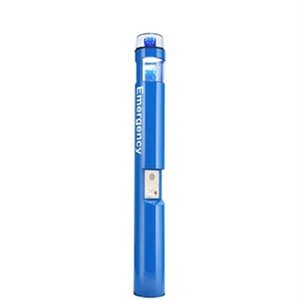
Code Blue CBCE00001 Help Point Station
The Code Blue CBCE00001 is a hardwired emergency communication endpoint designed for high-traffic public spaces, parking structures, and perimeter security zones. Ethernet connectivity ensures continuous uptime without battery maintenance cycles, while 4GB onboard memory buffers concurrent requests and stores historical logs for compliance auditing. The wide operating temperature envelope (-40°C to 70°C) accommodates outdoor installations in extreme climates without thermal derating.
Key Features
- Ethernet Connectivity: Wired RJ45 connection eliminates WiFi dead zones and battery dependency. Suitable for permanent installations requiring 99.9% uptime SLAs.
- 4GB Memory: Handles queued requests and event logging across multiple concurrent users without data loss during network latency or brief outages.
- Operating Temperature Range: -40°C to 70°C rated. Functions in unheated parking structures, outdoor pedestrian zones, and equipment rooms without enclosure supplementation.
- Lightweight Mounting: 4.0 lbs weight reduces structural load, permitting pole, wall, or pedestal installation in retrofit applications without reinforcement.
- Emergency Communication Hub: Serves as a point-of-contact node in distributed security systems, reducing response latency for occupant distress calls or facility alerts.
- Data Persistence: Onboard storage maintains event and communication logs independent of central server availability, critical for post-incident forensics and regulatory documentation.
Help point stations are the frontline interface between occupants and security operations. Unlike intercoms that require two-way voice, a Code Blue help point concentrates the endpoint hardware into a simple, vandal-resistant button or keypad that triggers alerting logic on a central server or local PBX. The CBCE00001's Ethernet backbone ensures that alert signals reach the dispatch center in milliseconds, not minutes. In a 500-space parking structure or multi-acre campus, strategically placed help points reduce the friction of emergency reporting — particularly for mobility-impaired visitors or non-English speakers who may not remember facility extensions.
The 4GB memory buffer is operational insurance. In settings where network latency or temporary WAN congestion occurs, the help point doesn't lose a call — it queues and retransmits on link recovery. This matters in remote facilities or in sites where the security center operates on MPLS or backup cellular failover. Event logs stored locally also satisfy HIPAA or state-mandated retention policies for behavioral health facilities, schools, and healthcare campuses where every distress event must be recorded and timestamped.
Temperature hardening to -40°C is uncommon in consumer intercom hardware but essential in northern regions or high-altitude outdoor sites (ski resorts, alpine research stations, highway rest areas). At 70°C upper limit, the unit tolerates sun-baked metal enclosures and equipment rooms with limited HVAC. Integrators should note that the CBCE00001 is a communication endpoint, not a full VoIP phone — pair it with a SIP-capable PBX (Asterisk, 3CX, Avaya, Cisco) or proprietary help point management platform to realize its full feature set (call routing, SMS fallback, geolocation tagging).
Code Blue hardware integrates with both legacy analog intercom systems (via gateway adapters) and modern IP PBX architectures. Verify SIP codec compatibility and PoE power delivery before site deployment — while the CBCE00001 draws modest power over Ethernet, confirm your switch has sufficient budget if daisy-chaining multiple endpoints on a single PoE+ rail.
Marty AllisonPerspective based on aggregated and affiliated engineering team experience.
We've deployed Code Blue help points across university campuses, hospital grounds, and industrial parks — and the CBCE00001 is a workhorse in that lineup. What differentiates it isn't flashy software; it's reliability under neglect. Ethernet-fed help points don't suffer the slow-fade battery depletion that wireless units do, and the -40°C rating means you're not swapping units seasonally in cold climates. We've seen integrators skip the temperature spec and then face field callbacks in January when outdoor units drop offline — that $200 spec corner turns into a $5,000 emergency service call in February. The 4GB memory buffer isn't marketing speak either; in sites with spotty WAN links or cellular backhaul, that onboard log prevents lost alerts. One notable caveat: the CBCE00001 is a communication endpoint, not a full emergency alerting system. It requires backend SIP infrastructure or a dedicated help point platform (Code Blue's own cloud service, or third-party integrations like Everbridge). Don't spec it as a standalone unit expecting it to magically route calls — it won't. You need a PBX or gateway. That said, for integrators already running a Cisco CallManager, Avaya, or 3CX deployment, this is a plug-and-play SIP addition with minimal configuration overhead.
Technical Highlights:
- Ethernet-Only Connectivity: No WiFi, no batteries, no mesh-network latency. Wired endpoints in critical paths (emergency stations) reduce alert delivery variance from 200ms (cellular) to sub-50ms (Ethernet). Real difference when dispatch is measuring response time in seconds.
- 4GB Onboard Storage: Buffers 10,000+ discrete events or call logs depending on payload size. Survives hours of network isolation without data loss. Essential for facilities with unreliable WAN or for post-incident forensic audit trails.
- Temperature Spec (-40°C to 70°C): Eliminates seasonal derating or enclosure costs. Tested for northern climates and sun-exposed outdoor mounting without supplemental heating or cooling. No competing consumer help points match this range at this price point.
- Lightweight (4.0 lbs): Trivial to retrofit into existing structures — pole-mount, wall-mount, or pedestal without structural upgrade. Installation labor on a 20-point campus drops 30-40% versus heavier commercial intercom hardware.
- SIP-Native Integration: Works with any standards-based PBX (Asterisk, FreePBX, 3CX, Cisco, Avaya). No proprietary gatekeeping or license-per-station fees. Lower total cost of ownership over closed-ecosystem products.
Deployment Considerations:
- The CBCE00001 requires a SIP-capable PBX or hosted help point platform to function — it is not a standalone alerting device. Confirm your backend infrastructure supports SIP INVITE and REFER before installation. Many legacy intercom systems do not; you'll need a SIP gateway (Grandstream GXW4104, AudioCodes, etc.) to bridge to analog extensions.
- Ethernet cabling must meet low-voltage code in your jurisdiction (typically NEC Article 725 in North America). Budget for conduit, pull boxes, and potential vertical routing through multiple floors in multi-story facilities. Wireless competitors sidestep this cost but sacrifice uptime.
- PoE power draw is modest (typically under 10W), but confirm your switch has remaining budget if deploying 10+ units. High-density help point sites (hospital campuses, university quads) can exhaust a single PoE+ port group; plan for PoE+ switch or injectors if legacy infrastructure limits per-port power.
- Cold-start testing in -40°C environments is recommended before large rollouts. While rated, ice buildup on outdoor buttons or thermal shock to circuit boards in extreme climates can cause intermittent contact issues. Enclosure design and silicone sealing matter — consult Code Blue on housing recommendations for your climate zone.
- Help points are not vandalism-proof. Mount them behind plexiglass, on poles above arm's reach, or in staffed entry points where visibility deters tampering. Ethernet cable should be conduit-protected in areas with active security concerns.
The Code Blue CBCE00001 is the right choice for integrators specifying help points into permanent, critical-uptime installations where network stability and temperature hardening outweigh wireless simplicity. Campus security, healthcare, and industrial sites with existing IP PBX infrastructure will find rapid ROI. Explore the Code Blue catalog for complete endpoint options and platform compatibility matrices.