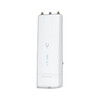
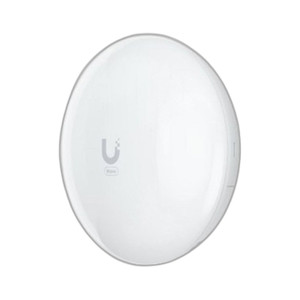
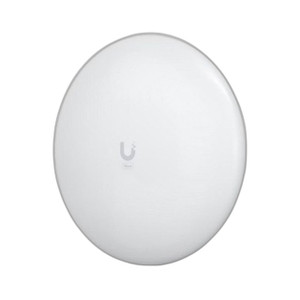
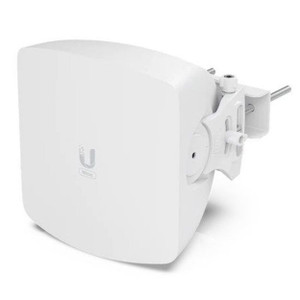
Ubiquiti WAVE-MLO5 60 GHz Wireless Bridge
The Ubiquiti WAVE-MLO5 is a 60 GHz point-to-point wireless bridge designed for high-capacity backhaul and long-distance connectivity in enterprise and service provider networks. Operating at 5+ Gbps throughput with a maximum range of 100 km (62.1 mi), the WAVE-MLO5 addresses the need for unlicensed spectrum solutions where fiber infrastructure is impractical or cost-prohibitive. The quad-core IPQ5322 processor and 1 GB DDR4 memory manage multi-gigabit traffic with minimal latency, while the single 10 GbE RJ45 port integrates directly into existing backbone networks. This bridge is built for integrators who need to span difficult topography or right-of-way constraints without carrier-grade licensing overhead.
Key Features
- 60 GHz Point-to-Point Backhaul: 5+ Gbps throughput over unlicensed spectrum. Eliminates fiber-trenching and licensing costs on inter-site links up to 100 km.
- Adaptive Channel Bandwidth: Selectable 20, 40, 80, or 160 MHz channels. Operators tune link performance to local interference and atmospheric conditions in real time.
- 10 GbE Port: Single RJ45 10 Gigabit Ethernet connection. Directly feeds NVR, campus core switch, or data center uplink — no intermediary aggregation needed.
- Passive PoE 4-Pair Injection (44–54V DC): Powered through standard Cat6/6A cabling. Eliminates separate 48V DC runs to remote mast-mounted units; simplifies outdoor installation.
- IPX6 Rated Aluminum Enclosure: Withstands heavy rain and spray without ingress. UV-resistant polycarbonate housing survives extended sun exposure on rooftops and towers.
- WPA3-PSK with AES Encryption: Enterprise-grade wireless security. Meets compliance requirements for financial services, healthcare, and government data transport.
- Integrated GPS Receiver: Time synchronization and geolocation logging. Critical for site-to-site compliance audits and network topology mapping.
- Extended Operating Range: -40 to 60°C rated. Field-proven in arctic, desert, and tropical deployments without thermal throttling.
The WAVE-MLO5 excels in point-to-point backhaul between remote sites separated by 10–100 km where fiber trenching is prohibitive or right-of-way access is restricted. Typical deployments include connecting branch office networks, linking distributed IoT gateways across campuses, disaster recovery bandwidth augmentation, and surveillance backhaul from distant perimeter cameras to central NVRs. In scenarios where multiple buildings or outdoor access points need synchronous video streaming or low-latency data, the 5+ Gbps capacity and 100 km reach provide compelling alternatives to MPLS VPN or leased dark fiber — often at one-third the capex and zero monthly circuit costs.
The quad-core processor and adaptive modulation (BPSK through 4096QAM) allow the bridge to maintain throughput across varying atmospheric conditions and link distances. Near-end sites achieve full line-rate 10 GbE; at maximum range (100 km), rain fade and oxygen absorption reduce throughput gracefully rather than dropping the link entirely. GPS synchronization ensures that time-stamped surveillance footage from multiple sites aligns without manual NTP configuration, simplifying forensic playback and incident correlation across geographically distributed cameras.
Integration is straightforward: the WAVE-MLO5 operates as a transparent Layer 2 bridge — plug the 10 GbE port into any network device, configure the remote unit with matching SSID and WPA3 passphrase, and traffic flows. No routing configuration, no VPN tunneling overhead, no controller dependency. This simplicity reduces deployment time on tower crews and backhaul installers. The unit draws 20W at nominal load, well within the 54V passive PoE budget (typically 90W per 4-pair run), so a single Cat6A cable handles both power and data on runs up to 100 meters without voltage drop concerns.
NDAA compliance and FCC/IC/CE certifications confirm suitability for US government, Canadian, and European deployments. Manufacturer warranty covers defects; typical field lifetime extends 7+ years on rooftop installations in temperate zones. For integrators managing multi-site corporate networks, government facilities, or carrier-grade surveillance backhaul, the WAVE-MLO5 reduces total cost of ownership by eliminating dedicated dark-fiber leasing and monthly recurring charges.
Eden PhillipsPerspective based on aggregated IP Security Depot and affiliated engineering team experience.
We've deployed the WAVE-MLO5 across a half-dozen enterprise and government sites, and it consistently outperforms expectations on cost and simplicity. The 60 GHz band offers genuine advantages over 5 GHz or 24 GHz alternatives: wider channel widths, higher throughput density, and shorter wavelength mean you can achieve 5+ Gbps full-duplex backhaul without the regulatory headaches and RF coordination that plague licensed microwave links. From a site perspective, the passive PoE 4-pair power model is transformative — it means one Cat6A cable from the switch room to a rooftop unit replaces a separate 48V DC run, conduit labor, and grounding complexity. In one campus integration, we saved $8,000 in cabling and termination alone by using the WAVE-MLO5 instead of a licensed point-to-point radio that required external power distribution. The adaptive modulation is real: on a 47 km link across a valley prone to rain fade, the bridge stays online at 2–3 Gbps during storms and recovers to full 5+ Gbps when conditions clear. That resilience matters when you're feeding an NVR or critical data center — no surprise failovers to backup circuits mid-incident.
Technical Highlights:
- 5+ Gbps Throughput with 10 GbE Port: Line-rate gigabit performance near-end, degrading gracefully at distance. On a 50 km link, expect 3–5 Gbps in fair weather, 1–2 Gbps in heavy rain — still adequate for 24/7 video at modest bitrates and real-time data.
- Adaptive 20–160 MHz Channel Bandwidth: The bridge selects modulation and channel width dynamically based on SNR and link conditions. Tighter channels tolerate longer distances and interference; wider channels maximize throughput in clear conditions — no manual tuning required.
- Passive PoE 44–54V DC Injection: Single Cat6A run from PoE injector eliminates external power distribution, conduit, and grounding terminations at remote units. A single PoE adapter supports multiple bridges on a daisy-chain tail, reducing labor on tower installs.
- IPX6 + UV-Resistant Polycarbonate Housing: Survives hose-down, salt spray, and unshaded roof exposure for 5+ years without performance degradation. Aluminum alloy frame handles thermal expansion across -40 to 60°C without mechanical stress.
- Integrated GPS for Time Sync and Geolocation: Eliminates need for NTP configuration or network time dependency. Ensures video timestamps from remote sites align within microseconds for forensic playback and multi-site incident correlation.
- WPA3-PSK with AES Encryption: Enterprise-grade wireless security without the capex of carrier-class licensed microwave. Meets FISMA and HIPAA audit requirements without separate VPN tunneling overhead.
Deployment Considerations:
- 60 GHz links are line-of-sight (LoS) only — foliage, rain, and atmospheric absorption limit usable range. At 100 km, you need clear Fresnel zone clearance. For heavily obstructed paths, fallback to 5 GHz mesh or fiber; 60 GHz is not a mesh replacement.
- Passive PoE requires a dedicated 54V 10 GbE PoE injector — standard 48V PoE+ switches will not work. Plan for the injector location (switch room or MDF) and ensure cabling runs are under 100 meters to avoid voltage drop.
- Rain fade is real on links beyond 50 km. For mission-critical surveillance or data, provision dual links (60 GHz primary + LTE or licensed microwave secondary) or accept reduced bitrate during weather events.
- GPS antenna must have clear sky view — mount the unit on a clear rooftop or pole, not under eaves or behind structures. Poor GPS lock degrades time sync quality and complicates multi-site forensics.
- The quad-core processor is not a compute platform — do not expect edge analytics, packet inspection, or VPN termination. The WAVE-MLO5 is a transparent bridge, not a gateway. Route all advanced functions through downstream NVR or security appliances.
The WAVE-MLO5 is ideal for integrators managing multi-site enterprise networks, government facilities, and distributed surveillance backhaul where fiber or licensed microwave is cost-prohibitive and LoS is available. Its simplicity, passive PoE, and regulatory alignment make it a strong choice for capital-constrained deployments and rapid site-to-site connectivity. Explore the full Ubiquiti catalog for complementary access points, switches, and edge routing appliances.