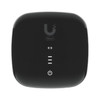
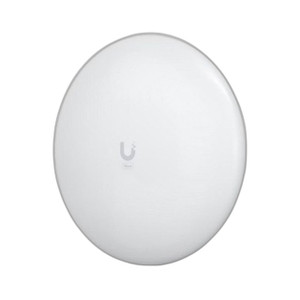
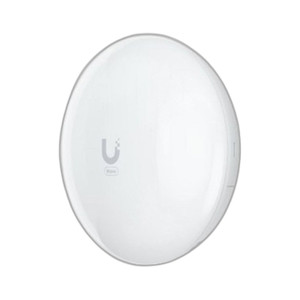
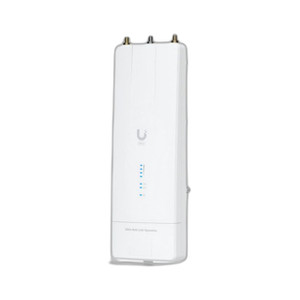
Ubiquiti WAVE-FIBER-ONU 60 GHz Wireless Bridge
Overview
The Ubiquiti WAVE-FIBER-ONU is a 60 GHz wireless bridge that operates as a GPON (Gigabit Passive Optical Network) Optical Network Unit, bridging fiber termination points to distributed network endpoints where traditional wired infrastructure becomes cost-prohibitive. The device delivers 2.5 Gbps downlink throughput via a single 2.5 GbE port, paired with 1.2 Gbps uplink capacity—an asymmetric architecture reflecting realistic enterprise traffic patterns where downstream demand typically exceeds return-path requirements. This throughput pairing means you avoid overpaying for symmetric bandwidth you won't use, while still maintaining adequate uplink headroom for service acknowledgments, DNS queries, and moderate cloud uploads.
Key Features
- 2.5 Gbps downlink via 2.5 GbE port: Sufficient for modern gigabit-class switching and avoiding congestion bottlenecks on access networks. The WAVE-FIBER-ONU (often searched as WAVE FIBER ONU) won't choke even if multiple users saturate available bandwidth simultaneously.
- 1.2 Gbps uplink: Adequate for interactive applications and modest return-path demand without requiring expensive symmetric fiber circuits to every remote location.
- 60 GHz millimeter-wave spectrum: Offers high bandwidth density with minimal interference to Wi-Fi, cellular, or other RF systems operating in lower frequency bands. No licensing required in most regions, though line-of-sight propagation is mandatory—obstructions cause signal loss.
- GPON ONU architecture: Integrates directly into fiber-fed networks, eliminating the need for separate optical-to-Ethernet conversion equipment. Operates downstream of an OLT (Optical Line Terminal); verify your headend supports this specific GPON variant to avoid incompatibility surprises.
- Compact form factor: Designed for confined spaces where traditional wireless access points or bridge housings would be impractical. Enables installation in tight equipment closets or on narrow cable trays.
- Point-to-multipoint deployment ready: Ideal for extending fiber service to remote buildings without underground conduit runs, backhauling traffic from distributed access points, or provisioning wireless fiber-to-the-site distribution across industrial parks, hospitality venues, or campus networks.
- Typical deployment range: Several hundred meters to beyond 1 km depending on antenna alignment, Fresnel zone clearance, and environmental conditions. Line-of-sight surveys are essential before ordering.
- Standard Layer 2 integration: The 2.5 GbE port supports tagged VLAN and untagged configurations, negotiating automatically with compatible switch infrastructure. SNMP-based monitoring recommended for visibility across distributed locations.
When to Choose This Model
Select the WAVE-FIBER-ONU if your deployment requires fiber-grade reliability and bandwidth without trenching costs, your site has clear line-of-sight paths between termination points, your OLT supports GPON and the WAVE-FIBER-ONU's optical specifications, and your traffic patterns favor downstream over upstream. This is particularly effective for extending service to remote buildings, backhauling aggregated traffic from distributed Wi-Fi access points, or serving industrial parks with multiple tenants.
When to Choose a Different Approach
If you need symmetric throughput or your return-path demand exceeds 1.2 Gbps, evaluate conventional fiber circuits or higher-capacity wireless bridge variants in the Ubiquiti catalog. If line-of-sight cannot be cleared, or if your OLT lacks GPON support, the WAVE-FIBER-ONU will not integrate—contact the OLT vendor to confirm compatibility before purchase. If you require indoor-only deployment or cannot manage weatherproofing, this is not the right tool.
Integration & Compatibility
Fiber termination requires standard LC or SC connectors matched to your OLT. Power delivery depends on configuration—verify whether your installation uses PoE or an external power adapter. Allow for thermal management in hot climates; 60 GHz equipment generates notable RF heating at full throughput. Site surveys must validate line-of-sight clearance and Fresnel zone integrity before mounting. Weatherproof enclosures are mandatory for outdoor deployments.
Frequently Asked Questions
Q: Does the WAVE-FIBER-ONU work with any GPON OLT?
A: No. The device must operate downstream of an OLT that supports this specific GPON variant. Verify optical specifications and ONT compatibility with your fiber headend before purchasing—not all OLTs recognize the WAVE-FIBER-ONU out of the box.
Q: What is the maximum distance the WAVE-FIBER-ONU can bridge?
A: Typical deployment distances range from several hundred meters to beyond 1 km depending on antenna alignment, Fresnel zone integrity, and environmental conditions. Line-of-sight is mandatory; rain and obstruction degrade performance significantly.
Q: Can I use the WAVE-FIBER-ONU indoors?
A: The device is designed for outdoor or semi-protected deployment with weatherproofing. Indoor use is possible but not typical; 60 GHz signals attenuate through walls and windows, reducing effective range dramatically.
Q: What happens to the link during rain or fog?
A: Expect 3–5 dB link margin degradation in light rain. For mission-critical paths, plan additional link margin and conduct site surveys under worst-case weather conditions before final deployment.
Q: Is the WAVE-FIBER-ONU GPON-only, or can it work over standard Ethernet?
A: The device operates as a GPON ONU and requires fiber-fed connectivity downstream of an OLT. It does not function as a standalone Ethernet-to-60 GHz bridge without GPON infrastructure.
Q: What are the uplink and downlink throughput specifications?
A: The WAVE-FIBER-ONU delivers 2.5 Gbps downlink and 1.2 Gbps uplink via a single 2.5 GbE port. This asymmetry reflects typical enterprise traffic patterns and avoids unnecessary expense for symmetric circuits.
Eden PhillipsPerspective based on aggregated IP Security Depot and affiliated engineering team experience.
The WAVE-FIBER-ONU fills a genuine gap in fiber extension tooling: you get fiber's reliability with wireless deployment speed, ideal when clients balk at trenching costs or timeline constraints make conduit infeasible. The asymmetric throughput profile (2.5 Gbps down / 1.2 Gbps up) is honest engineering for typical enterprise traffic, not marketing fiction. The critical gotcha—and I mean critical—is OLT compatibility. Not all fiber headends recognize the WAVE-FIBER-ONU out of the box. Verify your OLT supports this specific GPON variant and the device's optical specifications before purchasing. I've seen rollouts delayed two weeks because the wrong variant was ordered.
Technical Highlights:
- 2.5 Gbps downlink via 2.5 GbE port: Matches modern switching infrastructure headroom. Your access network won't become the bottleneck.
- 1.2 Gbps uplink: Realistic for interactive workloads and cloud uploads; avoids overspecifying return-path capacity you won't saturate.
- 60 GHz spectrum: High bandwidth density with negligible interference to Wi-Fi or cellular. Requires line-of-sight; obstructions kill the link.
- GPON ONU integration: Eliminates separate optical-to-Ethernet conversion equipment. Operates only downstream of a compatible OLT.
- Typical range beyond 1 km: Feasible with clear Fresnel zones and antenna alignment. Rain causes 3–5 dB margin loss; plan accordingly on mission-critical paths.
Deployment Considerations:
- Conduct line-of-sight surveys before final design. 60 GHz propagation is unforgiving—trees, buildings, and weather matter.
- Verify OLT support and optical connector type (LC or SC) before ordering. GPON variants are not all cross-compatible.
- Thermal management in hot climates: 60 GHz equipment generates notable RF heating at sustained throughput. Ensure enclosure ventilation.
- Weatherproof housing required for outdoor mounts. Budget enclosure cost into project total.
Deploy the WAVE-FIBER-ONU when fiber extension is mandated but conduit trenching is economically or logistically infeasible, your OLT explicitly supports this model, and your site has clear line-of-sight paths. It's particularly strong for remote building backhaul, multi-tenant industrial parks, and campus network extension where fiber termination points already exist.