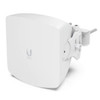
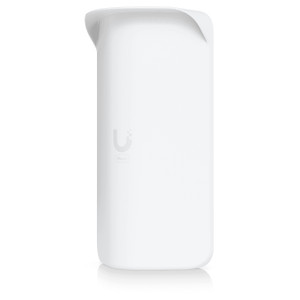
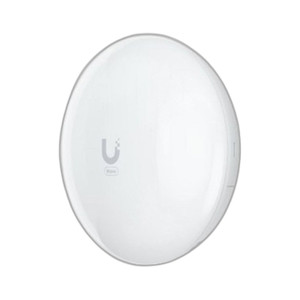
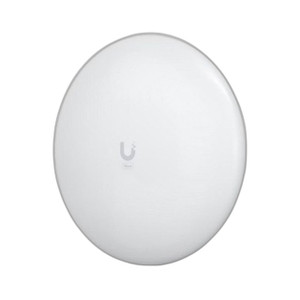
Ubiquiti WAVE-AP-MICRO 60 GHz Wireless Bridge
The Ubiquiti WAVE-AP-MICRO is an external 60 GHz wireless bridge engineered for enterprise campus backhaul, building-to-building links, and scenarios where fiber installation is economically or logistically impractical. Operating in the unlicensed 60 GHz band, this unit delivers 5 Gbps total throughput with 2.5 Gbps duplex capacity — sufficient to aggregate multiple gigabit client connections without bottlenecking modern data center interconnect speeds or campus LAN growth.
Key Features
- Dual-Radio Architecture (60 GHz Primary + 5 GHz Fallback): The WAVE-AP-MICRO pairs a 60 GHz transceiver (primary link) with a 5 GHz radio supporting 802.11a/b/g/n/ac/ax. This design eliminates single points of failure — if rain attenuation or seasonal atmospheric conditions degrade 60 GHz line-of-sight performance, the bridge automatically shifts to 5 GHz backup without manual intervention or external failover appliances. Reduces network downtime during weather events and simplifies topology by collapsing redundancy into one device.
- 5 Gbps Capacity in Compact Form Factor: The external-mount design (wall, pole, or mast-arm compatible) keeps cable runs short and deployment footprint minimal. A single WAVE-AP-MICRO unit replaces the need for separate point-to-point microwave links, eliminating licensing fees, frequency coordination overhead, and specialized RF engineering for most campus deployments under 10 km.
- 2.5 Gbps Duplex Throughput: Supports real-world full-duplex operation at 2.5 Gbps — enough for simultaneous uplink/downlink traffic across backup links, redundant fiber pairs, or load-balanced campus segments without practical saturation in typical enterprise bandwidth profiles.
- UISP Management Integration: Deploy and monitor the WAVE-AP-MICRO (often searched as WAVE AP MICRO) through Ubiquiti's unified UISP platform alongside other campus infrastructure — cameras, access points, switches. Single-pane-of-glass visibility into link status, throughput, failover events, and device health reduces NOC burden and speeds troubleshooting.
- Bluetooth Provisioning for Rapid Field Deployment: Initial configuration via Bluetooth eliminates dependency on temporary network access or SSH credentials during commissioning. Technicians can align antennas, verify line-of-sight performance, and verify failover paths from a mobile device before permanent mounting — critical when installing on rooftops or in areas with poor cable access.
- Clear Line-of-Sight Requirement (Standard for 60 GHz): 60 GHz signals attenuate sharply through obstacles, rain, and dense foliage. Plan for seasonal Fresnel zone clearance and monitor atmospheric conditions (heavy rain can introduce 15–30 dB additional loss). The 5 GHz fallback handles this gracefully, but expect reduced throughput during adverse weather — design link budgets with margin for seasonal degradation, not peak-condition capacity.
Integration & Compatibility
The WAVE-AP-MICRO integrates into existing Ubiquiti infrastructure via UISP's unified management plane. It operates transparently in bridge mode, supporting standard IP routing and VLAN tagging without protocol translation — simplifies network architecture by extending layer 2 or layer 3 segments across the link without appliance-level complexity. Works alongside Ubiquiti wireless access points and edge devices to create resilient backbone topologies.
Plan for seasonal line-of-sight validation, especially in climates with variable foliage or atmospheric conditions. Test failover paths quarterly to confirm 5 GHz backup performance meets your SLA. For links exceeding 10 km or requiring licensed spectrum, consider Ubiquiti's microwave bridge line or alternative licensed backhaul products.
Deployment Context
Typical scenarios: connecting adjacent office buildings across parking lots (50–500 m), establishing backup links alongside primary fiber routes, and bridging temporary network segments during data center migrations or campus expansion. The integrated failover design eliminates the cost and complexity of external redundancy appliances, making the WAVE-AP-MICRO practical for mid-market enterprises and integrators seeking fast deployment without sacrificing reliability. For guidance on sizing backhaul capacity for multi-building campuses, consult the network planning guide.
Frequently Asked Questions
Q: Does the WAVE-AP-MICRO require line-of-sight between units?
A: Yes. 60 GHz signals cannot penetrate buildings, heavy rain, or dense vegetation. Verify clear Fresnel zone geometry between unit pairs. The integrated 5 GHz fallback radio handles degraded conditions gracefully, but expect reduced throughput.
Q: Can I use Bluetooth provisioning without network access?
A: Yes. Bluetooth provisioning allows initial configuration and alignment verification from a mobile device without requiring temporary cable or network connectivity — speeds field deployment significantly.
Q: What is the maximum range of the WAVE-AP-MICRO?
A: Under optimal conditions (clear line-of-sight, standard atmospheric absorption), 60 GHz backhaul is practical to approximately 10 km. Actual performance varies with atmospheric conditions, antenna alignment, and Fresnel zone clearance. Test your specific path before final deployment.
Q: Does the WAVE-AP-MICRO integrate with UISP?
A: Yes. The WAVE-AP-MICRO provisions, monitors, and alerts within UISP's unified dashboard alongside other Ubiquiti infrastructure. Eliminates separate management consoles for backhaul and campus access points.
Q: What happens during 60 GHz signal degradation?
A: The integrated 5 GHz 802.11ac/ax fallback radio automatically assumes traffic. This reduces throughput to 5 GHz capacity but maintains service continuity without manual failover or external equipment.
Q: Is a separate power supply required?
A: Confirm exact power specifications in the product datasheet. Typical external bridges require 12 VDC or 24 VDC via standard connector — budget for PoE injectors or dedicated power supplies in high-altitude or remote installations.
Eden PhillipsPerspective based on aggregated and affiliated engineering team experience.
The WAVE-AP-MICRO hits a practical middle ground for integrators managing mixed fiber and wireless backhaul environments. The dual-radio design — 60 GHz primary plus integrated 5 GHz fallback — removes the operational complexity of external failover boxes. For campus networks under 10 km, the 2.5 Gbps duplex throughput and UISP integration make this a solid fit when fiber trenching costs or site access constraints push you toward wireless.
Technical Highlights:
- 5 Gbps Total / 2.5 Gbps Duplex: Enough headroom to aggregate multiple 1 Gbps client segments with overhead for redundancy protocols and bursting traffic. Don't expect sustained 5 Gbps in production — design for real duplex loads (file transfers, backup replication) at 60–70% utilization.
- 60 GHz + 5 GHz Dual-Radio: The integrated fallback eliminates external appliances and wiring complexity. Rain or seasonal foliage will trigger automatic failover to 5 GHz — throughput drops, but the link stays up. This is a reliability win, not a capacity guarantee.
- Bluetooth Provisioning: Field teams can align and test the link from a mobile device before permanent mounting. Saves trips and reduces commissioning time significantly — especially valuable on rooftops or where temporary cable runs are inconvenient.
Deployment Considerations:
- Line-of-Sight Hardening Required: 60 GHz doesn't tolerate vegetation or partial obstruction. Verify Fresnel zone clearance on both units and plan for seasonal growth. Install on masts or elevated brackets, not roof-flush against parapets.
- Atmospheric Attenuation: Heavy rain (>25 mm/hr) introduces 15–30 dB additional loss on 60 GHz paths. The 5 GHz fallback handles this, but don't spec this link as primary if your SLA requires sustained 5 Gbps during storm events. Size your 5 GHz fallback capacity for essential traffic only.
The WAVE-AP-MICRO is a strong choice for integrators deploying redundant backhaul at mid-size campuses where fiber is not available or cost-prohibitive, and where seasonal weather patterns are manageable. Pair with UISP for monitoring and validate line-of-sight paths quarterly to keep the 60 GHz leg performing.